

Most people in the Valley treat scorpion season as a summer problem. The stings peak in the hot months, the news covers it in July, and by the time the nights start cooling in October the assumption is that it is over for the year. It is not. What actually happens in autumn is that bark scorpions get more comfortable at the surface for longer, and they start testing the house rather than the yard. October and November are when we get called to homes that had no scorpion problem all summer, because the scorpions were outside and now they are looking for somewhere to be when it gets cold.
Why cooler nights mean more activity, not less
A bark scorpion is nocturnal and it avoids heat as much as it avoids cold. Through June and July, surface temperatures at night stay high enough that activity is compressed into a few hours.
As the nights drop into the seventies and sixties, that window widens. A scorpion that had three or four usable hours in midsummer has most of the night in October. More hours at the surface means more ground covered, more encounters with block walls and door thresholds, and more chance of ending up on the wrong side of one.
They also start doing something they do not do in summer. Looking for a place to overwinter.
The gap sizes that matter
Bark scorpions are flat. That is the whole problem. A bark scorpion can get through a gap of about the width of a credit card, and it climbs well enough that height is no protection.
In practice the openings that let them in are the same handful on nearly every house:
- The gap under an exterior door where the sweep has worn or was never fitted
- The weep screed at the base of a stucco wall
- The garage door seal, particularly at the two bottom corners
- The gap around a hose bib or a conduit where it passes through the wall
- Block wall cavities and the joint where a block wall meets the house
- Expansion joints in a concrete slab or driveway
None of those look like a way into a house. All of them are.
How to survey your own yard after dark
This is the one part of pest control a homeowner can do properly without any training, and it is genuinely useful. Bark scorpions fluoresce under ultraviolet light. Under a blacklight they glow a pale blue green and they are almost impossible to miss.
- Wait until at least an hour after full dark. Earlier is a waste of time.
- Use a proper UV flashlight rather than a phone screen. The wavelength matters.
- Walk slowly. Sweep the light low and let your eyes adjust between passes.
- Cover the block wall base, the stucco at ground level, the woodpile, the bases of pots and pavers, and any irrigation box.
- Check the wall on both sides where you can, and the shaded side of the house last.
What you find in the yard is a fair guide to what is already at the door. A survey that turns up nothing is worth as much as one that turns up six, because it tells you the pressure is coming from somewhere else.
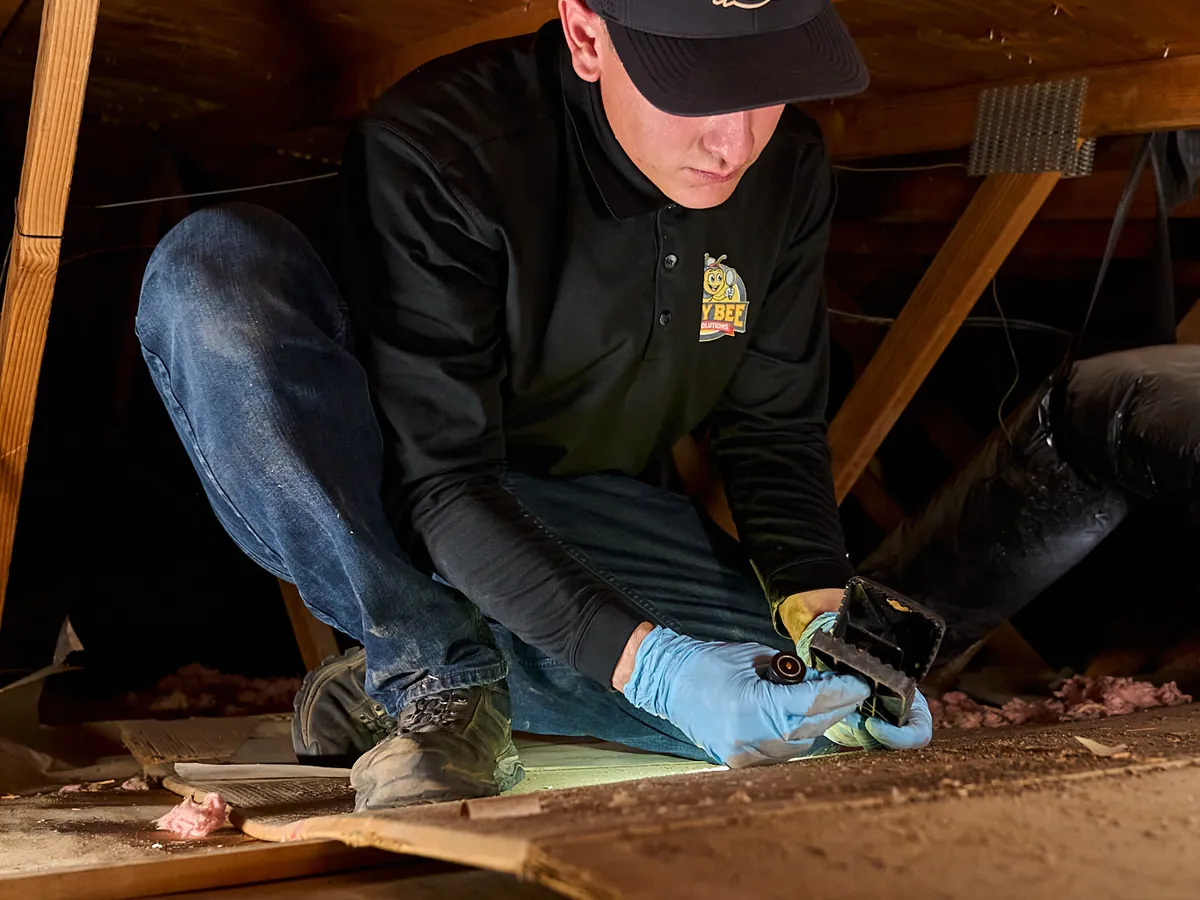
What they are actually after
Scorpions do not come indoors for the building. They follow food and moisture.
| What attracts them | Why it matters in autumn |
|---|---|
| Crickets and other soft bodied insects | The main prey item. Crickets gather under exterior lights and on overseeded winter lawns. |
| Water | A leaking irrigation head or a damp patch is a fixed resource in a dry yard. |
| Harborage | Anything with a gap that holds warmth. Woodpiles, pavers, block cavities, stacked tiles. |
| Shade and clutter | Stored pots, bricks and building material against the house wall. |
Deal with the crickets and the water and you have removed a good part of the reason a scorpion is spending time near your foundation.
What not to do
Do not rely on treating the yard while the doors still show daylight underneath. This is the single most common mistake we see. A property can be treated repeatedly and still deliver scorpions into a hallway every few weeks, because the treatment is doing nothing about the half inch gap under a door that opens onto a patio.
The order that works is exclusion first, then treatment. Close the gaps, then reduce the pressure outside. Doing it the other way round produces a house that keeps needing service.
The other thing not to do is move a woodpile or a stack of pavers with bare hands in October. If you are clearing harborage, wear gloves, and tip things away from you rather than towards you.
If one gets inside
A bark scorpion sting is medically significant, and Arizona is the one state where that is genuinely true rather than an exaggeration. Reactions vary widely, and children and older adults are more likely to have a serious one. The Arizona Poison and Drug Information Center takes calls around the clock and is the right first port of call if somebody is stung and reacting badly.
For the scorpion itself, a jar and a piece of card is safer than a shoe, and it means whoever comes out can confirm the species rather than guess.
The short answer
Scorpion activity does not end when the heat does. It shifts. Cooler nights mean longer hours at the surface and the beginning of the search for somewhere to spend the winter, which is why October is when they start finding gaps in the house rather than staying in the yard. Run a blacklight survey to see what you are actually dealing with, close the door sweeps and the weep screeds before the cold arrives, and take the crickets and the water away.
Frequently Asked Questions
Do scorpions go away in winter in Phoenix?
No. Bark scorpions do not hibernate and do not leave. They move into harborage such as block wall voids, expansion joints and the space behind a garage door seal, slow right down, and often overwinter in groups. Activity at the surface drops, which is not the same thing as the population dropping.
What gap size do I need to seal for scorpions?
A bark scorpion flattens into a gap about the width of a credit card. In practice that means door sweeps, the weep screed at the base of the stucco, the garage door seal and the gap around a hose bib. They also climb walls, so height is not protection.
Does a blacklight really work for finding scorpions?
Yes, and it is the one piece of pest control a homeowner can do properly with no training. Bark scorpions fluoresce pale blue green under ultraviolet light. Use a proper UV flashlight rather than a phone screen, and go out at least an hour after full dark.
Why do I still get scorpions after the yard has been treated?
Almost always because the gaps are still open. A treated perimeter does very little about an animal already overwintering inside a wall cavity, and nothing at all about a half inch gap under a patio door. Exclusion first, then treatment.
What should I do if somebody is stung?
A bark scorpion sting is medically significant in Arizona and reactions vary widely, with children and older adults more likely to have a serious one. The Arizona Poison and Drug Information Center takes calls around the clock and is the right first call.