

Western Honey Bee

Adult worker of the western honey bee
|
|
| Scientific name | Apis mellifera |
|---|---|
| Family | Apidae |
| Order | Hymenoptera |
| Common names | Honey bee, western honey bee |
| Distribution | Worldwide (introduced to the Americas, Australia, Asia) |
| Habitat | Forests, deserts, savannas, agricultural areas, urban sites |
| Pollination role | Generalist pollinator of crops, orchards, wildflowers |
| Social structure | Eusocial colonies with queen, drones, and workers |
| Nesting | Wax comb hives in cavities (trees, structures) |
The western honey bee (Apis mellifera) is the most widespread managed pollinator species in the world and the primary producer of commercial honey and beeswax. Originally native to Europe, western Asia, and Africa, the species was introduced to the Americas by European colonists in the 1600s and has since become a naturalized component of many ecosystems.
Honey bees are eusocial insects consisting of a single reproductive queen, thousands of sterile female workers, and seasonally produced male drones. Colonies build wax comb containing hexagonal cells used for brood rearing, nectar storage, and pollen storage.

Description
Worker honey bees are typically 10–15 mm long with banded amber and brown abdominal segments, dense thoracic hair, and transparent forewings and hindwings. Like other Hymenoptera, the mouthparts include a proboscis for drinking nectar and mandibles for manipulating wax and resin. Females possess a barbed stinger which is primarily used for colony defense.
The body is divided into the head, thorax, and abdomen. The hind legs of workers bear specialized structures called corbiculae, or pollen baskets, which are used to transport pollen back to the hive.
Behavior and life cycle
Worker bees progress through age-based labor divisions known as temporal polyethism. Young workers tend brood and maintain the hive interior, while older workers forage for nectar, pollen, water, and plant resins. Bees use pheromones and complex behaviors such as the waggle dance to communicate foraging locations.
Colonies reproduce by swarming, wherein the old queen departs with a portion of the workers to establish a new nest. Remaining workers rear a replacement queen from selected larvae.
Pollination
Honey bees are among the most economically important pollinators, contributing to the production of fruits, nuts, vegetables, oilseeds, and forage crops. Their generalist foraging behavior makes them compatible with a wide range of agricultural systems.
Africanized honey bees
In the mid-20th century, queens of the African subspecies Apis mellifera scutellata were imported to Brazil for breeding experiments aimed at improving tropical beekeeping. Hybrid swarms escaped confinement in 1957, producing what is now known as the Africanized honey bee.
Africanized bees are morphologically similar to European honey bees but differ in colony behavior: they defend nests more aggressively, respond more quickly to disturbance, pursue threats over longer distances, and swarm more frequently. These traits facilitated their spread throughout South and Central America, arriving in the United States by 1990.
Despite their reputation, Africanized honey bees remain functional pollinators and construct conventional wax hives. In the southwestern U.S., nearly all feral honey bee colonies exhibit at least partial Africanized ancestry.
Human interaction
Honey bees are maintained worldwide for honey, beeswax, propolis, and crop pollination. In urban and suburban areas, colonies frequently occupy building cavities such as roofs, walls, attics, and utility enclosures, occasionally requiring professional removal.
Valley Carpenter Bee

Adult male of the valley carpenter bee
|
|
| Scientific name | Xylocopa varipuncta |
|---|---|
| Family | Apidae |
| Order | Hymenoptera |
| Common names | Valley carpenter bee, golden carpenter bee |
| Distribution | Southwestern United States and northern Mexico (primarily California, Arizona, Nevada) |
| Habitat | Woodlands, dry valleys, desert edges, gardens, urban structures |
| Pollination role | Buzz pollination of native plants and agricultural crops |
| Social structure | Solitary (nesting females may share entrance tunnels) |
| Nesting | Excavated tunnels in dead wood, structural lumber, fence posts, and logs |
The valley carpenter bee (Xylocopa varipuncta) is one of the largest bee species in North America and a prominent pollinator throughout the American Southwest. Unlike honey bees, carpenter bees do not form eusocial colonies; instead, each female constructs and provisions her own nest tunnel in wood.
This species is sexually dimorphic, with females being solid black and glossy while males are covered in dense golden hair, earning the male the nickname "teddy bear bee" among naturalists and gardeners.
Description
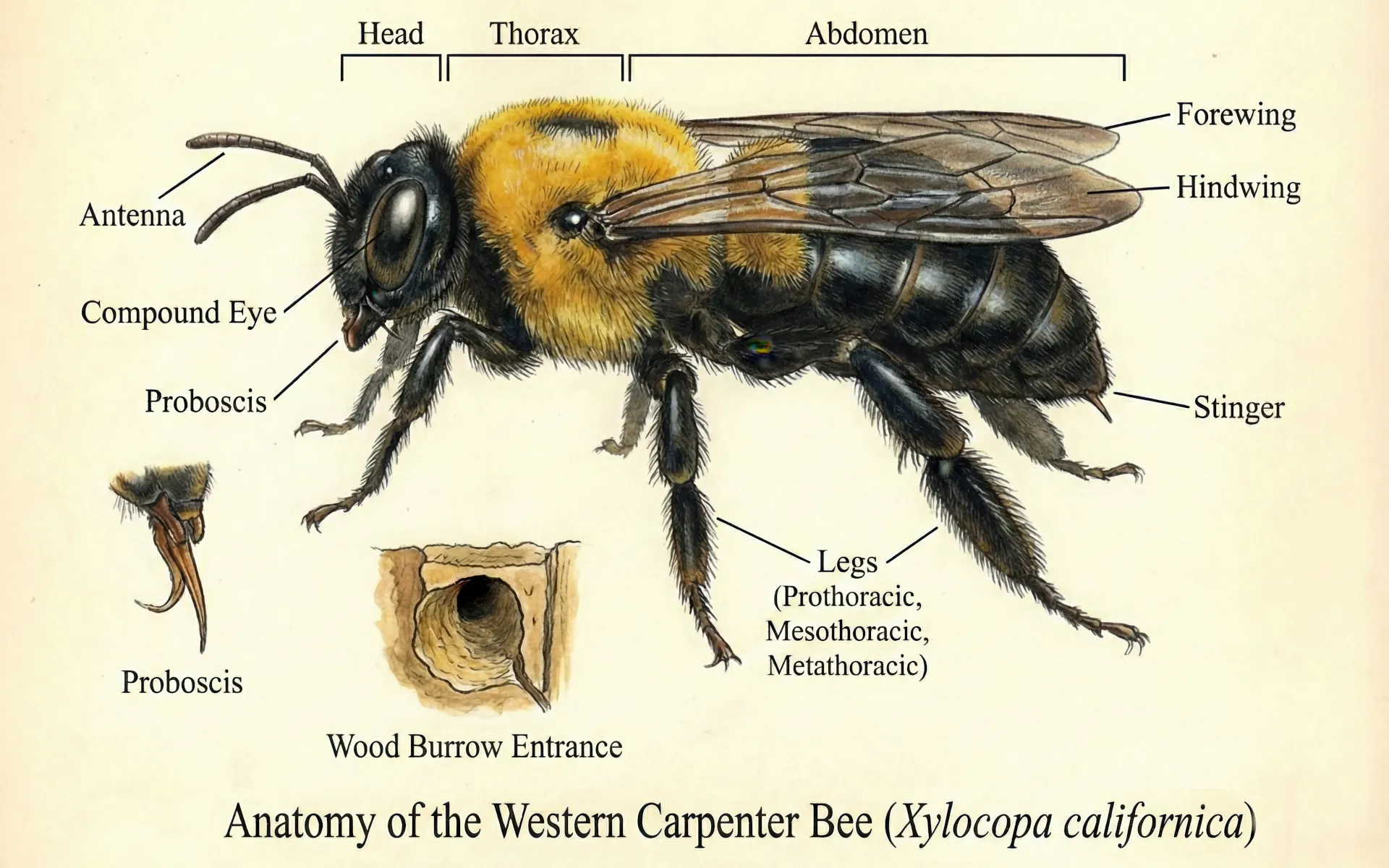
Valley carpenter bees are robust insects measuring 19–25 mm in length, with powerful flight and a characteristically shiny abdomen. Females are metallic black with sparse hair, while males are golden-brown with greenish eyes and dense thoracic pubescence.
The body is divided into the head, thorax, and abdomen. Strong mandibles allow females to excavate nesting galleries in wood, often producing coarse sawdust at entrance holes. Females possess a functional sting but are comparatively non-aggressive and sting only when handled.
Behavior and life cycle
Carpenter bees overwinter as adults and emerge in spring to mate. Females select dry wood and create linear tunnels composed of adjacent brood chambers. Each chamber contains a ball of pollen and nectar upon which a single egg is laid.
Development proceeds through larval and pupal stages before new adults emerge. Males establish territorial patrols near flowering plants and nesting substrates and will investigate movement but do not possess stingers.
Pollination
Valley carpenter bees are capable of sonication (“buzz pollination”), vibrating flight muscles to release pollen from tube-shaped flowers. They pollinate a variety of native desert plants and fruiting crops and may occasionally engage in nectar robbing when corollas are too deep to access.
Wood interaction
Nest excavation can cause cosmetic damage to structural lumber, fencing, pergolas, and patio beams. Tunnel networks may be reused for multiple generations, gradually enlarging cavities over time. Despite this, structural compromise is uncommon unless long-term nesting is left unmanaged.
Human interaction
Gardeners and homeowners frequently encounter carpenter bees around flowering plants and wood structures. The species is generally considered beneficial due to its pollination role and mild temperament. In urban settings, damage mitigation typically involves sealing old tunnels and providing alternative native pollinator habitat.
Sonoran Bumble Bee

Adult worker of the Sonoran bumble bee
|
|
| Scientific name | Bombus sonorus |
|---|---|
| Family | Apidae |
| Order | Hymenoptera |
| Common names | Sonoran bumble bee, yellow-faced bumble bee |
| Distribution | Southwestern United States, Mexico, and Baja California |
| Habitat | Desert scrub, riparian corridors, grasslands, gardens, agricultural margins |
| Pollination role | Buzz pollination of wildflowers, fruit crops, and nightshade family plants |
| Social structure | Annual eusocial colonies with queen, workers, and males |
| Nesting | Abandoned rodent burrows, ground cavities, compost piles, debris clusters |
The Sonoran bumble bee (Bombus sonorus) is a large, conspicuous bumble bee native to the American Southwest and northern Mexico. Recognized by its yellow thorax and face, it is a major pollinator in desert and riparian habitats and is frequently encountered in Arizona gardens during warm months.
Like other bumble bees, colonies are annual. A single overwintered queen founds a new nest each spring and produces successive generations of workers followed by males and young queens later in the season.

Description
Workers and queens are 15–22 mm in length with dense setae (hair) that aid in pollen collection and insulation. Coloration includes a yellow thorax and yellow facial hairs with a primarily dark abdomen. Males are similar in color but exhibit longer antennae and lack stingers.
The body consists of the head, thorax, and abdomen with robust flight musculature enabling sustained foraging flights. Females possess a smooth, unbarbed stinger and are capable of stinging multiple times if provoked, though defensive behavior is typically limited near nesting sites.
Behavior and life cycle
The colony cycle begins when overwintered queens emerge in spring to locate suitable nest cavities, often appropriating small mammal burrows. Queens rear the first brood alone before workers assume foraging and brood care.
Later in the season, colonies produce reproductives, males and daughter queens, after which the workers and the founding queen die. Only newly mated queens overwinter to continue the lineage the following year.
Pollination
B. sonorus performs buzz pollination (sonication) where flight muscles vibrate pollen loose from poricidal anthers, making the species valuable for pollinating tomatoes, peppers, eggplants, and numerous native flora. Foraging peaks during cooler morning hours, especially in desert climates.
Ecological status
Unlike some North American bumble bee species that have experienced significant declines, the Sonoran bumble bee remains relatively common throughout its range. It is frequently observed in irrigated suburban landscapes, which provide nectar during dry months.
Human interaction
Encounters with this species are usually benign. Bumble bees rarely nest inside human structures and are generally tolerant of nearby human activity. Due to their pollination importance and mild temperament, they are considered beneficial insects and encouraged by gardeners and conservation groups.
Pallid Bee
Adult male of the pallid bee
|
|
| Scientific name | Centris pallida |
|---|---|
| Family | Apidae |
| Order | Hymenoptera |
| Common names | Pallid bee, digger bee |
| Distribution | Southwestern United States and northern Mexico |
| Habitat | Arid deserts, washes, sandy soils, xeric gardens |
| Pollination role | Oil and pollen specialist; key pollinator of desert wildflowers |
| Social structure | Solitary (nests clustered but not eusocial) |
| Nesting | Vertical burrows in sandy soil; clustered nesting aggregations |
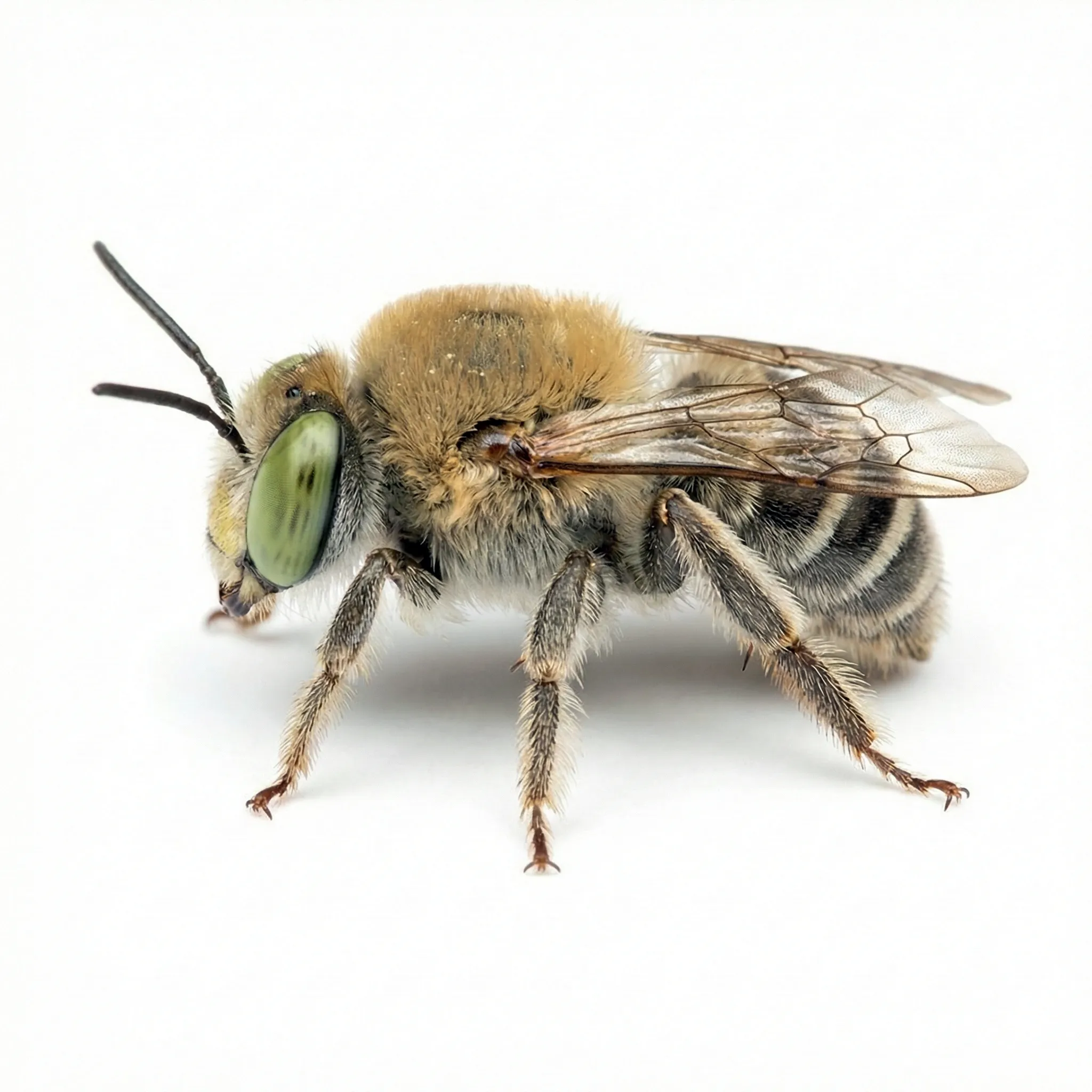
The pallid bee (Centris pallida) is a large, pale digger bee common in desert regions of the American Southwest. Males exhibit a distinctive creamy-tan coloration that blends with sandy soils, while females are darker and more robust. Although solitary, pallid bees frequently nest in dense aggregations that can contain dozens to hundreds of burrows.
Unlike honey bees, pallid bees do not produce colonies or wax comb. Each female constructs and provisions her own nest burrow, typically in loose, sandy soil that allows for rapid excavation.

Description
Adult males are 13–18 mm long and lightly covered in pale setae. Females are similar in size but darker and more heavily built for digging. Both sexes have strong mandibles and enlarged forelegs adapted for excavation.
Pallid bees possess specialized structures on the legs for collecting floral oils from certain plants, which are then used to provision brood cells along with pollen.
Behavior and life cycle
Males often patrol nesting sites and engage in territorial flights while searching for emerging females. A behavior easily observed in late spring and summer. Females excavate deep vertical burrows, sometimes exceeding 30 cm in depth, and create multiple lateral brood chambers.
After provisioning brood cells with oil and pollen, females lay a single egg per cell. Larvae consume the provision mass before pupating. Development may be accelerated in warm years or delayed under unfavorable conditions.
Pollination
Centris pallida is an oil-collecting specialist associated with desert plant genera such as Krameria (ratany) and Calochortus. These plants produce floral oils rather than nectar, which pallid bees collect and mix with pollen to nourish developing larvae.
Ecological significance
Oil-collecting bees form a critical pollination guild in arid ecosystems. Their activity enhances reproductive success in oil-bearing flora that lack generalist nectar rewards.
Human interaction
Pallid bees are non-aggressive and rarely sting. Despite forming noticeable nesting aggregations, they do not damage structures and are considered beneficial insects. Gardeners often encourage them by providing sandy soil and native desert plants.
Cactus Bee

Adult female cactus bee
|
|
| Scientific name | Diadasia rinconis |
|---|---|
| Family | Apidae |
| Order | Hymenoptera |
| Common names | Cactus bee, cholla bee |
| Distribution | Southwestern United States and northern Mexico |
| Habitat | Desert scrub, washes, chaparral, xeric gardens |
| Pollination role | Oligolectic specialist on cactus pollen |
| Social structure | Solitary (nesting aggregations common) |
| Nesting | Vertical soil burrows, large clustered colonies |
The cactus bee (Diadasia rinconis) is an oligolectic desert bee species whose life cycle is closely tied to the flowering cycles of cholla, prickly pear, and other cacti in the American Southwest. Despite being solitary, cactus bees frequently form dense nesting aggregations in sandy soils that can persist for multiple seasons.
Their specialization on cactus pollen makes them critical pollinators for native Opuntia and Cylindropuntia species, many of which depend on insect-mediated cross-pollination for fruit production.

Description
Adult females are 10–14 mm long and densely coated with pale yellow to orange setae that trap cactus pollen. Males are slightly smaller and paler, often seen hovering above flowering cactus pads or patrolling nest sites during peak bloom periods.
Both sexes possess strong forelegs optimized for excavation and pollen handling. The thorax is densely haired, while the abdomen exhibits banding patterns that can vary among individuals.
Behavior and life cycle
Cactus bees are synchronously active with regional cactus bloom events, typically emerging in late spring. Females dig vertical burrows with lateral brood cells, each provisioned with a pollen-rich loaf formed primarily from cactus pollen.
Larvae complete development within sealed brood cells, enter diapause, and overwinter underground until emerging during the next suitable flowering period.
Pollination
Diadasia rinconis is a primary pollinator of cholla and prickly pear cacti and contributes directly to cactus fruit production. During peak bloom, bees may become heavily dusted with pollen, visibly coating their thorax and head.
Ecological significance
The cactus bee is a representative member of the desert oligolectic guild, pollinators that specialize on particular plant genera. Loss of cactus habitat directly threatens their reproductive success, making them indicators of desert ecosystem health.
Human interaction
Cactus bees are non-aggressive and rarely sting. Nesting aggregations in residential areas are temporary and do not damage structures, making them generally harmless and beneficial. Their presence enhances fruit set in native cactus species commonly used in xeriscapes and arid landscaping.
Squash Bee

Female squash bee
|
|
| Scientific name | Peponapis pruinosa |
|---|---|
| Family | Apidae |
| Order | Hymenoptera |
| Common names | Squash bee, pumpkin bee |
| Distribution | North America; concentrated where squash & pumpkins are grown |
| Habitat | Farms, gardens, fields, sandy soils, pumpkin patches |
| Pollination role | Primary pollinator of squash, pumpkins, gourds |
| Social structure | Solitary (large nest clusters possible) |
| Nesting | Deep soil burrows near squash plant bases |
The squash bee (Peponapis pruinosa) is a specialist pollinator strongly associated with plants of the genus Cucurbita. Including squash, pumpkins, zucchini, and gourds. This species is uniquely adapted to the early-morning bloom cycle of squash flowers, often foraging before honey bees become active.
Squash bees are solitary ground-nesters, yet frequently form loose aggregations in soils surrounding garden beds and agricultural fields.

Description
Adult females are 11–14 mm long with dense, pale hairs and strong hind legs adapted for efficient pollen collection from squash blossoms. Males are slender, with noticeably long antennae and a habit of curling up inside flowers at night.
Compared to honey bees, squash bees have a more matte, dusty appearance and are noticeably more active at dawn.
Unique dawn-foraging behavior
Squash blossoms open just before sunrise and close by late morning. squash bees are adapted to this narrow window and begin foraging in pre-dawn light, often visiting flowers before they fully unfurl.
This timing gives them a major ecological advantage over honey bees, which generally begin foraging later. As a result, squash bees perform the majority of squash pollination naturally.
Flower-sleeping males
Male squash bees do not return to nests. Instead, they crawl into squash flowers at dusk and sleep inside the blossoms, often several males curled inside a single wilted flower.
When the flowers reopen at dawn, they emerge ready to mate and forage.
Behavior and life cycle
Females construct vertical nests in soft, well-drained soil, often directly beneath squash plant leaves. Each burrow contains multiple brood cells provisioned with pure Cucurbita pollen, which is unusually coarse and heavy.
Larvae develop within sealed chambers and overwinter underground as pre-pupae, emerging the following summer in sync with the squash bloom cycle.
Pollination
Peponapis pruinosa is the primary pollinator of cultivated squash crops. Even in large commercial fields, squash bees typically outperform honey bees for this crop due to:
- earlier foraging start times
- higher pollen transfer efficiency
- exclusive focus on squash flowers
Their activity directly influences fruit set and quality in pumpkins and gourds.
Human interaction
Squash bees are gentle and rarely sting. Their nests in gardens or farm soil are harmless and beneficial. Encouraging native squash bees can reduce or eliminate the need for managed honey bee pollination in pumpkin patches and squash farms.
Ligated Sweat Bee

Adult female ligated sweat bee
|
|
| Scientific name | Halictus ligatus |
|---|---|
| Family | Halictidae |
| Order | Hymenoptera |
| Common names | Ligated sweat bee, sweat bee |
| Distribution | Most of North America; urban & suburban regions |
| Habitat | Lawns, gardens, fields, disturbed soils, urban landscaping |
| Pollination role | Generalist pollinator of wildflowers & crops |
| Social structure | Primitively eusocial (small colonies with shared nesting) |
| Nesting | Soil burrows; multi-female nests |
The ligated sweat bee (Halictus ligatus) is a small, common sweat bee found across much of North America, frequently encountered in suburban and agricultural environments. The species is known for its metallic sheen, small size, and tendency to nest in exposed soils such as lawns, garden beds, and park grounds.
Sweat bees are named for their attraction to perspiration, from which they obtain salts and moisture. Despite this quirk, they are non-aggressive and seldom sting unless handled.

Description
Adult females measure 6–9 mm in length with metallic green to bronze coloration and pale abdominal bands. Males are similar but slender and shorter-lived. The species possesses strong mandibles and modified leg hairs for pollen transport.
Compared to honey bees, ligated sweat bees are substantially smaller and lack the dense thoracic hair typical of Apidae.
Primitively eusocial colonies
Halictus ligatus exhibits primitive eusociality. A social structure intermediate between solitary and highly eusocial insects. Colonies consist of a single reproductive female and several non-reproductive females that assist with nest maintenance and provisioning.
Unlike honey bees, all individuals are morphologically similar, and female “worker” status is based primarily on behavioral roles rather than anatomical specialization.
Nesting behavior
Soil nests consist of a vertical shaft with lateral brood chambers. Nest entrances are often surrounded by small volcano-like mounds of excavated soil, making aggregations visible in lawns and park grounds.
Multiple nests may form aggregated colonies in suitable soil, producing clusters of dozens to hundreds of entrances.
Pollination
Ligated sweat bees are generalist foragers and visit a wide range of plants including asters, dandelions, clover, sunflowers, cucurbits, and ornamentals. Their small size allows them to access flowers with narrow corollas that honey bees may ignore.
Urban significance
This species thrives in human-modified landscapes and contributes to pollination in home gardens and agricultural plots. Populations often increase in suburban areas where irrigation softens soil for nesting and ornamental plants provide forage.
Human interaction
Sweat bees rarely sting and are generally harmless. Occasional attraction to perspiration may bring them into proximity with humans, but their defensive threshold is very low. Their presence in lawns is beneficial and does not damage turf or structures.
Striped Sweat Bees

Male striped sweat bee from the genus Agapostemon
|
|
| Scientific name | Agapostemon spp. |
|---|---|
| Family | Halictidae |
| Order | Hymenoptera |
| Common names | Striped sweat bees, metallic green sweat bees |
| Distribution | North America, Central America, parts of South America |
| Habitat | Lawns, gardens, meadows, fields, desert scrub |
| Pollination role | Generalist pollinators of wildflowers & ornamentals |
| Social structure | Communal to primitively eusocial (species-dependent) |
| Nesting | Soil burrows; communal nest entrances common |
The striped sweat bees of the genus Agapostemon are small, metallic halictid bees known for their striking coloration and fast, darting flight. These bees are common across North America and are frequently encountered in gardens, lawns, and meadows where they forage on a wide range of flowers.
The genus contains more than two dozen species, with several widespread representatives in the American Southwest.

Description
Adult striped sweat bees are typically 7–12 mm in length. Females are entirely metallic green or blue-green, while males possess metallic green heads and thoraxes with bright yellow-and-black striped abdomens, giving the group its common name.
Wings are transparent with slight iridescence, and the body surface is polished rather than fuzzy, differentiating them from bumble bees and honey bees.
Species in the Southwest
Common species in the Sonoran and Chihuahuan deserts include:
- Agapostemon splendens, Green metallic sweat bee
- Agapostemon texanus, Texas striped sweat bee
- Agapostemon angelicus. Western striped sweat bee
These species frequently co-occur in gardens and parklands.
Communal nesting behavior
Unlike solitary bees, many Agapostemon species exhibit communal nesting, where multiple females share a single entrance burrow but excavate and provision their own brood cells independently.
This strategy increases nest defense without requiring true worker castes.
Pollination
Striped sweat bees are generalist foragers and pollinate a wide variety of plants, including sunflowers, asters, clover, daisies, and numerous ornamentals. Their small body size allows them to exploit narrow flowers inaccessible to larger bees.
Urban ecology
This genus thrives in human-modified landscapes. Irrigated lawns and garden beds soften soil for nesting and provide continuous forage through the growing season, supporting stable populations even in desert cities such as Phoenix and Tucson.
Human interaction
Striped sweat bees are gentle, fast-moving, and rarely sting. They may occasionally land on humans to collect salts from perspiration but pose no threat. Their presence in lawns and gardens is beneficial and does not damage turf or structures.
Leafcutter Bees

Adult female leafcutter bee
|
|
| Scientific name | Megachile spp. |
|---|---|
| Family | Megachilidae |
| Order | Hymenoptera |
| Common names | Leafcutter bees, leafcutters |
| Distribution | Worldwide; highly diverse in North America |
| Habitat | Gardens, orchards, wooded areas, urban structures |
| Pollination role | Fruit trees & wildflowers; efficient plant pollinators |
| Social structure | Solitary |
| Nesting | Cavity nests lined with leaf discs |
The leafcutter bees of the genus Megachile are solitary cavity-nesting bees recognized for their behavior of cutting circular leaf fragments to line brood cells. These bees are common in gardens and orchards across North America and are important pollinators of fruit trees and native wildflowers.
Leafcutter bees do not form colonies or produce honey. Instead, each female constructs her own nest and provisions brood cells independently.

Description
Leafcutter bees are typically 7–18 mm long and have robust bodies with muted gray or black coloration. The head is broad with strong mandibles specialized for cutting leaf and petal material.
Unlike honey bees, leafcutters carry pollen on specialized hairs on the underside of the abdomen, a structure called the scopa, rather than on the hind legs.
Leaf-cutting behavior
Females harvest circular or oval leaf pieces from plants such as roses, redbud, lilac, ash, and bougainvillea. These fragments are used to construct cylindrical brood cells inside natural or artificial cavities.
Leaf damage appears as clean, coin-shaped cutouts and is often the only evidence of their presence.
Cavity nesting
Nests are constructed inside hollow stems, abandoned beetle tunnels, gaps between wood structures, or artificial nesting tubes provided by humans. Each cell contains a pollen mass and a single egg and is sealed with a final leaf “cap.”
Multiple cells are arranged in linear series within a cavity, producing a column of leaf-lined chambers.
Pollination
Megachile bees are efficient pollinators in orchards and gardens. Their abdominal pollen transport results in high pollen transfer rates compared to honey bees, making them valuable in cultivation of crops such as alfalfa, melons, and fruit trees.
Interaction with human landscapes
Leafcutters thrive in suburban gardens and often adopt man-made structures for nesting, including fence posts, patio furniture, and gaps in lumber. Leaf damage is cosmetic and does not harm plant health.
Human interaction
Leafcutter bees are non-aggressive and rarely sting. Their presence is beneficial in gardens and agricultural systems, and they are increasingly managed as pollinators in orchard settings and small-scale farms.
Tiny Sweat Bees

Adult Lasioglossum female
|
|
| Scientific name | Lasioglossum spp. |
|---|---|
| Family | Halictidae |
| Order | Hymenoptera |
| Common names | Tiny sweat bees, halictid sweat bees |
| Distribution | Worldwide; extremely diverse in North America |
| Habitat | Lawns, gardens, meadows, disturbed soils, agricultural plots |
| Pollination role | Generalist pollinators; major contributors to wildflower pollination |
| Social structure | Solitary to primitively eusocial (species-dependent) |
| Nesting | Soil burrows; often cryptic and difficult to detect |
The tiny sweat bees of the genus Lasioglossum are small, inconspicuous halictid bees that represent one of the most abundant pollinator groups in North America. Despite their size, they are highly effective pollinators of wildflowers and many crops.
Members of this genus are typically overlooked due to their small size and muted coloration, often being misidentified as “gnats” or ignored entirely by casual observers.

Description
Adults typically measure 4–7 mm in length, making them among the smallest bees encountered by homeowners and gardeners. Coloration ranges from dull metallic green to brown or black with faint yellow abdominal bands.
Lasioglossum bees have short tongues compared to other bee groups and favor shallow or open flowers for nectar and pollen collection.
Extreme species diversity
Lasioglossum is one of the largest bee genera in the world with hundreds of species in North America alone. Many species are cryptic and differentiated primarily through microscopic morphological traits.
Due to this diversity, the genus is often referenced at group level in field guides.
Nesting and social behavior
Species exhibit a spectrum of social structures ranging from purely solitary to small primitively eusocial colonies where multiple females share a nest entrance. Nests are constructed in soil and frequently occur in aggregations, though individual nest entrances are extremely small and difficult to detect.
Brood cells are provisioned with pollen and sealed, and larvae develop underground.
Pollination
Tiny sweat bees are important generalist pollinators of wildflowers including asters, daisies, clover, and numerous composite flowers. Their small size allows them to access floral resources unavailable to larger bees.
Urban and agricultural significance
This genus thrives in human-modified environments and contributes significantly to pollination in gardens and small-scale agriculture. Irrigation and consistent floral plantings support stable populations in suburban landscapes.
Human interaction
Sweat bees are gentle and typically non-stinging. Their attraction to perspiration is due to the need for salts rather than aggressive behavior. Their presence is harmless, beneficial, and goes unnoticed by most residents.
Paper Wasps

Adult female paper wasp in alert posture
|
|
| Scientific name | Polistes spp. |
|---|---|
| Family | Vespidae |
| Order | Hymenoptera |
| Common names | Paper wasps, umbrella wasps |
| Distribution | Worldwide; common throughout North America |
| Habitat | Urban structures, eaves, porches, attics, shrubs, trees |
| Diet | Nectar (adults), caterpillars & larvae (fed to brood) |
| Social structure | Eusocial; small open-comb colonies |
| Nesting | Hanging paper comb without outer envelope |
Paper wasps (Polistes spp.) are slender, long-legged vespid wasps known for constructing exposed paper comb nests beneath overhangs, eaves, and sheltered surfaces. Colonies are relatively small compared to yellowjackets and hornets, typically containing 20–100 adults at peak season.
Adults feed on nectar and fruit juices, while larvae are supplied with chewed-up caterpillars, making paper wasps important biological control agents in gardens and landscapes.

Description
Paper wasps are typically 16–25 mm in length with elongated bodies, narrow waists, long legs, and orange to brown antennae. Wing posture is distinctive: wings are folded lengthwise when at rest.
Coloration varies by species and may be yellow, reddish, brown, or golden with contrasting stripes or blotches.
Open-comb nest architecture
Nests consist of a single layer of hexagonal cells attached via a central stem, resembling an upside-down umbrella. Unlike yellowjackets, paper wasps do not build an outer envelope; the brood is visible.
Nests are constructed from weathered wood fibers mixed with saliva, producing a thin papery structure.
Behavior and colony cycle
Colonies are founded by one or several overwintered queens in spring. Workers emerge in early summer and assist with nest expansion, brood care, and foraging. Colonies decline in autumn as reproductive males and new queens are produced.
Only the new queens overwinter; the remainder of the colony dies with the first frosts.
Predatory role
Paper wasps are major predators of caterpillars, sawfly larvae, and other soft-bodied insects. Their hunting behavior makes them valuable natural pest control in gardens and orchards.
Sting and defense behavior
Paper wasps defend their nests aggressively when disturbed. Stings are painful and can be delivered repeatedly. Unlike honey bees, paper wasps retain their stingers and do not die after stinging.
Defensive behavior is primarily triggered by proximity to the nest rather than territory.
Human interaction
Paper wasps frequently nest on buildings, play structures, and outdoor furniture. Nests located near entryways or high-traffic areas may require removal due to sting risk. Colonies located away from human activity can often be left in place due to their beneficial predatory role.
Mud Daubers

Adult female mud dauber foraging
|
|
| Scientific name | Sceliphron spp. |
|---|---|
| Family | Sphecidae |
| Order | Hymenoptera |
| Common names | Mud daubers, thread-waisted wasps |
| Distribution | Worldwide; widespread throughout North America |
| Habitat | Urban structures, sheds, eaves, garages, attics, rock faces |
| Diet | Nectar (adults), paralyzed spiders (larvae) |
| Social structure | Solitary; no colony or workers |
| Nesting | Mud tubes stocked with spiders |
Mud daubers (Sceliphron spp.) are solitary thread-waisted wasps known for constructing elongate mud tubes on sheltered vertical surfaces. Unlike social wasps, mud daubers do not form colonies, do not defend their nests, and are considered non-aggressive around humans.
Adult females capture and paralyze spiders, which are sealed inside mud cells as a food source for their developing larvae. This behavior makes mud daubers important spider population regulators in and around homes.

Description
Mud daubers are slender wasps measuring 15–28 mm in length. A defining trait is the extremely narrow “thread waist” connecting the thorax to the abdomen. Legs are long and dangly during flight.
Coloration varies by species, but is commonly black with yellow markings. Wings are transparent to smoky-brown.
Mud tube nest architecture
Nests are composed of cylindrical mud tubes arranged singly or in organs-pipe-like clusters. Each tube contains several sealed chambers, each stocked with multiple spiders to serve as larval provisions.
Old nests may show round emergence holes created by the adult wasp upon maturation. Nests opened irregularly from the side typically indicate parasitism by other wasps.
Behavior and life cycle
Females locate suitable mud sources and repeatedly shuttle pellets to the nest site. After provisioning the cells with spiders and laying a single egg per chamber, the nest is sealed.
Larvae consume the spiders, pupate within the mud cell, and emerge as adults weeks to months later depending on season. Some individuals overwinter within sealed nests and emerge in spring.
Spider hunting behavior
Mud daubers prey on a wide range of spiders including orb weavers, jumping spiders, and house spiders. Prey are stung only once or twice, causing paralysis while keeping them alive and fresh.
Sting and aggression
Mud daubers rarely sting and do not defend their nests, making them among the least aggressive wasps found around structures. Stings typically occur only if the wasp is handled or trapped against the skin.
Human interaction
Mud daubers frequently build nests in garages, sheds, patios, and attics. Nests are cosmetic and do not damage surfaces. Many homeowners tolerate mud daubers due to their beneficial predatory behavior and low sting risk.
Tarantula Hawks

Adult female tarantula hawk with orange wings
|
|
| Scientific name | Pepsis spp. |
|---|---|
| Family | Pompilidae |
| Order | Hymenoptera |
| Common names | Tarantula hawks, spider wasps |
| Distribution | Southwestern United States, Mexico, Central & South America; warm regions worldwide |
| Habitat | Deserts, scrublands, grasslands, open woodlands, urban edges |
| Diet | Nectar (adults), paralyzed tarantulas (larvae) |
| Social structure | Solitary; no colonies or workers |
| Nesting | Burrows in soil or existing cavities provisioned with a single tarantula |
Tarantula hawks (Pepsis spp.) are large, metallic-blue spider wasps famous for hunting tarantulas in desert and grassland habitats. Despite their intimidating size and reputation for an extremely painful sting, they are generally non-aggressive and rarely sting unless handled or trapped.
Adults are most often seen flying low over the ground on hot days, searching for burrows or nectaring at flowers such as milkweed, mesquite, and desert willow.

Description
Tarantula hawks are among the largest wasps in North America, reaching 40–50 mm in length. They have metallic blue-black bodies, very long legs with hooked claws, and distinctive bright orange or amber wings in many species.
The body is smooth and shiny, with relatively sparse hair compared to bees. Females possess a long, robust stinger used to subdue tarantulas.
Life cycle and tarantula hunting
Female tarantula hawks locate adult tarantulas by searching on foot and by detecting vibrations near burrow entrances. Once a spider is found, the wasp engages in a brief struggle before delivering a precise sting that paralyzes but does not kill the tarantula.
The wasp drags the immobilized spider to a prepared burrow or uses the spider’s own burrow, lays a single egg on the abdomen, and seals the chamber. The emerging larva feeds on the still-living tarantula, consuming non-vital tissues first before finally killing the host and pupating within the burrow.
Sting and behavior
The sting of a tarantula hawk is considered one of the most intensely painful of any insect, though the pain is brief and rarely medically serious for healthy adults. Because they are solitary and do not defend nests as a group, stings are uncommon.
When not hunting, adults are typically docile and can be observed feeding at flowers without showing interest in nearby people.
Ecological role
Tarantula hawks act as top invertebrate predators of large spiders, helping regulate tarantula populations in desert ecosystems. As nectar feeders, adults also function as pollinators for a variety of native flowering plants.
Human interaction
Encounters most often occur near flowering shrubs or open ground in desert communities. Because they are solitary, there are no nests to treat or remove. The best management practice is simple avoidance and education: they are beneficial wasps that pose little risk when left undisturbed.
Western Cicada Killer

Adult female western cicada killer wasp
|
|
| Scientific name | Sphecius grandis |
|---|---|
| Family | Crabronidae |
| Order | Hymenoptera |
| Common names | Western cicada killer, giant cicada killer wasp |
| Distribution | Western & southwestern United States, Mexico |
| Habitat | Sandy soils, lawns, desert washes, open fields, sloped embankments |
| Diet | Nectar (adults), paralyzed cicadas (larvae) |
| Social structure | Solitary; no colony or workers |
| Nesting | Deep underground burrows stocked with cicadas |
The western cicada killer (Sphecius grandis) is a large solitary wasp that preys on annual cicadas in arid and semi-arid regions of the western United States. Despite their intimidating size and loud flight, cicada killers are non-aggressive toward people and rarely sting unless handled.
Females excavate deep burrows in sandy or loose soil, where they provision brood cells with paralyzed cicadas that serve as food for their developing larvae.

Description
Western cicada killers are among the largest wasps in North America, with females reaching 30–40 mm in length. They have reddish-brown heads and thoraxes, large amber eyes, and black abdomens marked with broken yellow bands.
Wings are transparent to amber-colored, and the body is robust and heavily built for carrying cicadas that may be nearly equal to or larger than the wasp itself.
Burrow nest architecture
Nests are constructed as sloping tunnels in sandy or loose soil, often in sunny, well-drained locations such as lawns, roadside banks, or desert washes. Entrances are typically surrounded by a fan-shaped pile of excavated soil.
Burrows may extend 30–50 cm or more underground and include several lateral chambers, each used as a separate brood cell provisioned with cicadas.
Behavior and life cycle
Adults emerge in mid- to late summer, coinciding with the seasonal appearance of cicadas. Males establish and defend small territories above nesting areas, while females focus on burrowing and hunting.
After completing a nest and provisioning cells, the female seals the burrow and dies later in the season. Larvae develop within the underground chambers, overwinter as prepupae, and emerge as adults the following year.
Prey and hunting
Female western cicada killers locate adult cicadas in trees or shrubs, sting them to induce paralysis, and then fly or drag the immobilized prey back to the burrow.
Each brood cell usually contains one large or two smaller cicadas, upon which a single egg is laid. The larva consumes the cicadas and pupates within the chamber.
Human interaction
Large nesting aggregations in lawns or playgrounds can cause concern due to the wasps’ size and activity. However, western cicada killers are unlikely to sting and do not defend nests aggressively like yellowjackets.
In most cases, they are considered beneficial predators that reduce cicada populations. Management is usually unnecessary unless nests occur in high-traffic areas where people feel uncomfortable.
Western Yellowjacket

Worker western yellowjacket in foraging posture
|
|
| Scientific name | Vespula pensylvanica |
|---|---|
| Family | Vespidae |
| Order | Hymenoptera |
| Common names | Western yellowjacket, ground yellowjacket |
| Distribution | Western United States, southwestern Canada, Hawaii (introduced) |
| Habitat | Lawns, fields, walls, crawlspaces, irrigation boxes, voids, underground burrows |
| Diet | Scavenged meats & sweets (adults), insects & larvae (fed to brood) |
| Social structure | Eusocial; large paper comb colonies |
| Nesting | Underground or structural cavities lined with layered paper comb |
The western yellowjacket (Vespula pensylvanica) is a common scavenging wasp and one of the primary species responsible for stinging incidents in the western United States. Colonies are typically located underground or within wall voids, irrigation boxes, and other sheltered cavities.
Adults feed on sugars and proteins and may aggressively scavenge at barbecues, trash bins, campsites, and outdoor events, especially late in the season when colony demands peak.

Description
Workers are 10–14 mm in length with compact bodies, short legs, and distinctive black and yellow banding on the abdomen. The thorax is primarily black with yellow markings, and the head features black antennae and large compound eyes.
Yellowjackets fold their wings lengthwise at rest and fly with a swift, direct pattern.
Nest architecture
Yellowjacket nests consist of multiple layers of paper comb arranged vertically and enclosed within a paper envelope. Colonies are typically hidden underground in rodent burrows or structural voids. Entrances may be inconspicuous, with heavy forager traffic during daylight hours.
Mature colonies may contain 1,500–5,000 workers by late summer, significantly larger than paper wasp colonies.
Behavior and colony cycle
Colonies begin in spring when overwintered queens establish new nests. Worker numbers increase throughout summer, with peak colony size occurring from late August through October.
In autumn, colonies produce males and new queens. After mating, only the young queens overwinter; the remainder of the colony dies after the first frosts.
Foraging and diet
Western yellowjackets are both predators and scavengers. Workers hunt insects for brood protein and seek sugars from nectar, fruit, and human foods. This scavenging behavior increases conflict with people during late summer.
Sting and defense behavior
Yellowjackets aggressively defend their nests and are capable of delivering multiple stings. Stings are painful and may cause allergic reactions in sensitive individuals.
Disturbance near the nest entrance, especially vibrations, commonly triggers defensive swarms.
Human interaction
Western yellowjackets are considered significant urban pest wasps due to scavenging, sting risk, and nesting in high-traffic areas. Colonies inside structures often require professional removal to prevent injury and prevent technicians from inadvertently sealing active nests.