

Norway Rat Removal in Phoenix, AZ. Ground-Burrow Experts
Norway Rat Burrow Specialists
We provide fast Norway rat removal in Phoenix: locate burrows, place tamper-resistant bait stations, return in a week to confirm results, and offer ongoing exterior service where pressure is high. Norway rats are one part of our rodent control in Phoenix.
Norway rat removal for Phoenix homes, from burrow mapping to sealed gaps.
Posted on Google
 Mike Severson1 days ago
Trustindex verifies that the original source of the review is Google.
Very professional and explained everything very clearly.Posted on Google Debbie Kutchinsky1 days agoCarter was very professional and kept me informed of what needed to be done and why. He was very friendly and did an excellent job. I appreciate how he seems to enjoy his work and helping people in difficult situations. Thank you for responding so quickly.+0Posted on Google
 Kotank5 days agoJust being able to not only know the situation wasn’t as bad as initially thought was a great relief. Not everyday you have to deal with burrowing yellowjackets but now I feel that it’s initially taken care of but I know how to handle it next time with their knowledge and experience.Posted on Google
 Matthew Johnson6 days agoIan was very professional, explained the process with transparency, and completed in a timely manner.Posted on Google
 Marci Nedialkov6 days agoThank you so much for getting out to the property so quickly and taking care of the wasps!! Excellent service and I’ll be using you again.Posted on Google
 Marianne Weeks7 days agoPosted on Google
 Russ Slagenweit7 days agoVery professional did what needed to be donePosted on Google
 Alex Islas7 days agoGreat service! Quick and friendly staff…Posted on Google
 Anne Klink8 days agoPosted on Google
 Home Improvement8 days agoCliff was punctual, professional, and efficient. He identified what I thought was a rodent issue in my porch recessed light as bat droppings. He was thorough and I would recommend his expertise (and that of BusyBee) to anyone. Thank you Cliff!Verified by TrustindexTrustindex verified badge is the Universal Symbol of Trust. Only the greatest companies can get the verified badge who has a review score above 4.5, based on customer reviews over the past 12 months. Read more


Quick facts: Norway rats in Phoenix
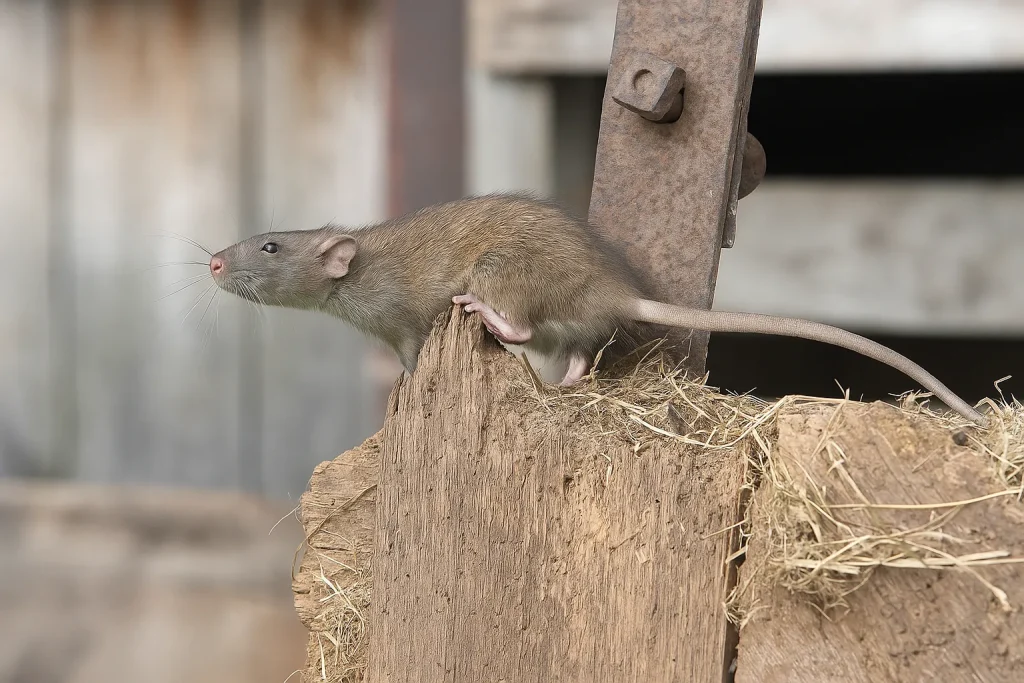
- What it is: Rattus norvegicus, also called the brown rat or sewer rat. Stocky, about a pound, with a blunt nose, small ears and a tail shorter than its body.
- How common here: less common than the roof rat, the Valley’s main rat. University of Arizona Cooperative Extension says Norway rats are confirmed in the Phoenix metro from time to time.
- Where they turn up: at ground level around block walls, irrigation, pool equipment, trash areas and sewer lines, with burrows along foundations and under sheds and woodpiles. Indoors they stay low: garages, crawl spaces and the base of walls.
- Signs: round burrow holes, droppings half an inch to an inch long with one blunt end, gnawed hoses and pool lines, and noise at floor level rather than overhead.
- Damage: they gnaw wiring and pipes, contaminate more food than they eat, and their gnawing and burrowing can damage buildings (UA Extension, Commensal Rodents).
- When: active all year. Monsoon runoff floods their burrows and pushes them toward houses; see rodents after monsoon storms and our Phoenix rodent season calendar.
- How our Norway rat control works: burrow mapping, locked tamper-resistant stations at burrow mouths outside, traps (no loose bait) inside, a follow-up in about a week, then sealing of ground-level gaps.
- Cost: priced like any other rodent job (see the table below). Our guide to rodent control cost in Phoenix explains what adds to the total.
What Norway Rat Activity Looks Like (Phoenix Signs)
- Round burrow holes along foundations, sheds, planters, or turf
- Gnawing on garage storage, trash bins, garden hoses, pool lines
- Grease rub marks & large droppings near ground-level routes
- Noises at floor level (crawl spaces, under patios), not overhead
Need help now? See all our rodent control services in Phoenix »
Norway Rat vs. Roof Rat (Which One Do You Have?)
Roof rats (Rattus rattus) dominate Phoenix attics and citrus trees; Norway rats (Rattus norvegicus) are heavier burrowers that stick to ground and structure bases.

| Norway rat | Roof rat | |
|---|---|---|
| Build | Stocky, about a pound; blunt nose, small ears and eyes, big feet | Slender, 5 to 10 ounces; pointed nose, large ears and eyes |
| Tail | Shorter than the head and body | Longer than the head and body |
| Droppings | Half an inch to an inch, blunt at one end | About half an inch, pointed ends |
| Nests | Ground burrows along foundations and block walls, under woodpiles and debris | Attics, wall and ceiling voids, palms and dense trees |
| How it moves | Mostly at ground level; can climb pipes and jump about 3 feet up | Climbs utility lines, block walls, trees and rooflines |
| Where you hear it | Floor level: garage, crawl space, under patios | Overhead: attic and ceiling after dark |
| In Phoenix | Less common; confirmed in the metro from time to time | The Valley’s most common rat; first documented in Phoenix in 2001 |
| Where the work is | Ground level: burrows, slab and foundation gaps, drains | Roofline: tile edges, vents, AC line chases |
If you’re hearing attic scratching, check our Roof Rat Removal in Phoenix »
Want to try on your own first? See how to get rid of roof rats in Phoenix.
Sources: University of Arizona Cooperative Extension, Roof Rats: Identification, Ecology, and Signs (2018) and Commensal Rodents.
Why Phoenix Sees Norway Rats
Norway rats are less common in Phoenix than roof rats. University of Arizona Cooperative Extension says they are confirmed in the Phoenix metro from time to time rather than established across the Valley. Where they do turn up, it is at ground level near steady water, food and cover: block walls, irrigation, pool equipment, trash areas and sewer lines. Burrows usually sit along block walls, slabs and stored materials.

Rats coming up the toilet or sewer?
It does happen. The Norway rat’s other name is the sewer rat, because in many cities it lives in and travels through sewer lines. Phoenix has fewer Norway rats than roof rats, and roof rats swim too: University of Arizona Cooperative Extension notes that roof rats can swim and may use sewer systems or canals to move to new areas. Either way, a rat in a toilet or floor drain got into the drain line somewhere: from the sewer, or through a broken pipe, a missing cleanout cap or an open drain.
Right now: close the lid, set something heavy on it, and keep pets and children out of that bathroom. Don’t try to grab the rat or pour drain chemicals into the bowl. Put the strainers back on floor, shower and laundry drains.
What to check around the house:
- Sewer cleanout caps in the yard or beside the house. A missing or cracked cap leaves the line open.
- Roof vent stacks. Maricopa County’s roof rat guidance includes screening sewer stacks.
- Fresh burrows or sunken soil along the drain line or where pipes leave the slab. A burrow there can mean a broken pipe underground.
- Gaps around pipes under sinks, behind the washer and around floor drains. The CDC lists these among the places to check and seal to keep rodents out.
What we do: we inspect the yard, the slab edge, the cleanouts, the floor drains and the plumbing penetrations to find where the rats are getting in, trap out the ones inside and seal the gaps we can reach. If the entry point turns out to be a break inside the drain or sewer pipe, that is a plumbing repair, and we will tell you so rather than keep trapping.
Rats still coming back after another company’s treatment? A second opinion rodent inspection looks for the entry point that was missed. The county won’t trap rats on private property; see what Maricopa County Vector Control will and won’t do about roof rats.
Our 3-Step Norway Rat Control Program
1) Property Patrol & Burrow Mapping
We walk the perimeter, outbuildings, planters, canal-adjacent edges, and crawl-space access points to locate and document active burrows.
2) Targeted Removal (Pet-Conscious)
- Place tamper-resistant bait stations directly at burrow mouths and travel routes
- Trapping for garages/crawl spaces if needed (no loose rodenticide indoors)
- Optional exclusion at ground-level gaps; see Rodent Exclusion in Phoenix »
3) One-Week Follow-Up & Service Plans
We return in ~7 days to check uptake and activity. For properties near canals or with repeat pressure, we offer monthly or quarterly exterior service. Deodorize/clean where needed with Rodent Decontamination ».
Where We See Them Most (Phoenix)
When we do find Norway rats, it is usually around block walls, irrigation lines and boxes, pool equipment, trash and dumpster areas, and sewer lines, on older lots with soil gaps under the slab and in mixed residential and commercial blocks. It is spot work, not a neighborhood-wide pattern like roof rats.
Outside Phoenix the same conditions show up along canal banks and alleys in older neighborhoods: see Norway rats along Tempe’s canal banks, rat control in west Mesa, rats along Scottsdale’s canals and rats in older Glendale neighborhoods.

Norway Rat Identification: Size, Droppings and Burrows
| Weight | 7 to 18 ounces, about a pound for a typical adult |
|---|---|
| Build | Stocky, with a blunt nose and small ears relative to the head |
| Coat | Brownish or reddish-grey with a lighter belly |
| Tail | Shorter than the head and body. Pulled forward, it reaches only the middle of the skull |
| Droppings | Half an inch to one inch, blunt at one end |
| Nests | Underground burrows, usually against foundations, under debris piles and woodpiles; indoors they stay at ground level |
| Litters | Four to six litters a year; 20 or more young weaned annually |
| Jumping | Up to 3 feet vertically and 8 feet horizontally |
| Smallest opening | A half-inch gap, including under a door |
| Active | Mostly nocturnal |
| Confused with | The roof rat, which is slimmer, climbs, and has a tail longer than its body |
The dropping shape is the fastest field test we have. Blunt at one end and up to an inch long means Norway rat and sends us to the ground. Foundations, block wall lines, irrigation boxes and woodpiles. Pointed ends and about half an inch means roof rat and sends us to the attic. Getting this wrong wastes an entire service visit. For mice, pack rats and the other rodents around Valley homes, see how to tell Arizona rodents apart.
Sources: UC IPM Pest Notes, Rats; University of Arizona Cooperative Extension, Commensal Rodents.
Norway Rat FAQs for Phoenix Homes
Why are they called “Norway” rats? Misnomer. They originated in northern China/Mongolia and spread via ships; the name stuck after an 18th-century mistake. (See National Geographic and Smithsonian links below.) An English naturalist, John Berkenhout, named it in 1769, assuming it had just arrived in England on Norwegian ships. It is also called the brown rat, sewer rat or wharf rat.
Do you use poison inside my house? No. Indoor work uses secured traps only. Rodenticide stays outside in locked stations near burrows.
How fast does the program work? You’ll usually see activity drop within a few days. Most cases resolve after 1–2 follow-ups; heavy-pressure properties benefit from ongoing exterior service.
Do you fill/knock down burrows? We collapse inactive tunnels after control and can install simple burrow-exclusion measures (hardware cloth, stone borders) as part of a long-term plan.
What about attic noises? That’s typically roof rats. Check our Roof Rat page ».
What does the Busy Bee Seal Guarantee cover?
If rodents get back in through an entry point we sealed, we return and fix it under your plan. Every seal point is noted during the work, so there is a record of exactly what was covered.
What does Norway rat pest control include?
It is ground-level work. We map the burrows and the gaps along the foundation, set locked tamper-resistant bait stations at burrow mouths outside, use traps (never loose bait) inside, come back in about a week to check activity, and seal the ground-level openings so new rats can’t move in. Properties near canals or with repeat pressure can add monthly or quarterly exterior service.

What rodent control costs in Phoenix
Rodent pricing at a glance
| Service | Price | What it includes |
|---|---|---|
| Initial rodent service | $245 | Full-home inspection, entry-point mapping, trap placement and the first removal. No commitment. |
| Follow-up visit | $95 | Clear traps, service exterior stations and verify the repairs are holding. |
| Initial service with year-round plan | $29 | The same initial service. Requires a 12-month year-round pest control plan started at booking. |
| Exclusion and attic cleanup | Quoted | Priced after the inspection, because scope varies with roof type, entry-point count and attic condition. |
Inspections are free. No poison indoors, and every entry point we find gets sealed so rodents do not come back. Every job carries the Busy Bee Seal Guarantee.
Norway rats are a ground-level problem, and the fix is priced the same as any other rodent job. If you are adding year-round pest control, the initial rodent visit drops to $29 under the $29 rodent special.
Part of our Phoenix rodent control service. The same crews handle rodent exclusion and attic cleanup. Not sure which rat you have? Compare them on our Phoenix rat control page.
Ready to Clear Norway Rats From Your Yard?
Busy Bee Pest Solutions. Phoenix
Address: 14819 N Cave Creek Rd Ste 2, Phoenix, AZ 85032
Phone: 623-289-3375
Hours: Open 24 hours, seven days a week
Learn More (Authoritative External Resources)
- Brown Rat (Norway Rat). National Geographic National Geographic, Rat Species Profile
- The Surprising History of Rats, Smithsonian Smithsonian, In Defense of Studying City Rats
- Rats & Mice, Maricopa County Vector Control (practical prevention) Maricopa County, Vector Control
- CDC, Rats: Health & Prevention CDC. Controlling Wild Rodent Infestations
Get a free rodent inspection
Tell us what you are hearing and where you are hearing it. A technician calls you back the same day, and the inspection is free.