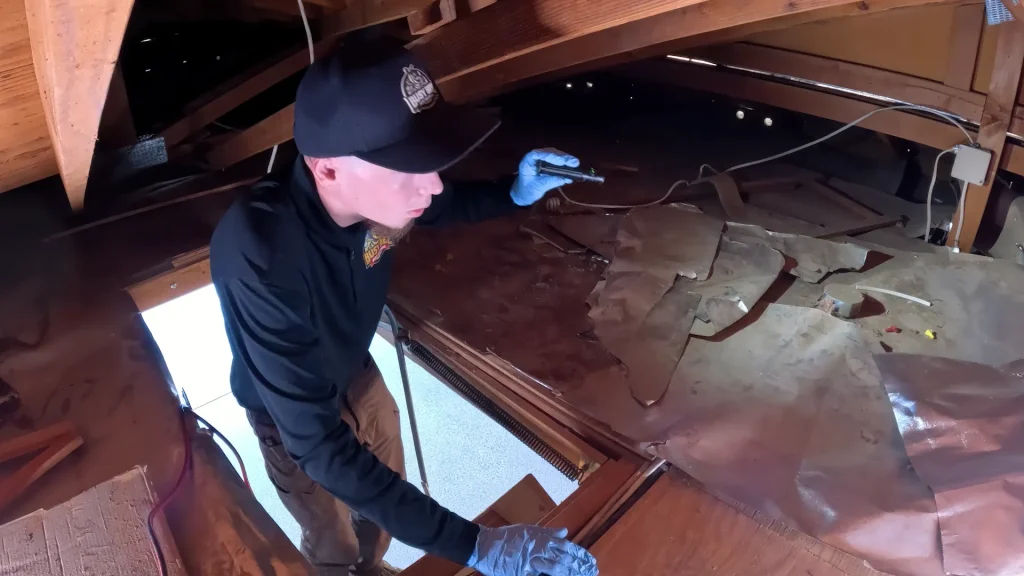
Mice are not small rats, and treating them like rats is why a lot of mouse problems never fully clear. A house mouse passes through a gap the width of a pencil, breeds year-round indoors, and rarely travels more than twenty feet from its nest, which means the nest is almost always closer than homeowners expect. For professional help, see mouse control in Phoenix or our full rodent control in Phoenix services.
Telling mice from young rats
This distinction changes the entire treatment plan, and it is easy to get wrong.
- Droppings. Mouse droppings are about an eighth of an inch, rice-grain shaped, and scattered widely. A mouse produces 50 to 75 a day, more or less continuously as it moves. Roof rat droppings are half an inch with pointed ends and concentrated along runways.
- Head and ears. A house mouse has a small head with proportionally very large ears and eyes. A juvenile rat has a blunt head with proportionally small ears and noticeably large feet for its body.
- Feet. This is the reliable tell: a young rat looks like it has not grown into its hind feet yet. A mouse is proportionate.
- Behaviour. Mice are curious and investigate new objects within hours. Rats are neophobic and avoid new objects for days.
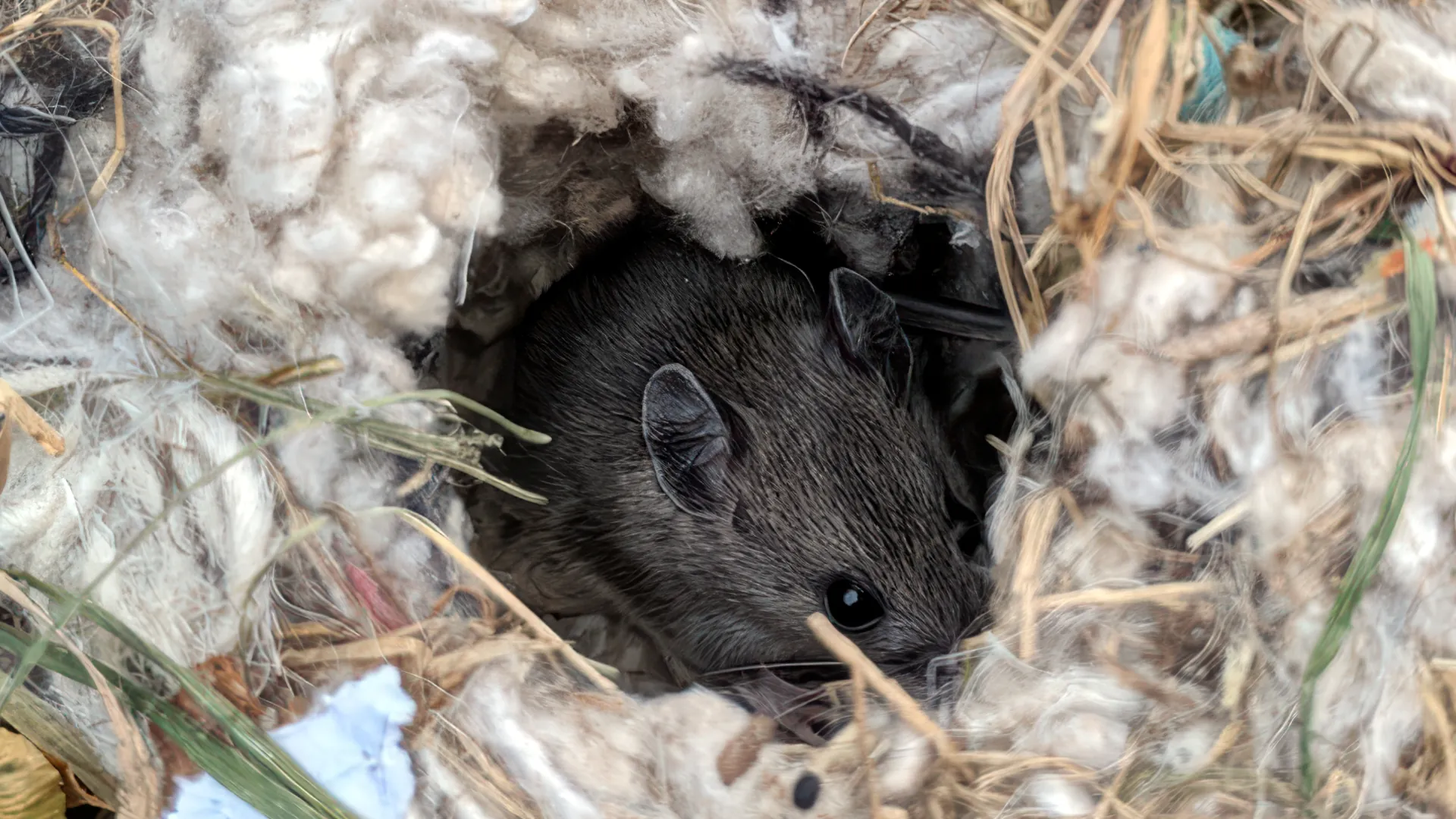
Where mice actually are in Phoenix homes
The twenty-foot home range is the most useful fact in mouse control. Droppings in a pantry mean the nest is in that room or in the wall behind it, not across the house. We work outward from the activity rather than treating the whole structure.
The common Valley nest sites:
- Inside the kick space beneath kitchen and bathroom cabinets
- Behind and beneath the refrigerator, dishwasher and range
- In the water heater closet and around plumbing penetrations
- In the garage, stored cardboard, seed, pet food and camping gear
- Inside wall voids at the slab transition, where older stucco has cracked
- In the laundry area, particularly around dryer vent penetrations
Why mouse-proofing is different from rat-proofing
Rat exclusion in Phoenix is largely roofline work: tile edges, soffit returns, vent stacks. Mouse exclusion is almost all ground-level work, and the tolerances are tighter. A quarter-inch gap stops a rat and admits a mouse. We seal at the slab-to-wall transition, around plumbing and electrical penetrations, at garage door jambs and bottom seals, and around the dryer vent, using materials mice cannot chew through, not foam, which they open easily.
Why breeding rate matters
A female house mouse can produce five to ten litters a year of five to six young, and offspring reach breeding age in about six weeks. Indoors, where temperature is stable, this continues year-round rather than seasonally. The practical consequence is that a small mouse problem does not stay small, and partial treatment is close to no treatment, the survivors rebuild the population quickly.
It also means dense trapping beats sparse trapping. We place many traps in a small area rather than a few across a wide one.
Health and cleanup
Mouse droppings and urine can carry salmonella and, in the case of deer mice, hantavirus. Deer mice are present in Arizona and appear in garages, sheds and outbuildings at the desert edge more often than in central Phoenix homes. Do not dry-sweep or household-vacuum droppings. That aerosolises particles. HEPA vacuuming and disinfection are the appropriate approach, and contaminated pantry goods should be discarded.
Frequently Asked Questions
How small a gap can a mouse get through?
About a quarter of an inch, roughly the width of a pencil. That is significantly smaller than a rat needs, which is why rat-proofing a house does not automatically mouse-proof it. Mouse exclusion requires tighter sealing at ground level.
Do I have mice or baby rats?
Check the feet and ears. A juvenile rat has disproportionately large hind feet and small ears for its head; a house mouse has very large ears and eyes on a small head and is proportionate overall. Dropping shape also differs, mouse droppings are eighth-inch and rice-shaped, rat droppings half-inch with pointed ends.
How many mice is a mouse problem?
More than you see. Mice are active mostly at night and stay hidden, so visible activity generally indicates an established population. A female can produce five to ten litters a year with young breeding at six weeks, so numbers rise quickly.
Will mice go away on their own in winter?
No, the opposite. Indoor conditions are stable year-round, so an indoor population breeds continuously rather than seasonally. Cooler weather tends to drive more mice indoors rather than fewer.
How much does mouse control cost in Phoenix?
Mouse service is priced the same as our other rodent work: $245 for the initial visit including inspection, entry-point mapping and trap placement, and $95 per follow-up. A $29 first visit is available with a year-round pest control plan. Sanitation and exclusion are quoted after inspection.