Small holes in bare, dry soil with insects going in and out are usually solitary ground nesting bees, and those are harmless. Two things need ruling out first. One is a yellow jacket colony, which uses a similar-looking entrance and behaves entirely differently. The other, and the one with the higher consequences in the low desert, is a honey bee colony living in a valve box, a meter box or an old rodent burrow. You can separate all three by watching from a safe distance, and what you see decides whether you do anything at all.
Phoenix yards produce this call every year, usually from decomposed granite areas, dry planting beds and the strip along a block wall.
The distinctions that matter
| What you see | Ground nesting bees | Honey bees in a box or burrow | Yellow jackets |
|---|---|---|---|
| Number of entrances | Many small holes, scattered over a patch | One, often a gap in a box lid, a conduit knockout or a single old burrow | Usually one, sometimes two |
| Traffic at the entrance | One insect at a time, unhurried | Heavy, steady, two-way | Continuous stream in and out of one point |
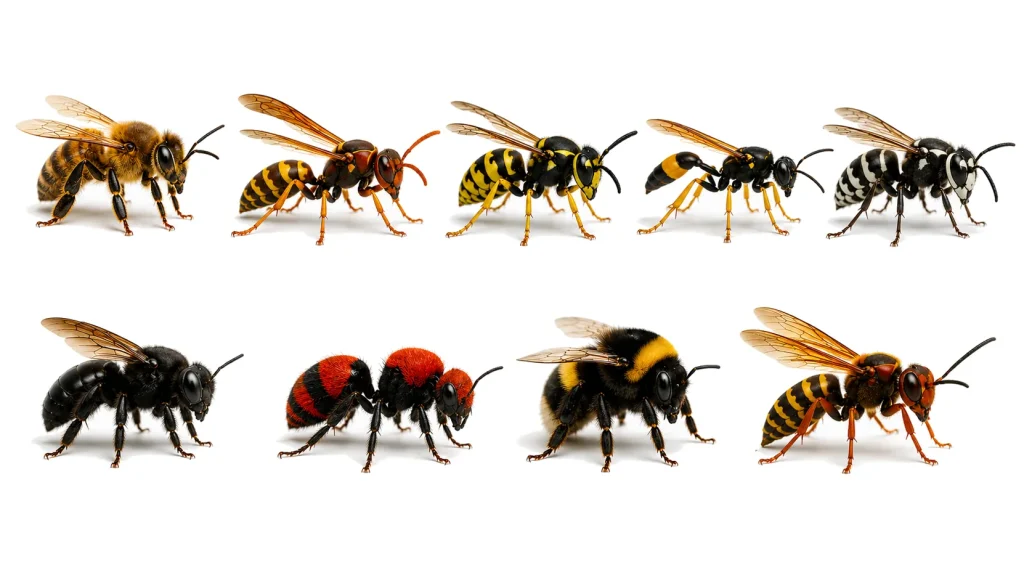
| Insect appearance | Fuzzy, often dark or metallic, bee shaped | Amber and brown honey bee, many with yellow pollen packed on the hind legs | Glossy, sharply banded, no fuzz |
| Behaviour when you stand near | Ignores you | Ignores you at a distance, reacts as you approach the entrance | Investigates you, may bump you |
| Response to vibration | None | Can be strong, particularly in hot afternoons | Immediate and numerous |
| Practical risk | Effectively none | High, and to be assumed Africanized | High |
The most useful test is to stand a safe distance away and watch one hole for a minute. Many holes, each with occasional unhurried traffic, means solitary bees. One hole with a heavy stream running in both directions means a colony of some kind, either honey bees or yellow jackets, and either way the answer is to stop mowing and hand it over rather than dig it up.
Loose soil at the entrance does not settle it. Ground nesting bees usually push out a small volcano of fine soil, but ground-nesting yellow jackets deposit spoil as well, so its presence tells you little on its own.
If it turns out to be a yellow jacket colony, this article is not the one you want. Busy Bee handles wasp and hornet work too, and a ground yellow jacket nest belongs with a wasp removal crew rather than a shovel.
The one that is not a ground bee at all: honey bees in a box
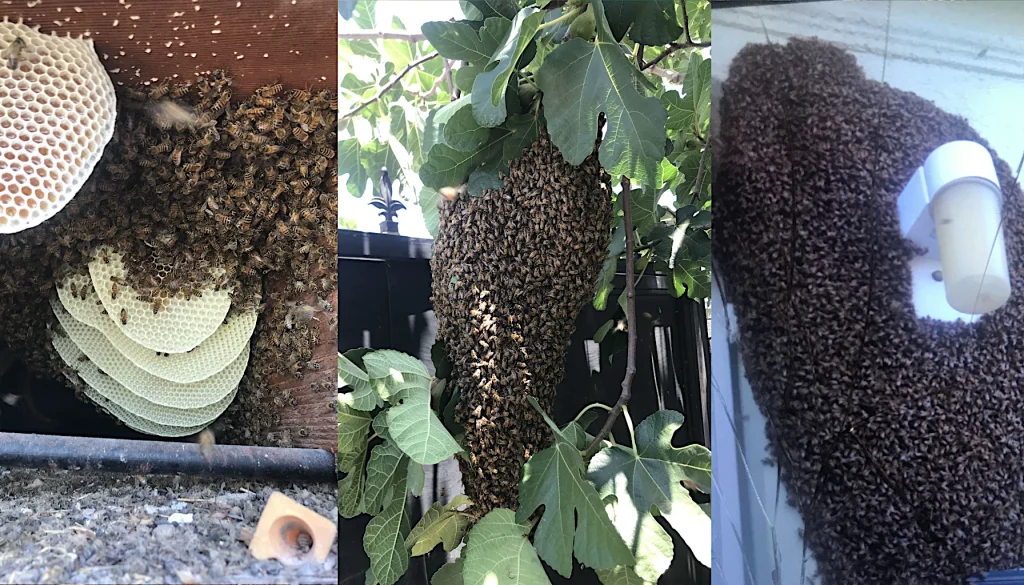
In the low desert, check this one before anything else. Feral honey bee colonies around Phoenix routinely move into cavities at or below ground level: irrigation valve boxes, water meter boxes, utility and pull boxes, the hollow base of a block wall, and abandoned rodent or ground squirrel burrows. From across the yard it reads as a busy ground nest.
What it looks like up close, watched from a safe distance:
- One entrance rather than many. Usually a gap under a box lid, a conduit knockout, or a single burrow mouth.
- A heavy flight line running both ways along the same track, steady all day rather than occasional.
- Bees carrying yellow or orange pollen packed onto the hind legs, which means there is brood being fed inside.
- The same activity at the same point month after month, rather than tailing off after a few weeks.
That is a different animal from an aggregation of solitary burrows. A solitary bee has nothing to lose but her own tunnel. A honey bee colony has comb, stores and brood in there, and it will defend them. Feral colonies in Maricopa County should be assumed to be Africanized, because most of them are. That does not mean they come after people unprovoked. It does mean the response to a mower, a string trimmer, a shovel or a lifted lid is quicker, involves more bees and carries further than people expect.
So do not lift the lid to get a better look, do not spray it, and do not seal the entrance with a colony inside. Mark the spot, keep people and pets well back, and hand it over as a honey bee removal in Phoenix, which means opening the box, taking the comb out and closing the cavity so the next swarm does not move into the same one.
What ground nesting bees actually are
Most native bee species are solitary and a large proportion of them nest in the ground. Each female digs her own burrow, provisions cells with pollen and nectar, lays an egg in each, and seals it. In most cases there is no queen, no worker caste and no colony to defend. Several of the ground nesters found around Phoenix are communal or semi-social and share a single entrance between a number of females, but even those do not mount the organised defence a honey bee or wasp nest does. Arizona has a very long list of these species, and our guide to Arizona bee species sets out who is who.
They frequently nest in aggregations, which is what alarms people. Dozens or hundreds of individual burrows in the same patch of good soil looks like a colony and is not one. They are neighbours, not a hive.
Because there is little or nothing communal to defend, they are very docile. The females can sting and effectively never do. The males, which often patrol low over the nesting area in numbers, cannot sting at all.
Why they chose that patch
Ground nesting bees are specific about substrate, which is useful, because it tells you how to move them on without treatment.
They want bare or sparsely vegetated soil, good drainage, and sun. In a Phoenix yard that means decomposed granite, the dry strip along a wall or path, thin patches in a lawn, unplanted beds and the bare ground under a tree that gets no irrigation.
They avoid soil that is consistently damp, mulched deeply, or densely covered.
What to do about them, in order
First option: nothing. They are active for a matter of weeks, they are effective pollinators, they do not damage the structure, they do not sting in practice, and the aggregation disperses on its own. For a patch at the back of a lot this is usually the right answer.
Second option: change the soil conditions. If the patch is somewhere people actually walk, make it less suitable rather than treating it.
- Mulch to a decent depth, or lay landscape fabric under gravel.
- Establish ground cover so the soil is not bare.
- Watering the patch consistently does work, because these bees avoid persistently damp soil more reliably than they avoid anything else. Set that against water use on a Phoenix lot, and treat it as a short-term measure over a small area rather than a standing irrigation habit.
- Do these outside the active period where possible, so you are discouraging next season rather than sealing this one in.
Third option: treatment. Reserve this for cases where there is a genuine conflict, such as an aggregation in a play area, along a main path, or where somebody in the household has a sting allergy. Treating a large aggregation of beneficial native pollinators to tidy up a gravel strip is not a good trade, and we will say so.
What we do when we are called out
Identify the insect first, because a fair proportion of these calls turn out to be yellow jackets or honey bees in a box, and either one changes everything.
If it is ground nesting bees, we will usually tell you what they are, roughly how long they will be active, and what soil change would make the area unattractive next season. That conversation is often the whole visit.
If it is a wasp colony, the entrance is located and marked in daylight, treated at low activity, and the area is left marked until foraging traffic stops.
If it is honey bees in a valve box, a meter box or a burrow, it is a colony removal rather than a yard problem, and closing the cavity afterwards is part of the work. Our guide to bee proofing a Phoenix home covers the other ground level cavities worth checking while somebody is already on site.
Frequently asked questions
Are ground bees dangerous?
Solitary ground nesting bees are among the least dangerous stinging insects you will encounter. Males cannot sting and females almost never do, because there is usually no shared nest to defend.
How do I get rid of ground bees without killing them?
Change the soil. Mulch, gravel over landscape fabric or established ground cover all make a site unattractive, and consistent watering does the same if you are willing to use the water. This works for next season rather than instantly.
They are all over my decomposed granite. Is anything being damaged?
No. The burrows are narrow and the volume of soil moved is small, whether the surface is decomposed granite, gravel, an unplanted bed or a thin patch of turf. Ground nesting bees are usually a sign that the ground is bare and dry rather than a cause of it.
How long will they be there?
Activity at a given aggregation is typically a matter of weeks rather than months, after which the adults are gone and the next generation develops underground.
What if I am not sure whether they are bees or wasps?
Do not mow, dig or string trim while you are unsure, and do not stand over the hole to get a better look. Watch from a distance, or send us a photograph and a short video of the entrance. The count of entrances is the fastest thing to check: many scattered holes with light traffic is a solitary aggregation, while one hole with a heavy two-way stream is a colony, and a colony is either wasps or honey bees.
The short version
Many small holes with calm, unhurried traffic means solitary bees, and the best response is usually to leave them and change the soil later. One hole with a heavy two-way stream means a colony rather than an aggregation. If the insects are glossy and banded and they investigate you, it is wasps. If they are honey bees carrying pollen into a valve box, a meter box or an old burrow, treat it as an Africanized colony and hand it over. Either way, that one needs handling before somebody mows it.