

Common Bees, Wasps, Hornets & Stinging Insects Found in Arizona
Arizona is home to a wide variety of bees and wasps, from important pollinators like honey bees and bumblebees to aggressive stinging insects such as yellowjackets and Africanized honey bees. In the Phoenix metro area, the combination of extreme heat, year-round flowering plants, irrigation systems, and dense housing creates ideal conditions for many species to thrive near homes and businesses.
This guide was created to help Arizona homeowners identify the most common bee and wasp species found throughout the state, including how they look, where they nest, how aggressive they are, and when professional removal may be recommended.
Some species are relatively harmless and beneficial to the environment. Others can become dangerous when nesting inside walls, rooflines, patios, irrigation boxes, or high-traffic outdoor areas. Correct identification is the first step toward choosing the safest response.
Inside this guide, you’ll find detailed profiles for:
- Honey Bees
- Africanized Honey Bees
- Bumblebees
- Carpenter Bees
- Paper Wasps
- Yellowjackets
- Mud Daubers
- Bald-faced Hornets
- Cicada Killer Wasps
- Velvet Ants
Whether you are seeing bees entering a wall, wasps building nests under your eaves, or large insects flying around your yard, this Arizona field guide will help you better understand what you are dealing with and what steps to take next.
Common Types of Bees & Wasps in Arizona
Honey Bee
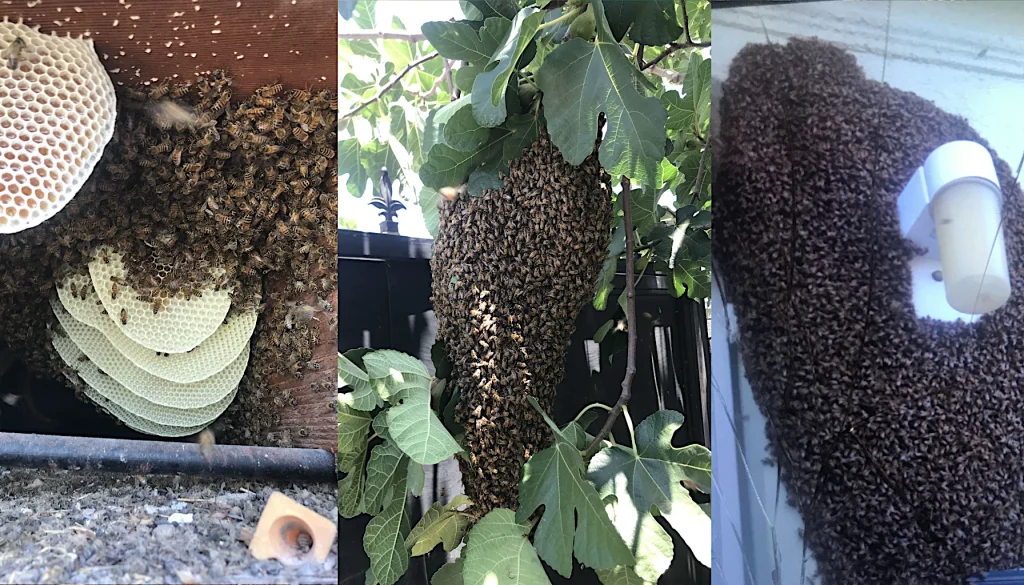
The western honey bee (Apis mellifera) is the most commonly encountered bee species in Arizona and the primary species responsible for honey production, pollination, and structural hive infestations throughout the Phoenix metropolitan area. Honey bees are highly adaptable and frequently establish colonies inside walls, attics, rooflines, irrigation boxes, sheds, and hollow trees.
Honey bees are generally considered beneficial pollinators and are responsible for pollinating a significant portion of flowering plants and agricultural crops. However, colonies nesting near homes, schools, patios, walkways, or pool equipment can become dangerous if disturbed, especially in Arizona where many wild colonies exhibit Africanized defensive traits.
Identification
Honey bees are smaller and fuzzier than most wasps. Their bodies are covered in fine hairs used to collect pollen, giving them a softer and more rounded appearance compared to yellowjackets or paper wasps.
- Golden-brown thorax with darker abdominal stripes
- Noticeably fuzzy body texture
- Steady, direct flight pattern
- Often seen collecting pollen on flowering plants
- Heavy traffic entering and exiting a single gap may indicate a hidden hive
Behavior
Honey bees are social insects that live in large colonies centered around a queen. Worker bees gather nectar, pollen, and water while defending the colony from threats. Swarming behavior typically occurs during warmer months when a colony splits and searches for a new nesting location.
A swarm hanging from a tree branch is usually temporary and less defensive than an established structural colony. Once bees move into a wall or attic cavity and begin building comb, defensive behavior may increase substantially.
Common Nesting Locations in Arizona
Honey bees in Arizona frequently nest in shaded voids that protect the colony from extreme summer temperatures. Common nesting sites include:
- Tile roof cavities
- Stucco wall voids
- Attics and eaves
- Irrigation valve boxes
- Sheds and detached garages
- Palm trees and hollow trunks
- Block walls and utility enclosures
Removal Considerations
Removing visible bees alone is often not enough when a colony is established inside a structure. Honeycomb, brood, wax, and residual scent can attract future swarms if the hive material is left behind.
Professional structural bee removal typically includes locating the colony, accessing the hive cavity, removing honeycomb, treating remaining activity, and sealing entry points when appropriate.
Bumblebee
Bumblebees (Bombus spp.) are large, round, fuzzy bees known for their black-and-yellow coloration and important role as pollinators. Compared with honey bees, bumblebees are usually larger, hairier, and slower-moving, with a noticeably heavy-bodied appearance.
In Arizona, bumblebees may be seen visiting flowers, desert plants, gardens, and landscaped yards. They are generally beneficial insects and are not usually a removal concern unless a nest is located near a doorway, walkway, patio, pet area, or another high-traffic space.
Identification
Bumblebees are among the easiest bees to recognize because of their large size and dense fuzz. They are often confused with carpenter bees, but carpenter bees usually have a shinier, less hairy abdomen.
- Large, rounded body
- Dense fuzzy hairs across the body
- Black and yellow banding
- Slower, heavier flight than honey bees or wasps
- Often seen visiting flowers close to the ground
Behavior
Bumblebees are social bees, but their colonies are much smaller than honey bee colonies. They usually keep to themselves while foraging and are not aggressive away from the nest. However, they can defend a nesting area if stepped on, handled, or repeatedly disturbed.
Unlike honey bees, bumblebees do not lose their stinger after one sting. A single bumblebee can sting more than once, though stinging is usually defensive rather than aggressive.
Common Nesting Locations in Arizona
Bumblebees often nest in protected spaces close to the ground. Their nesting sites are usually smaller and less obvious than honey bee hives.
- Abandoned rodent burrows
- Ground holes
- Under logs or debris
- Dense grass or vegetation
- Under sheds or low structures
- Occasionally inside wall voids or insulation
Removal Considerations
Because bumblebees are beneficial pollinators and usually not aggressive, nests that are away from people can often be left undisturbed. If activity is close to a doorway, playground, patio, pool area, or pet space, professional inspection may be recommended.
Do not pour water, gasoline, pesticides, or household chemicals into a suspected ground nest. Disturbing the nest can trigger defensive stinging and may make the situation more dangerous.
Carpenter Bee
Carpenter bees (Xylocopa spp.) are large solitary bees known for tunneling into wood to create nesting galleries. Unlike honey bees, carpenter bees do not build wax hives or form large colonies. Instead, individual females drill circular holes into wood surfaces where they lay eggs and raise their young.
In Arizona, carpenter bees are commonly found around wooden structures such as patio covers, exposed beams, fences, sheds, pergolas, fascia boards, and decks. Repeated nesting activity over time can weaken wood and create cosmetic or structural damage.
Identification
Carpenter bees are often mistaken for bumblebees because of their large size and fuzzy thorax. However, carpenter bees usually have a noticeably shiny, hairless abdomen while bumblebees appear fuzzy across the entire body.
- Large bee with loud hovering flight
- Fuzzy yellow or golden thorax
- Smooth, shiny black abdomen
- Round entry holes in wood about the size of a fingertip
- Sawdust-like material may appear beneath nesting holes
Behavior
Carpenter bees are solitary nesters and do not defend a hive like honey bees or wasps. Males are often seen hovering aggressively near people, especially around nesting sites, but males do not have stingers and cannot sting.
Female carpenter bees are capable of stinging, though they are generally non-aggressive unless directly handled or trapped.
Common Nesting Locations in Arizona
Carpenter bees prefer exposed wood surfaces that are unfinished, weathered, or lightly protected from direct sunlight and rain.
- Wooden patio covers
- Fascia boards and roof overhangs
- Pergolas and gazebos
- Deck railings and supports
- Fences and gates
- Sheds and barns
- Wooden outdoor furniture
Damage and Removal Considerations
Carpenter bee tunnels are usually perfectly round and may extend several inches into the wood before turning and following the grain internally. Over time, repeated nesting can weaken wood and allow moisture intrusion or woodpecker damage.
Prevention often includes sealing, painting, or treating exposed wood surfaces. Existing nesting holes may require professional treatment and sealing to discourage future activity.
Paper Wasp
Paper wasps (Polistes spp.) are among the most commonly encountered wasps around Arizona homes. They are named for the papery material they create by chewing wood fibers and mixing them with saliva to form nests.
These wasps frequently build exposed umbrella-shaped nests beneath eaves, patio covers, roof overhangs, porch ceilings, sheds, and outdoor furniture. While paper wasps are generally less aggressive than yellowjackets, they will defend their nest if disturbed or approached too closely.
Identification
Paper wasps are recognizable by their slender shape, narrow waist, and long legs that hang downward during flight. Their nests are usually exposed and visibly open-celled rather than enclosed inside a paper shell.
- Long, thin body with narrow waist
- Legs hang noticeably during flight
- Brown, red, yellow, or black coloration
- Open umbrella-shaped paper nest
- Frequently found beneath shaded structures
Behavior
Paper wasps feed on nectar and small insects, making them beneficial predators in some environments. However, they become a concern when nesting close to doors, patios, walkways, play areas, or pool equipment.
Unlike bees, paper wasps can sting repeatedly. Defensive behavior usually increases as the colony grows larger during spring and summer.
Common Nesting Locations in Arizona
Paper wasps prefer shaded protected surfaces that shield the nest from direct sun and rain.
- Patio ceilings
- Roof eaves and overhangs
- Garage entries
- Porch lights and fixtures
- Outdoor furniture
- Sheds and barns
- Play structures and gazebos
Removal Considerations
Small paper wasp nests are often first noticed as a few hanging cells attached beneath an overhang. If left untreated, these nests can expand throughout the warm season and lead to increased wasp activity around the property.
Because paper wasps may defend the nest aggressively, especially during daylight hours, removal is safest when handled with proper protective equipment and treatment methods.
Yellowjacket
Yellowjackets (Vespula spp.) are aggressive social wasps commonly found throughout Arizona. Unlike bees, yellowjackets have smooth shiny bodies with very little visible fuzz and are capable of stinging repeatedly.
These wasps are known for building hidden nests inside wall voids, underground cavities, attics, irrigation boxes, and other protected spaces. Colonies can become extremely defensive if disturbed, especially during late summer and early fall when populations peak.
Identification
Yellowjackets are often confused with honey bees at a distance, but they have a noticeably sleeker appearance and more rapid, aggressive flight behavior.
- Bright yellow-and-black coloration
- Smooth shiny body with little hair
- Fast, darting flight pattern
- Frequently attracted to food, trash, and sugary drinks
- May repeatedly enter and exit a hidden ground or wall opening
Behavior
Yellowjackets are highly territorial social wasps that aggressively defend their nest. Unlike honey bees, a single yellowjacket can sting multiple times without dying.
Workers actively hunt insects and scavenge for proteins and sugars, which is why they are often seen around outdoor dining areas, trash cans, picnic spaces, pet food, and pool decks.
Common Nesting Locations in Arizona
Yellowjackets prefer concealed nesting areas protected from heat and predators.
- Underground rodent burrows
- Wall voids
- Attics and soffits
- Irrigation valve boxes
- Block wall cavities
- Sheds and storage structures
- Landscape voids and retaining walls
Removal Considerations
Yellowjacket colonies can contain large numbers of wasps and may react aggressively to vibration, noise, or attempted DIY treatment. Spraying visible wasps alone often does not eliminate the colony if the nest itself remains active inside a hidden cavity.
Professional treatment is generally recommended for yellowjacket nests located near homes, walkways, schools, pets, or heavily used outdoor areas due to the risk of multiple stings.
Mud Dauber
Mud daubers (Sceliphron and Chalybion spp.) are solitary wasps known for constructing distinctive mud tube nests on buildings and outdoor structures. Unlike yellowjackets or paper wasps, mud daubers do not form aggressive social colonies and are generally considered one of the least dangerous wasps commonly found in Arizona.
These wasps are beneficial predators that hunt spiders, which they paralyze and place inside their mud nests as food for developing larvae. Although their nests may appear alarming, mud daubers rarely sting people and are usually calm even at close range.
Identification
Mud daubers are easy to recognize because of their extremely narrow waist and long, delicate-looking body shape. Their nests are often the most obvious sign of activity.
- Very thin thread-like waist
- Long narrow body and legs
- Usually black, metallic blue, or black-and-yellow
- Slow, deliberate flight pattern
- Build mud tube nests attached to walls or ceilings
Behavior
Mud daubers are solitary wasps, meaning each female builds and maintains her own nest rather than living in a colony. They are not territorial in the same way as paper wasps or yellowjackets and rarely defend nests aggressively.
Female mud daubers collect mud to construct tubular chambers, then stock each chamber with paralyzed spiders before sealing it closed for larval development.
Common Nesting Locations in Arizona
Mud daubers prefer protected surfaces shielded from heavy rain and direct sun.
- Garage ceilings
- Patio overhangs
- Exterior walls
- Storage sheds
- Barns and workshops
- Attic vents and rafters
- Under bridges or protected structures
Removal Considerations
Old mud dauber nests are often abandoned and inactive by the time homeowners notice them. In many cases, nests can simply be scraped away after confirming no active activity remains.
Because mud daubers are non-aggressive and beneficial predators, professional treatment is usually unnecessary unless large numbers are repeatedly nesting around sensitive areas or creating cosmetic concerns.
Bald-faced Hornet
The bald-faced hornet (Dolichovespula maculata) is a large black-and-white social wasp known for constructing enclosed paper nests suspended from trees, structures, and rooflines. Despite the common name, bald-faced hornets are technically a type of yellowjacket rather than a true hornet.
These wasps are highly defensive around their nest and may aggressively respond to nearby movement, vibration, or attempted removal. Their enclosed gray paper nests are often among the most recognizable aerial wasp nests in North America.
Identification
Bald-faced hornets are easy to distinguish from most Arizona wasps because of their black body coloration combined with bright white markings on the face and abdomen.
- Large black wasp with white facial markings
- Bold white or pale banding near the abdomen tip
- Enclosed football-shaped paper nest
- Fast, direct flight behavior
- Frequently patrol around the nest entrance
Behavior
Bald-faced hornets are social wasps that live in colonies centered around a queen. Workers aggressively defend the nest and may pursue perceived threats over significant distances if the colony is disturbed.
These wasps prey on flies, caterpillars, and other insects while also feeding on nectar and sugary substances. Their defensive behavior becomes more intense as colony size increases during warmer months.
Common Nesting Locations in Arizona
Bald-faced hornets typically build suspended enclosed nests in protected elevated areas.
- Trees and shrubs
- Roof overhangs
- Sheds and barns
- Covered patios
- Utility structures
- Attic openings
- Dense vegetation
Removal Considerations
Bald-faced hornet nests should not be disturbed casually. Colonies may react rapidly and aggressively if they perceive vibration, impact, or nearby movement around the nest.
Because nests are often elevated and contain many defensive workers, professional treatment is generally recommended when nests are located near homes, pathways, playgrounds, patios, or frequently used outdoor areas.
Cicada Killer Wasp
Cicada killer wasps (Sphecius spp.) are very large solitary wasps known for hunting cicadas and nesting in underground burrows. Despite their intimidating appearance, cicada killers are generally non-aggressive toward humans and are far less dangerous than social wasps such as yellowjackets.
These wasps are commonly seen flying low over lawns, dry soil, pathways, golf courses, and landscaped areas during warmer months. Their size and loud flight often alarm homeowners, but most activity is defensive bluffing rather than true aggression.
Identification
Cicada killers are among the largest wasps found in Arizona and are frequently mistaken for hornets because of their size.
- Very large wasp with thick body
- Black abdomen with broken yellow bands
- Reddish or rust-colored wings
- Loud buzzing flight
- Often seen hovering close to the ground
Behavior
Cicada killers are solitary hunters rather than colony-forming wasps. Females hunt cicadas, sting and paralyze them, then drag them underground into nesting chambers where the cicadas serve as food for developing larvae.
Males are highly territorial and may hover aggressively near people, but males do not possess stingers. Females are capable of stinging but are usually reluctant to do so unless directly handled or trapped.
Common Nesting Locations in Arizona
Cicada killers prefer exposed dry soil with good drainage and minimal vegetation.
- Lawns with bare patches
- Landscaped beds
- Golf courses
- Dry sandy soil
- Sidewalk edges
- Retaining wall gaps
- Open desert terrain
Removal Considerations
Cicada killer wasps are usually considered more intimidating than dangerous. In many cases, activity can simply be monitored until the seasonal nesting cycle ends naturally.
If large numbers are nesting in high-traffic areas or causing concern around pets, walkways, playgrounds, or outdoor gathering areas, professional treatment or habitat modification may be recommended.
Velvet Ant
Velvet ants (family Mutillidae) are actually wingless female wasps rather than true ants. They are known for their bright warning colors, dense fuzzy appearance, and extremely painful sting. In Arizona, velvet ants are most commonly encountered in dry desert environments and sandy soils during warmer months.
These insects are solitary and do not form colonies like ants, yellowjackets, or honey bees. Although their appearance can seem alarming, velvet ants are not aggressive and usually attempt to avoid confrontation unless directly handled or stepped on.
Identification
Velvet ants are easy to recognize because of their fuzzy brightly colored body and ant-like appearance. Females are wingless, while males possess wings and are less commonly noticed.
- Dense velvet-like fuzz covering the body
- Bright red, orange, yellow, black, or white coloration
- Wingless females resemble large hairy ants
- Fast-moving ground behavior
- Often seen wandering alone rather than in groups
Behavior
Velvet ants are parasitic wasps that invade the nests of other ground-nesting insects, where they lay eggs inside host chambers. They spend most of their lives alone and do not build visible nests or paper structures.
Their bright coloration serves as a warning to predators. Velvet ants possess one of the more painful insect stings in North America, which has earned some species the nickname “cow killer,” although the sting is not medically dangerous to livestock under normal conditions.
Common Habitats in Arizona
Velvet ants are most often found moving across open ground in warm dry environments.
- Desert landscapes
- Sandy soil areas
- Dry trails and pathways
- Open yards and natural terrain
- Near ground-nesting bees and wasps
- Parks and undeveloped lots
- Rocky desert habitats
Removal Considerations
Because velvet ants are solitary and do not form colonies, professional treatment is rarely necessary. Most encounters involve a single wandering insect rather than an infestation.
Velvet ants should never be handled directly. If found near children, pets, or high-traffic areas, the safest approach is usually simple avoidance or careful relocation.
What to Do If You Find Bees or Wasps Around Your Home
Keep children and pets away, do not spray or block the entry, and have the insect identified before anything is done, because honey bees, paper wasps and yellowjackets each need different handling.
Finding bees or wasps around your property does not always mean there is an active nest nearby, but repeated activity in the same area should never be ignored. In Arizona, colonies can establish surprisingly quickly inside walls, roof cavities, irrigation boxes, sheds, and underground voids. Especially during the warmer months.
If you notice consistent insect traffic entering a crack, vent, roofline, or ground opening, there may already be an established colony inside the structure.
For your safety:
- Avoid spraying or disturbing active nests yourself
- Keep children and pets away from the area
- Do not block entry holes, which can force insects deeper into walls or into living spaces
- Avoid using water or fire on underground nests
- Watch for increased activity during the afternoon and evening hours
Honey bees, paper wasps, yellowjackets, and other stinging insects all behave differently. Some species are relatively calm, while others may aggressively defend their nest if they feel threatened. Because many Arizona honey bee colonies contain Africanized genetics, it is safest to treat unknown bee activity cautiously.
Early identification and treatment is usually the easiest and safest approach before colonies grow larger or begin causing structural issues.
Professional Bee & Wasp Removal in Arizona
Busy Bee Pest Solutions provides professional bee and wasp removal services throughout the Phoenix metro area and surrounding Arizona communities. Whether you are dealing with honey bees in a wall, paper wasps under a patio, yellowjackets in the ground, or another stinging insect issue, our team can help identify the species and recommend the safest solution.
Our technicians handle:
- Bee removal and hive extraction
- Live bee relocation when possible
- Wasp nest treatment and removal
- Yellowjacket nest treatment
- Entry point sealing and prevention
- Structural hive cleanup and honeycomb removal
If you are unsure what species you are seeing, professional identification is the safest first step.
Call Busy Bee Pest Solutions today to schedule an inspection or removal service.


It’s very simple to find out any matter on net as compared to books, as I found this post at this website.