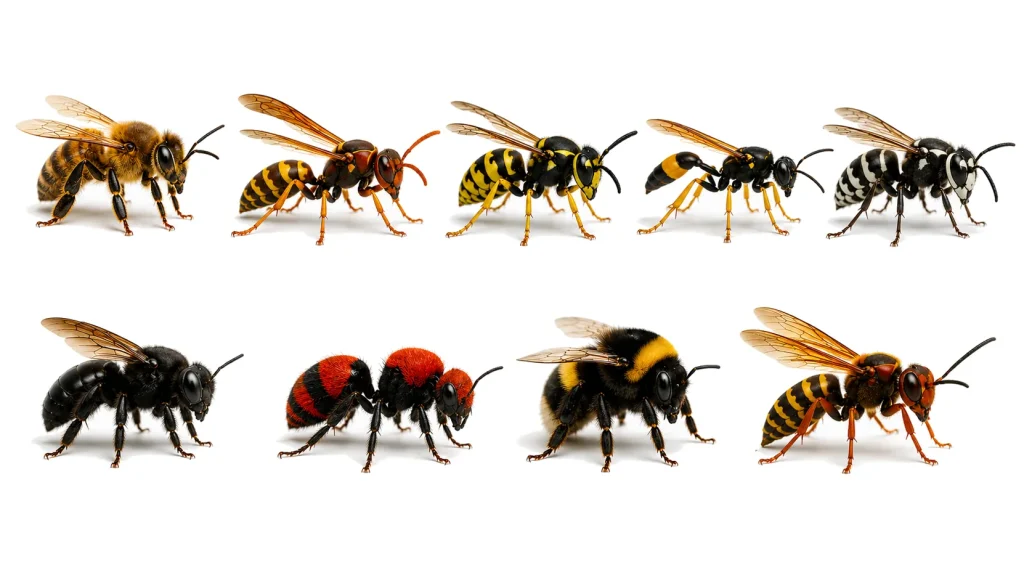
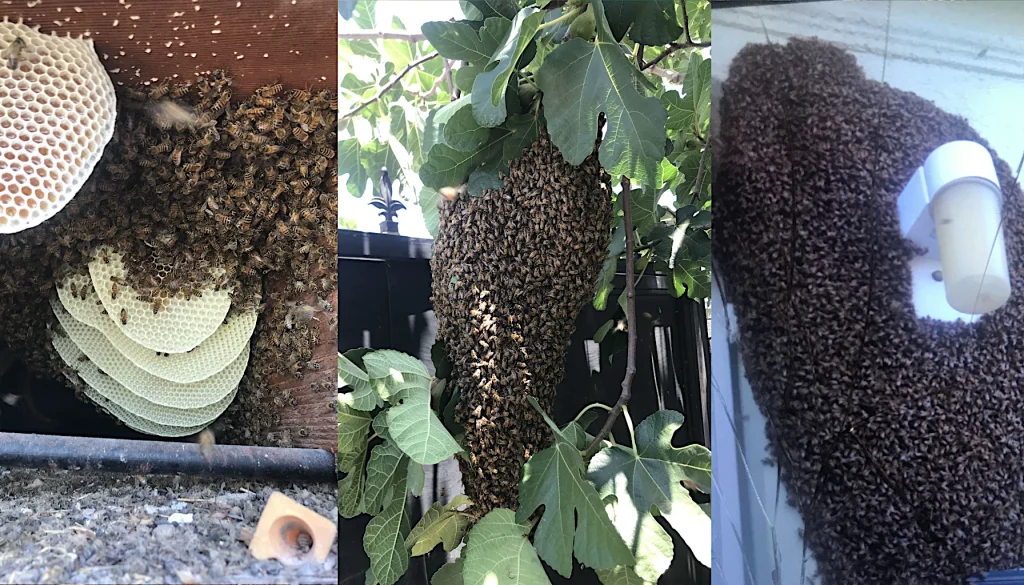
Got bees in Phoenix?
Before you grab a broom or panic. Take a breath. Because while honeybees may be small, the truth is: they’re full of big mysteries.
In fact, scientists still don’t fully understand how these brilliant insects navigate, communicate, or even choose their queens. These honeybee mysteries are fascinating, sometimes eerie, and always humbling. Reminding us that nature’s secrets are still very much alive and buzzing.
So, without further ado, let’s explore 10 things about honeybees that even science can’t explain.
🐝✨
And if your bee encounter is less theoretical and more on your porch, call Busy Bee Pest Solutions at 623-289-3375. Phoenix’s trusted experts in live, humane removal.
Honeybee Mysteries that Scientists Still Don’t Fully Understand
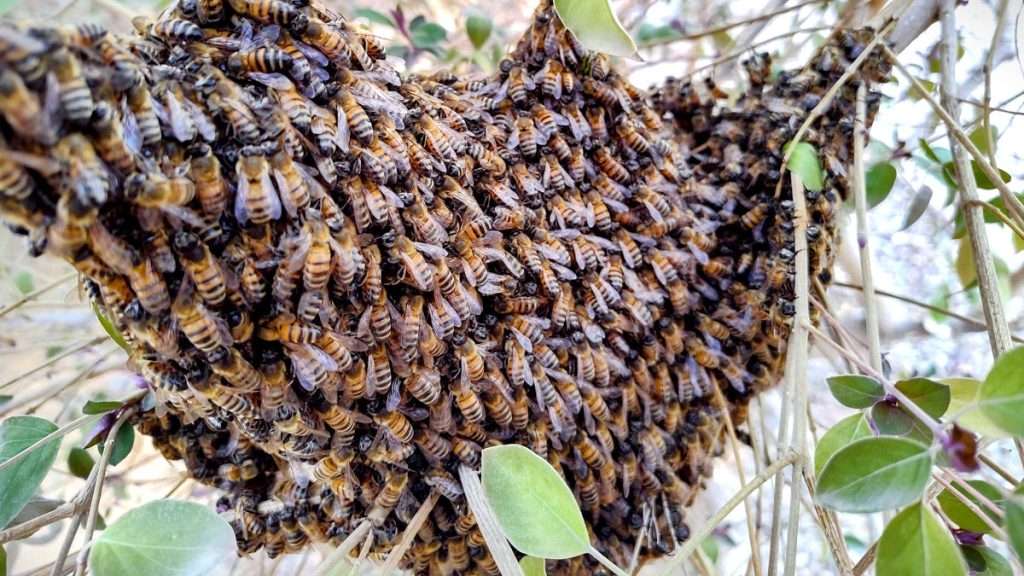
🧠 1. How Exactly Do Honeybees Process Complex Spatial Memory?
With a brain no bigger than a sesame seed, honeybees can do something astonishing: they build detailed mental maps of their environment. They remember landmarks, sun angles, and distances between flowers and the hive, and they can update those maps in real time.
Bees returning from a food source often take different routes home depending on light, wind, and obstacles. It’s as if they hold a dynamic 3D GPS system in their heads, adapting constantly.
But here’s the mystery: how are they doing this?
Researchers know bees use polarized light from the sky and optic flow (the way scenery moves past them) to gauge direction and speed. But the internal neural architecture behind these calculations is still poorly understood. Their brains don’t work like ours. They process information in compressed, hyper-efficient ways we haven’t fully mapped.
The real question isn’t just how bees navigate. It’s how they do it with such small, decentralized processing power, and whether swarm-level intelligence contributes to it in subtle ways.
It’s one of nature’s most elegant riddles. A creature with a pinhead brain, solving mazes we still struggle to understand.
🔗 Worried about bees moving in?
Read our guide on bee-proofing your home in Phoenix to stop hives before they start.
💃 2. The Full Purpose and Mechanics of the Waggle Dance
Bees don’t just forage. They choreograph directions. When a honeybee finds a good food source, she returns to the hive and performs the iconic waggle dance: a figure-eight movement with a vibrating “waggle run” at the center.
We know the basics:
- The angle of the waggle indicates the direction of the food relative to the sun.
- The duration of the waggle conveys the distance.
It’s like a GPS signal made of tiny bee hips and serious enthusiasm.
But… how do the watching bees decode this info so perfectly?
That’s the unsolved part.
Scientists suspect there’s more going on than visual observation. Some believe bees rely on vibrational cues sensed through their legs on the comb. Others suggest pheromonal trails or acoustic signatures might reinforce the message. There’s even evidence that ambient hive temperature and humidity might play a role in enhancing or dampening the signal’s clarity.
And the bigger mystery? Why such a complex method evolved in the first place, when scent-marking or direct recruitment would’ve been simpler.
It’s possible the waggle dance is not just about sharing information. It might be a hive-wide signal of excitement, a ritualized call to action that synchronizes behavior in ways we don’t fully understand.
In the dark, humming chambers of the hive, these dances play out like ancient code. We’ve cracked the first few lines… but the full message? Still encrypted.
🔗 Hear buzzing in your pool shed or irrigation box?
Check out this wild hive discovery in Phoenix. You won’t believe where they built it.
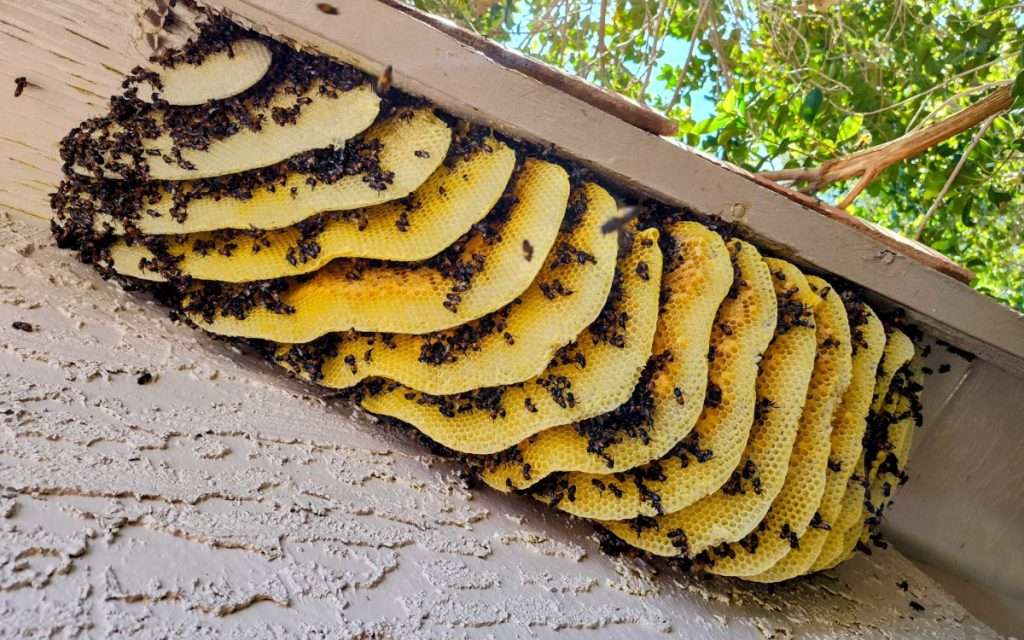
👑 3. Why Do Queen Bees Reject Certain Sperm Despite Mating?
A queen bee’s mating flight is her only one. A once-in-a-lifetime skyward ritual, where she mates with up to 20 drones in rapid succession, high above the hive. By the end, she’s collected all the genetic material she’ll ever use, storing it in a special internal organ called the spermatheca.
But here’s where it gets mysterious:
Not all the sperm she collects ends up used.
Some drones’ genetic material simply… doesn’t make the cut.
Why?
Researchers aren’t sure. It’s tempting to assume it’s random, but evidence suggests the queen may filter or prioritize sperm in a subtle form of post-mating selection. Certain sperm might be chemically tagged for rejection. There may be markers of genetic compatibility, or even microbial signals that influence which sperm survive in her long-term reservoir.
This raises strange evolutionary questions:
- Is the queen exercising unconscious mate choice after mating?
- Is the hive’s immune system involved?
- Could pheromonal interactions during mating influence future use?
Whatever the mechanism, it’s clear the queen isn’t just a passive vessel. She’s a genetic gatekeeper, subtly shaping the next generation of the colony with choices science still doesn’t fully see.
In the end, only a chosen few contribute to the future of the hive.
The rest? Preserved… but forgotten.
🔗 Found a hive in your backyard?
Here’s what to do about a bee hive in your backyard to stay safe and keep the bees calm.
🦠 4. How Do Honeybees Manage Immune System Tradeoffs?
Despite their small size and short lifespans, honeybees live in densely packed, humid environments. Literal petri dishes of disease potential. And yet, somehow, most colonies thrive… until they suddenly don’t.
Bees have immune systems, yes, but they’re incredibly minimal compared to other insects. They produce a limited set of antimicrobial peptides and show only a few known immune pathways. And unlike mammals, they can’t adaptively “remember” past pathogens.
So how do they survive at all?
The mystery lies in the colony-level immunity, a concept called “social immunity.” Bees clean each other, groom for mites, remove sick brood, and coat surfaces in propolis (a natural antimicrobial resin). But even this social system isn’t enough to explain how they balance survival with minimal internal defenses.
And then there’s the paradox:
When stressed, from pesticides, pathogens, or poor nutrition, bees can overactivate their immune response, leading to self-destruction of gut flora or energy collapse. It’s like a system that works… until it doesn’t.
Why evolution landed on such a razor’s edge of immunity is still unclear.
It’s as if bees survive not by fighting infection head-on, but by managing vulnerability with grace. A fragile agreement between biology, chemistry, and collective behavior.
One that can shatter if any piece falters.
🔗 Curious about live removals?
Learn how we safely relocate bees without harming them.
🍽️ 5. The Chemical Complexity of Royal Jelly
Royal jelly is the food of queens. Literally.
Every honeybee larva is born genetically identical… but the ones fed royal jelly exclusively transform into queens. They grow larger, live longer, develop reproductive organs, and take on entirely different behaviors.
All because of this one mysterious substance.
We know royal jelly is rich in proteins, sugars, fatty acids, and vitamins. The big player seems to be royalactin, a protein that appears to trigger queen development. But the story isn’t that simple. Some studies show royalactin’s effects don’t replicate outside the hive. Others suggest epigenetic changes, gene expression modified without changing DNA, are the real mechanism.
So the mystery deepens:
- Is it royalactin alone, or a symphony of chemicals?
- Is there a microbial or hormonal factor we haven’t detected?
- Why do some species respond to royal jelly and others don’t?
No lab-made formula fully recreates its effects.
No microscope has revealed the exact recipe for royalty.
It’s not just a superfood. It’s a genetic key.
And somehow, nurse bees wield it like alchemists, transforming ordinary larvae into sovereign queens.
How they do it with such precision…
Remains one of the hive’s most sacred secrets.
🔗 Dealing with a sudden bee swarm?
Discover our humane swarm relocation process and why timing matters.
🏡 6. The Origin of Collective Decision-Making ‘Quorum’ Thresholds
Imagine this:
A swarm of 10,000 bees has left their old hive. They’re clinging to a tree branch, exposed, vulnerable, and they need a new home fast.
Scout bees fly out, investigate potential sites, then return and perform waggle dances to advertise what they found. Some locations are better than others… but how does the entire swarm reach an agreement?
There’s no leader. No central control.
And yet, somehow, a consensus forms.
Researchers have observed a tipping point:
When about 15% of the scouts all dance for the same location, the swarm moves.
But how this quorum threshold evolved, and how it’s so precise, is still unknown.
Are bees counting? Timing? Responding to emotional buzz intensity?
Do they weigh dance enthusiasm, or use subtle vibrational cues from scouts that reach a critical “volume”?
Some suspect it’s not just numbers, but a kind of emergent intelligence, where decentralized signals create a decision without anyone being “in charge.”
Even more strangely, this method outperforms some AI algorithms in efficiency and accuracy.
It’s not just voting. It’s consensus without conflict, a collective intuition built from individual conviction.
And the swarm obeys it perfectly.
Where does that obedience come from?
What ancient instinct drives a thousand wings to agree… without a word?
We don’t know. But every time a swarm takes flight toward its new home, it reminds us that leadership can be silent, and wisdom shared.
🔗 Need quick bee removal tips?
This Phoenix bee removal guide covers prevention, safety, and who to call.

⚔️ 7. Why Do Honeybees Die After Stinging, and Why Hasn’t Evolution Fixed It?
When a honeybee stings a mammal, say, a human, the barb catches in the skin. As the bee pulls away, part of her abdomen is ripped out with it: her venom sac, muscles, even nerve endings. It’s not just painful for the target. It’s fatal for the bee.
So here’s the evolutionary riddle:
If suicidal defense is so costly to the individual…
Why does it still exist?
Natural selection favors survival and reproduction, right?
Yet here we have a system where the act of protection guarantees death. It’s not just inefficient. It’s brutal.
Researchers suspect the answer lies in colony-level selection.
The individual worker isn’t the unit of survival. The hive is.
In this model, a bee dying to protect the queen and brood isn’t a loss… it’s altruistic armor.
But even that raises questions:
- Why don’t they sting mammals without dying, like other insects?
- Why has evolution kept the barbed sting, which guarantees a fatal tear?
- Is this defense mechanism designed specifically for soft-skinned mammals (i.e., us), not insects?
Some theories suggest the barbed sting evolved long before mammals were common, and just never needed to adapt. Others propose it’s a deterrent mechanism. One bee dies, but the pheromones in her venom rally the swarm.
Still… the fact remains:
A creature programmed to die for its home is a mystery of biology and a marvel of loyalty.
She doesn’t just sting.
She writes her final act into the hive’s survival.
🔗 In a bee emergency?
Read our urgent removal guide for fast help when time is critical.
🧭 8. How Do Honeybees Detect Magnetic Fields?
Honeybees don’t just see with their eyes. They feel the Earth’s pull.
They’re sensitive to the planet’s magnetic field, using it to orient themselves on cloudy days, navigate long distances, and even align their combs with uncanny precision.
But how they sense this invisible force?
That’s the unsolved mystery.
Some researchers believe bees may have tiny crystals of magnetite (a magnetic mineral) in their abdomens or brains, acting like internal compasses. Others point to cryptochromes. Light-sensitive proteins in the eye that react to magnetic fields under certain wavelengths.
And then there’s the behavioral evidence:
- Bees trained to find food in a magnetic direction can still do it when visual cues are removed.
- Sudden magnetic field changes disorient them. Like a compass needle shaking loose.
But here’s the twist:
No one has definitively found where this magnetic-sensing organ is. No consistent magnetite structures. No isolated magnetic receptor.
It’s like chasing a ghost in the dark. We see the effects, but not the source.
And some scientists wonder:
What if it’s not in a single organ at all?
What if magnetoreception is distributed. A body-wide sense we barely understand?
For now, the bee’s internal compass remains one of nature’s quietest marvels. Always spinning, always guiding, and still… entirely unseen.
🔗 Ever wonder where killer bees came from?
Explore the history of Africanized bees in Arizona. It’s more dramatic than you think.
🗳️ 9. How Do Honeybee Swarms ‘Vote’ on a New Home?
When a colony splits and forms a swarm, they leave their hive behind in search of a new home. But here’s the catch: they don’t know where they’re going.
No single bee decides. No leader draws a map.
And yet… they almost always make an excellent choice.
How?
Scout bees fan out and discover potential nest sites. Hollow trees, roof eaves, irrigation boxes (oops). When they find a spot they like, they come back and waggle dance to promote it. Other bees visit the site, evaluate it, and return with their own votes… in the form of more waggle dances.
This creates a feedback loop of excitement.
The better the site, the more intense and frequent the dances.
Eventually, one location gathers enough support, and the entire swarm takes off in perfect unity.
But here’s the mystery:
There’s no defined quorum.
No bee says, “Okay, 51% voted, time to go.”
And the mechanism that pushes the decision from deliberation to action is still unknown.
Are bees counting waggle dances?
Do they use vibrational consensus?
Is there a chemical cue, or a subtle network effect, like a biological algorithm unfolding in real time?
Some believe this is a pure example of emergent intelligence. Where simple individual behaviors create a complex, wise collective outcome.
Others suspect there’s a deeper, sensory mechanism we haven’t discovered yet. A kind of hive-field that shifts when consensus builds.
Whatever the answer, bees vote in silence, with elegance.
And when the decision comes, thousands of wings lift in perfect agreement, no debate, no regret, just movement.
🔗 Not all bees are the same.
Learn about different bee species found in Arizona and what makes them unique.
⏳ 10. How Do Honeybees Perceive Time?
Bees don’t wear watches. They don’t check the sun with a sundial app.
And yet. They know when things happen.
Researchers have trained bees to visit food sources at specific times of day, and those bees will return at the exact same hour. Even days later. This means they’re not just reacting to the sun or temperature… they’re tracking time itself.
But how?
Bees show clear circadian rhythms, much like humans. Their bodies follow internal clocks that regulate behavior, energy levels, and even hive tasks. But what’s baffling is the precision of their time perception. They can adjust their routines in response to environmental changes with uncanny accuracy.
Even more mysterious:
Bees placed in constant light or darkness still maintain their internal rhythms… for a while.
This suggests something deeper than a basic solar cue. An endogenous clock, running quietly inside them.
But where is it? How does it work?
Their brains are tiny. Their lifespans are short. And yet somehow, they operate on temporal memory, aligning not just to space (like with flowers and landmarks), but to sequences, when to go, not just where.
Some scientists suspect this ability evolved so bees could optimize nectar collection based on when certain plants bloom. Others believe there may be quantum-level sensory mechanisms. A theory whispered about in cutting-edge neurobiology circles.
What’s clear is this:
Honeybees don’t just live in space. They live in time.
And they seem to feel it in ways we’re only beginning to imagine.
🔗 Want a safer way to handle bees?
Our safe removal practices protect both people and pollinators.