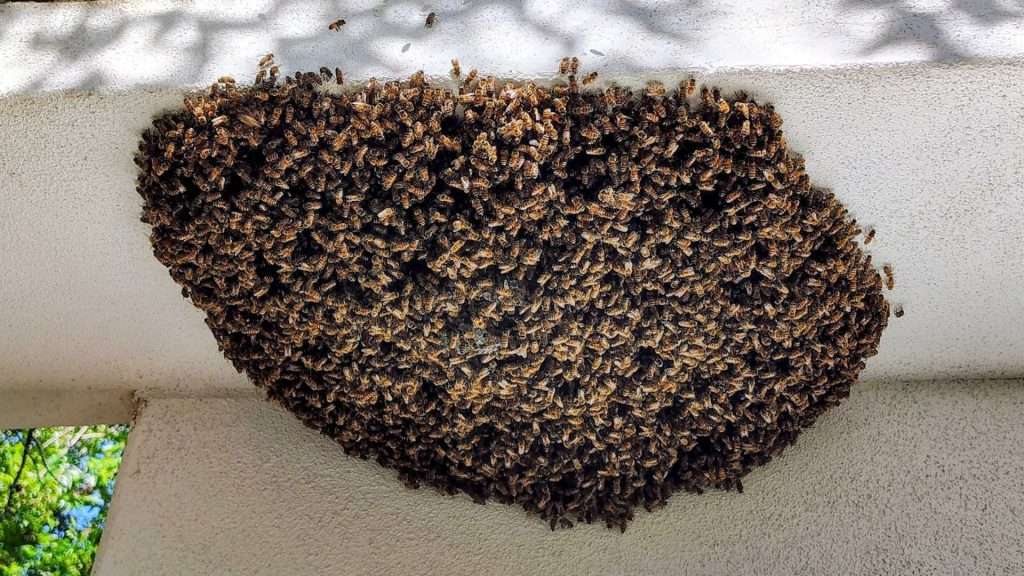
Removing a colony from under a tile roof means lifting tile, cutting the underlayment and often the decking beneath it, taking out the comb, and then repairing the roof properly afterwards. It is as much a roofing job as a bee job, and the part worth asking about before anyone starts is who is putting the roof back together.
Tile is the default in most of the Phoenix metro built since the 1990s, which makes this one of the more common structural bee removal jobs in the Valley, and one that is often finished badly.
Why tile roofs hold colonies so well
Concrete and clay tile do not sit flat on the deck. They sit on battens or on a raised profile, which creates a continuous void between the tile and the underlayment. At the eave, the first course leaves a row of open half round channels, and unless a bird stop closes them off, that gap runs the length of the house.
Behind that opening is a dry, shaded, temperature-buffered cavity with a small defensible entrance. From a colony’s point of view it is close to purpose built.
The result is that tile roof colonies are usually established in the void above the deck or in the rafter bay below it, and frequently spread further along the run than the entry point suggests.
What the job actually involves
What follows is a description of what a crew does, not a set of instructions. This is not a homeowner job. It puts a live colony, work at height on a surface that breaks underfoot, and a roof assembly that has to go back together correctly all in the same afternoon.
It is also worth assuming the colony is Africanized. In Maricopa County a feral colony is treated that way unless a lab says otherwise, and the practical difference is not day to day behaviour, which looks like ordinary honey bee traffic, but how strongly the colony reacts once it is disturbed. Prying tile, a saw on the deck and people working within arm’s reach of the comb are exactly the triggers involved. Anyone with a known sting allergy should stay away from the area entirely while the colony is there, and multiple stings, difficulty breathing, swelling that spreads beyond the sting site, or faintness, is a 911 call.
Locating the entry and the extent. The flight line shows where the bees are going in. It does not show how far the comb runs, which is why thermal imaging or an inspection camera goes over the run before anything is lifted.
Lifting tile. Tile comes up by hand, starting clear of the colony and working in. Weathered tile chips and cracks more readily in handling than newer tile, because years of sun, foot traffic and fastener holes leave edges already damaged, and the damage is where it fails when it is lifted. Some breakage is normal on any tile job. A crew that tells you there will be none is either very lucky or not being straight with you.
Opening the roof. This is the step homeowners tend to underestimate. Under the tile there is a batten or raised profile, then the underlayment, then a plywood or OSB deck, and only then the rafter bay. Cutting the underlayment reaches the top of the sheathing and no further. If the comb is above the deck, in the void under the tile, lifting tile and cutting underlayment gets to it. If the comb is in the rafter bay, the deck itself has to be cut, or the bay has to be opened from inside the house through the ceiling. That is a structural opening rather than a peeled back layer, and which route a crew takes depends on where the comb sits and which surface is easier to make good afterwards.
Removing the colony and all of the comb. This is the step that cannot be shortcut. Comb left in a rafter bay in a Phoenix summer softens, stores fail, and what runs out ends up on the ceiling below. What that stage involves is covered in more detail in our piece on removing honeycomb after a bee removal.
Cleaning and treating the cavity. Residual wax and pheromone marking is what draws the next swarm to the same bay.
Closing the cavity and repairing the roof. Underlayment patched properly, any cut decking or ceiling made good, tile relaid, broken tile replaced, and the eave channel closed with a bird stop or screen so the entry route is gone.
The question to ask before work starts
Who is doing the roofing repair, and what does the finished state look like.
There are three common arrangements, and it is worth knowing which one applies before work starts:
| Arrangement | What it means for you |
|---|---|
| Removal company does the roof repair | One point of responsibility. Ask what they replace and what they patch |
| Removal company opens, roofer closes | Coordinate the two, and agree who owns a leak if one appears |
| Removal only, homeowner arranges repair | The narrowest scope of work, and the roof stays open until you have a roofer on site |
The third arrangement is where problems start. An opened tile roof left through a monsoon storm takes water into the decking, the insulation and the ceiling below, which turns a contained job into a much larger repair on a much longer timeline.
Ask specifically about broken tile. Matching tile on an older roof is not always possible, and the honest answer is sometimes that the replacement will not match exactly, which is better said before the job than after.
Why the eave channel matters more than the colony
A tile roof that held one colony will hold the next one, because the feature that let them in is architectural rather than accidental.
The fix is a bird stop, also sold as an eave closure, fitted under the first course. It closes the half round channel while keeping the ventilation the roof needs. It is not the same component as an eave riser, which is a different part used mainly with flat tile to give the first course its rise, and which does nothing to close the channel. The two get confused often enough to be worth naming separately when you ask for one. Manufacturers of tile roofing produce them as standard components, and on many Phoenix houses they were either never fitted or have degraded.
That single detail is the difference between a removal and a permanent fix. Our guide to where wasps nest on a Peoria house covers the same eave gap from the wasp side, because the opening does not discriminate.
What good looks like when the crew leaves
- No comb left in any cavity that was opened.
- Underlayment patched, not just tile laid back over a cut.
- Broken tile replaced, and you were told in advance it might be.
- The eave channel closed along the affected run, not just at the entry hole.
- Photographs of the cavity before and after, because you cannot see it yourself.
That last one is worth asking for as a matter of course. It is the only way a homeowner can verify the part of the job that is hidden.
Frequently asked questions
Will my roof leak after bee removal?
It should not, if the underlayment is patched, any cut decking is made good and the tile is relaid correctly. Leaks after this kind of job usually trace back to underlayment or decking that was cut and then covered over rather than properly repaired.
Can the bees be removed without lifting tile?
Occasionally, where the colony is right at the eave and shallow. In most cases the comb is further in and the roof has to be opened to reach it. Treating without opening leaves the comb, which is not a finished job.
How long does it take?
Most jobs are done inside a day, and a straightforward colony near the eave typically runs a few hours from setting up to relaying tile. It goes longer when the comb turns out to run further along the roof than the entry point suggested, when the deck has to be cut and made good, or when the roofing repair is handed to a second trade and lands on another day. Extent is the variable, and extent is not known until the roof is open.
What if the colony is in the rafter bay rather than under the tile?
Then the access is through the deck rather than just the tile, or through the ceiling from inside, and the repair is correspondingly larger. It is also the more common of the two on Phoenix houses.
Do I need a beekeeper or a roofer?
Both skills, in that order. The colony and comb come out first, the roof goes back together second, and the failure mode is a crew that is good at one and improvising the other.
The short version
A tile roof colony is a roofing job with bees in it. The comb has to come out, everything that was cut has to be patched properly, and the eave channel has to be closed or you are doing it again. Ask who is repairing the roof before anyone lifts a tile, and ask for photographs of the cavity you will never see.