A dead rat in a wall smells for about three to six weeks in Phoenix, with the worst two weeks first. The odour is unmistakable, sickly, sweet and heavy, and it usually appears one to three days after the animal dies. Heat shortens the total timeline but makes the peak far more intense. For removal and sealing, see rat control in Phoenix and our Phoenix rodent control services.
Why this happens, and why it is usually avoidable
Almost every dead-rat-in-the-wall call we take follows interior baiting, either by a previous company or by the homeowner. Anticoagulant bait is designed to act slowly, so the animal keeps moving for days after feeding and dies wherever it happens to be. In a structure, that is usually a wall void, above a ceiling, or on top of attic insulation. If a previous company baited inside and you are still hearing activity, a second opinion rodent inspection shows what was missed.
This is the single reason we do not place bait inside a structure. Trapping keeps the carcass retrievable. It is a less convenient method and it is the right one.
Finding it
Locating a carcass in a wall is genuinely difficult, but there are reliable methods:
- Follow the odour gradient. Move slowly along the wall at different heights. The smell is strongest within a foot or two of the source, and often strongest low, since animals fall to the bottom of a stud bay.
- Look for flies. A small cluster of blow flies at a baseboard, outlet or ceiling seam is the most precise indicator there is. Flies find it before you do.
- Check the obvious cavities first. Above a dropped soffit, behind a water heater, under a bath tub access panel, in the void above kitchen cabinets.
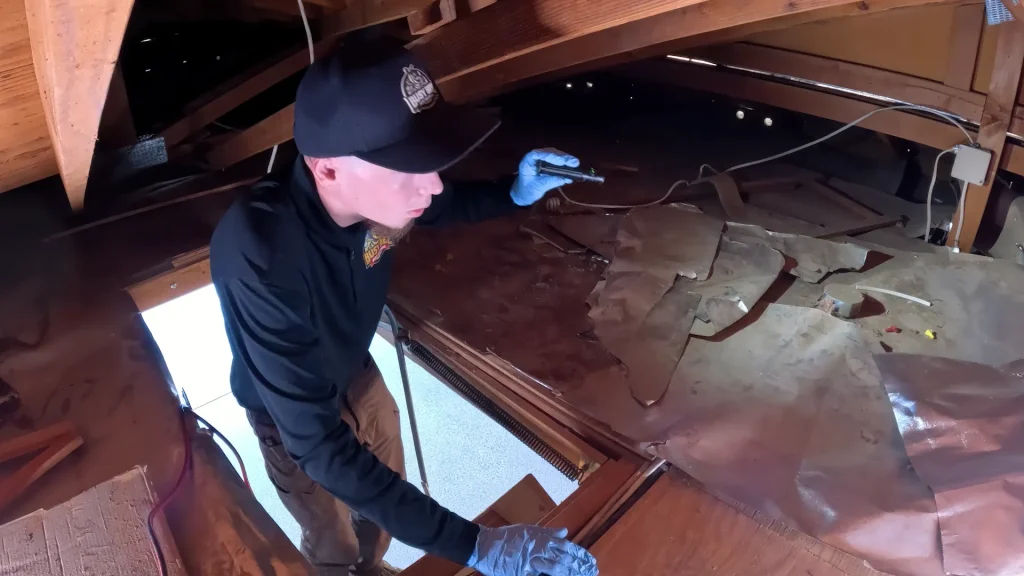
- Check the attic before opening drywall. A carcass on top of the insulation is common and requires no repair to reach.
- Note staining. In warm conditions decomposition fluid can leave a yellowish-brown stain on drywall or ceiling.
What actually helps while you wait
- Ventilate. Air movement is the single most effective thing available: fans, open windows in cooler hours, and running the HVAC fan to keep air circulating.
- Odour absorbers. Activated charcoal and zeolite-based products near the source genuinely help. Bowls of vinegar or coffee grounds do very little.
- Enzyme-based odour eliminators work on the source once it is reached, but sprayed on a wall surface they do not touch a carcass inside the cavity.
- Air fresheners mask rather than remove and often make the combined smell worse.
- Check the HVAC. If a carcass is in or near a duct, the system will distribute the odour through the house. Do not run the system if you suspect this. Call us.
Is it a health risk?
The carcass itself is a low direct risk if it is not handled, but the associated material is not. Rodent droppings, urine and nesting material can carry hantavirus, salmonella and leptospirosis, and dried droppings should never be swept or vacuumed with a household vacuum, because that aerosolises the particles. Use HEPA filtration and appropriate PPE, or have it done professionally. If droppings and nests have soiled the attic insulation, attic cleanup cuts out the soiled sections and sanitizes the attic, and TAP insulation, a borate-treated cellulose that also treats the attic for insects, can go back down once the entry points are sealed.
Blow flies and dermestid beetles arriving to the carcass are a secondary nuisance that resolves once the source is removed.
When to open the wall
Our order of operations is: locate as precisely as possible, exhaust every access route that does not require cutting, attic, crawl space, access panel, removing an outlet cover or a section of baseboard, then cut only if necessary, and cut small. A four-inch inspection hole in the right place beats a two-foot hole in the wrong one.
If the animal died as a result of a rodent problem you still have, removal is only half the job. The entry points need sealing or you will repeat this. See rodent exclusion in Phoenix. If the smell is coming from the ceiling or the attic, the rat is most often a roof rat; see roof rat removal in Phoenix.
Frequently Asked Questions
How long does a dead rat smell in a wall in Phoenix?
Typically three to six weeks, with peak intensity in the first one to two weeks. Arizona heat accelerates decomposition, which shortens the overall timeline but makes the early period considerably worse. Cooler months are less intense but last longer.
How do I find a dead rat in my wall?
Follow the odour gradient slowly along the wall at several heights, and look for a small cluster of blow flies at a baseboard, outlet or ceiling seam. That is the most precise indicator available. Check the attic before cutting any drywall, since carcasses on top of insulation are common.
Will a dead rat smell eventually go away on its own?
Yes, it will dissipate as the remains dry out, but you are looking at several weeks and the residue and staining can persist. Removal is faster and eliminates the flies and beetles the carcass attracts.
Is a dead rat in the wall dangerous?
The carcass itself poses limited risk if undisturbed. The associated droppings and nesting material are the real concern. They can carry hantavirus, salmonella and leptospirosis, and should never be dry-swept or vacuumed with a household vacuum. HEPA equipment and PPE are appropriate.
Can you find and remove a dead rat without cutting my drywall?
Often, yes. We check the attic, accessible cavities and access panels first, and cut only when there is no alternative, and then a small inspection opening in a located spot rather than exploratory demolition.
More answers about dead rats, droppings and attic cleanup are in our Phoenix rodent control FAQ.