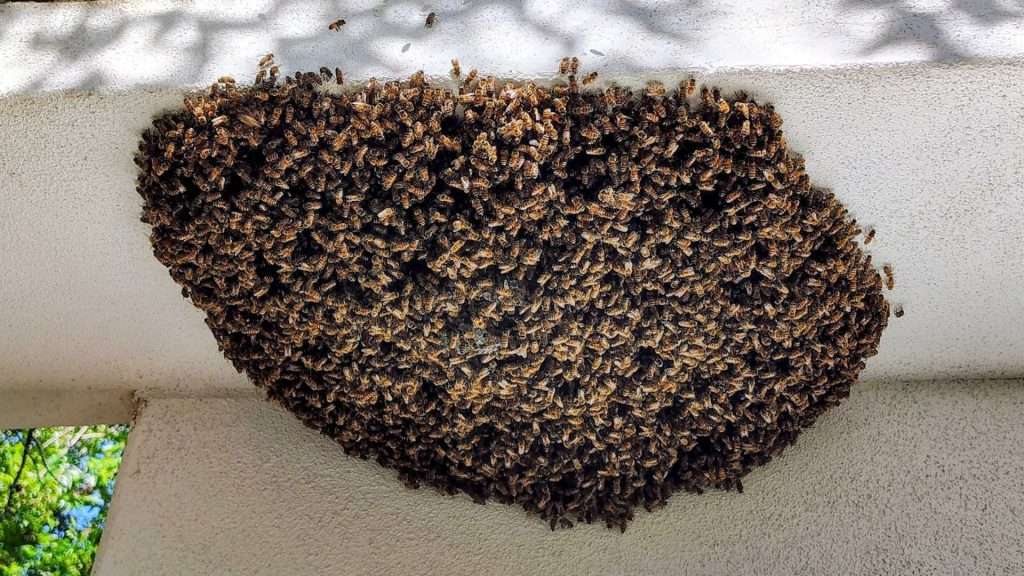
A rooftop solar array sits a few inches above the roof surface, which creates a shaded, sheltered, rain-protected void running the length of the roofline. That is a good cavity by any bee’s standards. Colonies establish under arrays in Phoenix, and because the void is rarely inspected between installation and a fault, they are often well developed by the time anyone notices.
We wrote recently about roof rats using the same void. Bees use it for the same reasons and cause a different set of problems.
Why the void works for a colony
Honey bees look for shelter from weather, stable temperature, and an entrance they can defend. A solar array gives them the first two straight away. The third comes from the way the void is broken up. The run under an array is continuous along the roofline, but tile profile, racking feet, flashing and mounting hardware pinch it into a series of smaller pockets, and a colony settles into one of those pockets rather than occupying the whole length. The space is long, and the part the bees actually hold is small and easy to guard.
The thermal argument is the strongest one. Panel surfaces get extremely hot, but the shaded deck underneath stays cooler than the exposed tile beside it through the worst of a Phoenix afternoon. For a colony managing brood temperature, shade with airflow is worth a great deal.
It is the same reasoning that drives the other cavities they choose, which is why bees nest in walls, roofs and valve boxes rather than out in the open.
There is a second presentation under an array that the cavity description misses, and it is common enough to expect. Where the shade is deep and the site is undisturbed, bees build open comb directly onto the racking rails or onto the underside of the panels, with no cavity involved at all. It hangs in the gap in flat parallel sheets, it can often be seen from the ground once you know what you are looking at, and it is not a hidden cavity job. It is still a colony, the comb still has to come out, and it is more exposed to handling than one tucked into a pocket.
Bees or wasps up there
Worth settling before anyone is called out, because the two jobs are not comparable. Settle it from the ground, with binoculars if you have them, rather than by going up for a closer look.
| What you can see from the ground | Likely |
|---|---|
| Steady two-way stream in and out of one point on a straight flight line | Honey bees |
| Insects returning with coloured lumps on the back legs | Honey bees, carrying pollen |
| Amber to brown, banded, slightly fuzzy, stout body | Honey bees |
| Slim waisted, smooth and hard looking, back legs hanging down in flight | Paper wasps |
| Slower, more deliberate flight with a lot of hovering | Paper wasps |
| Pale wax comb in flat parallel sheets, or wax visible at the edge | Honey bees |
| A small open umbrella of grey papery cells on a short stalk | Paper wasps |
| Dark staining or dripping below the array in hot weather | Established honey bee colony with comb |
That last row is the one that decides urgency. Staining or dripping means comb and stores, which means the colony has been there long enough to build, and that is a removal with a cleanup attached.
Why this is worse than a colony in a tree
Three reasons specific to an array.
You cannot see it. A colony in a wall usually announces itself with traffic at eye level. A colony under panels is above the roofline, visible only as bees crossing the sky, and often gets attributed to a neighbour’s tree.
Comb and heat are a bad combination. Comb built under an array sits in a hot void. In Phoenix summer conditions, wax softens and stores can fail, and what comes out of a failing colony runs across the roof deck and into whatever is below it.
Access is constrained. Working under a panel is not the same as working on an open roof. There is limited clearance, live electrical equipment nearby, and racking in the way.
Those three together are why this is not a homeowner job. A live colony, a hot roof and an energised array is not a combination to investigate personally, and there is nothing useful to be gained on the roof anyway. Everything a crew needs from you before they arrive can be seen from the ground, which is what the checklist further down sets out.
Assume the colony is Africanized
In Maricopa County a feral colony should be assumed Africanized unless a lab says otherwise. Day to day that makes little difference to what you see, because the bees forage and come and go much like any other honey bees. The difference is in how strongly and how quickly the colony responds once it is disturbed, and the disturbances that matter under an array are exactly the ones the work involves: vibration carried through the deck, power tools, a ladder against the fascia, and anyone within a few feet of the entrance.
Anyone in the household with a known sting allergy should stay away from that part of the property entirely while the colony is active. Multiple stings, or any difficulty breathing, swelling spreading beyond the sting site, or faintness, is a 911 call rather than something to sit out.
The part homeowners ask about first: do the panels come off
What decides it is where the comb actually sits, and whether the comb can be reached and cleaned properly with the array intact. A colony near the array edge, or open comb hanging off a perimeter rail, can often be worked without touching a panel. Comb built well in under the middle of an array, or into a pocket behind racking hardware, generally cannot, because reaching it and then cleaning the deck behind it needs the panel out of the way.
Where a panel does have to come off, detaching and reinstalling it is your solar installer’s work rather than ours, and the job becomes a coordination between you, your installer and us. None of that can be settled before someone has looked, so treat any answer given over the phone as provisional. Our part is the colony, and it is the same Phoenix bee removal work as anywhere else on the house: the bees out, the comb out, the deck cleaned, the entry point closed.
What we will not do is treat a colony and leave the comb in place under panels. In that void, in that heat, leaving comb is the decision that produces the stain on the ceiling three weeks later.
Do not seal it
The instinct is to close the gap. It is the wrong move in the same way it is with a colony in a wall.
Sealing a live colony under an array traps the bees inside a hot void with comb. They look for another way out, and the routes available on a roof lead toward vent stacks, tile edges, soffit returns and, eventually, the attic. Remove first, then exclude.
The same logic applies to the rodent guard or mesh skirt fitted around array perimeters. As a physical barrier it does its job, and it belongs on the roof, but only once the void underneath is confirmed empty. Fitting it around an occupied array is sealing with extra steps.
What to look for from the ground
- Bees crossing consistently in one direction at roof height, in a straight line rather than wandering.
- Activity concentrated at one point along the array edge rather than spread along it.
- Traffic that is heaviest in the first and last hours of daylight.
- Any staining, discolouration or drip marks on tile, fascia or wall below the array.
- Increased bee interest around a pool, hose bib or drip line on the same property, which often accompanies an established colony nearby.
Frequently asked questions
Will bees damage solar panels?
Not the panels themselves. The damage is from comb and stores in the void, and from what happens when those fail in summer heat. Roof rats under an array are the ones that chew wiring.
Can I just wait until winter?
The reason not to wait is that the colony keeps growing. A honey bee colony is not seasonal the way a wasp nest is: it persists through the year, adds comb and stores, and a larger colony defends itself more readily than a small one, so the job gets bigger and touchier the longer it sits. Africanized colonies do abscond more readily than European ones, so a colony can leave of its own accord, but that is not something to plan around, and an absconded colony leaves the comb behind for you to deal with anyway.
Does removal void my solar warranty?
There is rarely only one warranty in play. A typical rooftop system carries a manufacturer product warranty on the panels, a separate performance or output warranty, an inverter warranty, the installer’s own workmanship warranty, and often a roofing or roof penetration warranty covering the mounts. Detaching or reinstalling panels by anyone the terms do not authorise can affect more than one of those at once, and the roof penetration cover is the one people forget about. Ask your installer what their workmanship terms allow and who they consider authorised to handle the equipment, check the panel and inverter warranty documents for the same, and ask whoever holds the roofing warranty before anything is unbolted.
Can the colony be relocated alive?
For an established colony under an array in Phoenix, realistically no, and it is better to say so at the outset. Live relocation suits a swarm, which is a cluster of bees with no comb and no brood yet and can be collected and rehoused. An established colony here is presumed Africanized, so rehoming it means finding a beekeeper willing to take it and requeen it with a European queen, and few will. It also means cutting comb out of a confined space under panels in a condition worth moving, which the access rarely allows.
How do I stop it happening again?
Close the entry point after removal, and guard the array perimeter once the void is confirmed empty. The rest of the roofline matters too, because a house that offered one cavity usually offers several.
The short version
The gap under a solar array is a sheltered cavity that hardly ever gets inspected, and bees find it. Watch for a straight-line flight path at roof height and any staining below the panels. Get the colony and the comb out before fitting any guard, and treat sealing the gap as the one thing not to do.