Why Do Bees Keep Coming Back to My House? The Structural Hive Guide
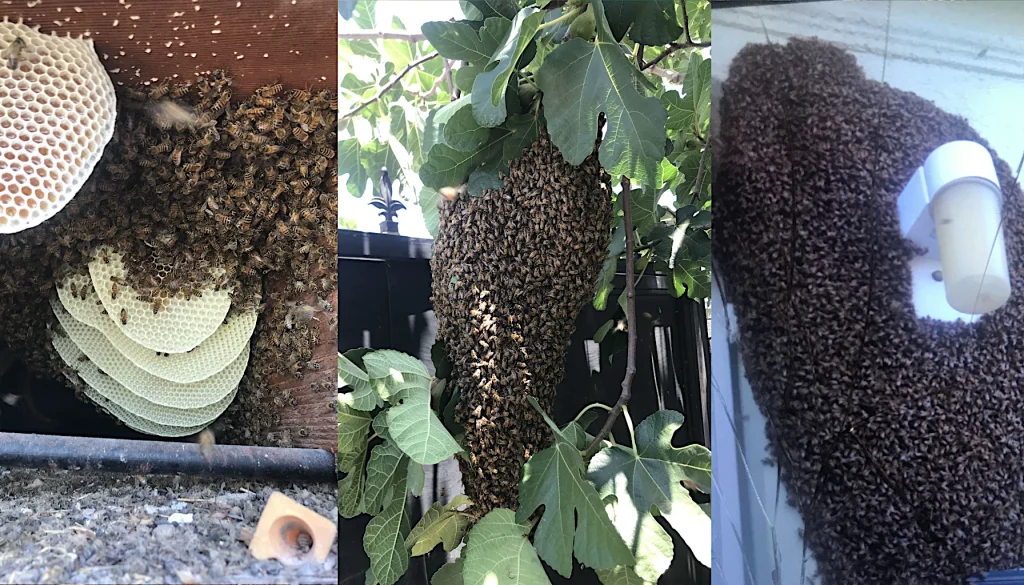
If you’ve ever watched bees stream in and out of a tiny crack in your stucco, you’ve already seen the whole story. You aren’t looking at a random infestation. You are looking at a calculated construction project.
Honey bees are cavity nesters. In the wild, they don’t just settle anywhere; they hunt for a dark, enclosed void with a single, defensible entrance. They are looking for a fortress that allows them to regulate temperature and build vertical comb.
Here is the problem: To a scout bee, your home is just a really weird forest.
A wall void, a roof eave, or a valve box often mimics the geometry of a hollow tree perfectly. Once you understand this “natural blueprint,” the locations of structural hives stop being random and start becoming predictable.
This guide breaks down the four “repeat offender” locations, trees, walls, roofs, and utility boxes. We’ll use cross-section diagrams to show you exactly what is happening inside the dark, and why standard pest control methods often fail to solve the real problem: the architecture itself.
Why Do Bees Live in Hollow Trees?

To understand why bees move into buildings, you have to look at their original landlord: the hollow tree.
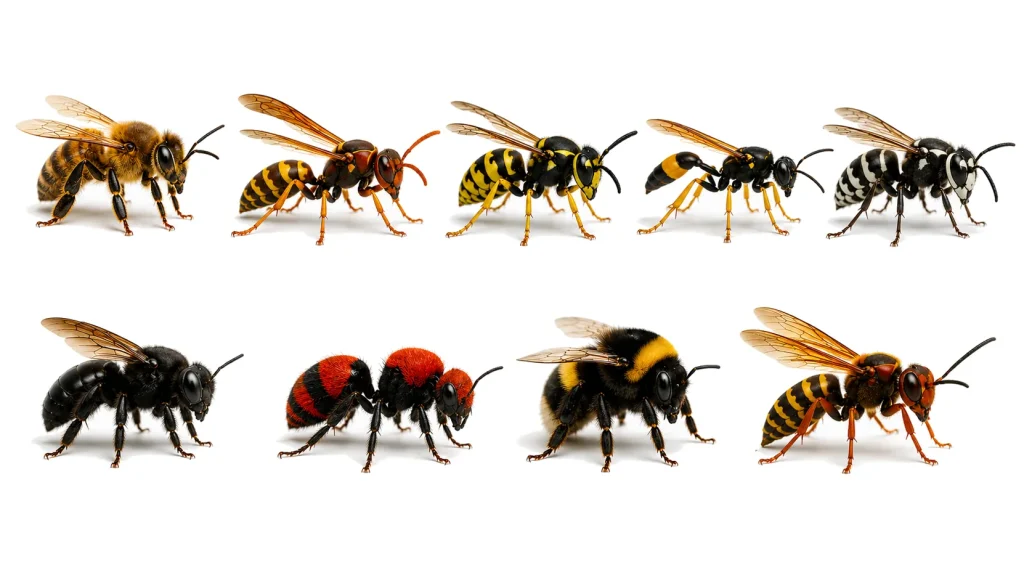
In the wild, honey bees are cavity nesters. They don’t build exposed hanging nests like wasps or hornets. Instead, they hunt for a specific volume of space, roughly 40 liters, or the size of a medium carry-on bag, that provides safety from the elements.
This natural “apartment” has three non-negotiable features, which you can see in the diagram above:
- The Protected Void: Thick wood acts as insulation, keeping the colony cool in summer and warm in winter.
- A Single Defensible Entrance: The colony prefers one small knot-hole (about 2 inches wide). This allows them to guard their resources against robbers and wasps easily.
- Vertical Attachment: The rough interior wood allows bees to anchor wax comb at the top and build vertical sheets downward, aligned with gravity.
From Swarm to Resident That ball of bees you see hanging on a branch? That is a swarm. A temporary bivouac. They are homeless travelers waiting for scout bees to find a location that matches the blueprint above.
According to extensive research on nest-site selection, scouts are incredibly picky. They measure volume, entrance size, and height. Once they find a hollow that fits the “Tree Blueprint,” the cluster relocates, moves inside, and immediately begins secreting wax to build the permanent infrastructure.
The Structural Lesson: This is the key to the whole problem. If a man-made structure provides a void, a small entrance, and vertical space, the bees don’t know it’s a house. To them, it’s just a tree with vinyl siding.
How Do Bees Build Hives Between Wall Studs?

Once you understand the hollow tree, a wall hive stops being mysterious. It’s just a geometry problem.
Modern construction accidentally creates the perfect “synthetic tree.” A standard framed wall consists of vertical studs spaced 16 inches apart. To a scout bee, the empty space between those studs, the stud bay, is functionally identical to a hollow trunk.
As shown in the diagram, the bees adapt their behavior seamlessly to the man-made environment:
- The Stud Bay: This replaces the natural hollow. It is enclosed on all sides, protecting the colony from wind and light.
- Framing Anchors: Bees attach their wax comb directly to the wood framing or the back of the drywall, hanging vertical sheets just like they would from a tree limb.
- The “Insulation” Bonus: Fiberglass or foam insulation unintentionally helps the bees. It buffers temperature swings, making it easier for them to keep the brood nest at a steady 95°F.
The “Tip of the Iceberg” Effect This is why wall hives are so often underestimated. From the outside, all you see is a small crack in the siding or a gap near a pipe. The “entry point” in the diagram.
But inside? The colony can occupy the entire height of the wall.
According to University of Georgia extension research, once a swarm moves into a void like this, they transition rapidly from “squatters” to permanent residents. They can build pounds of comb in just a few days.
The Takeaway: You cannot “plug” this problem. If you seal the entrance without removing the hive, you are trapping 10+ pounds of honey, wax, and brood inside your wall. That biological mass will eventually melt, rot, and attract other pests. You have to open the “tree” to remove the nest.
Why Are Bees Entering My Roof Eaves?

If walls are the “standard apartment,” roof structures are the luxury penthouse. They offer elevation, massive volume, and, most importantly, warmth.
Roof voids are arguably the most effective substitute for a natural tree cavity. As you can see in the diagram, the rafters and roof decking provide a sturdy, rough surface for bees to attach their comb, much like the upper interior of a hollow limb.
Why Roofs Accelerate Growth Bees are cold-blooded animals that rely on colony heat to raise their young. Roofs trap heat.
- The “Incubator” Effect: In the spring, the natural warmth of the roof allows the colony to ramp up brood production earlier than they could in a cold, shaded area.
- Unlimited Space: Unlike a wall cavity, which is limited by studs every 16 inches, a roof void often allows the colony to expand horizontally along the eaves.
- The Entry: Bees typically enter through small gaps where the roofline meets the fascia, or under lifted tiles. These entries are high up and easy to defend.
The “Invisible” Hive Roof hives are notorious for growing to massive sizes before they are detected.
Because the activity is high above eye level, you might not notice the flight path. Meanwhile, the colony is building sheet after sheet of vertical comb inside the dark void.
Research into honey bee nest-site selection confirms that bees prioritize cavities that support long-term expansion. A roof offers exactly that. Often, a homeowner only realizes there is a problem when the weight of the honey causes the ceiling to sag, or when melting wax starts dripping through a light fixture.
Can Bees Live Underground in Valve Boxes?

This is the location that catches most homeowners off guard. You walk out to check your water lines, lift the green plastic lid, and suddenly you are face-to-face with thousands of bees.
To a human, an irrigation box is a utility access point. To a scout bee, it is a pre-fabricated, rigid bunker.
As shown in the diagram, these boxes check every box on the “Tree Blueprint” list, despite being buried in the ground:
- The Lid = The Roof: Bees don’t build up from the dirt; they attach their comb to the underside of the lid and build down. The lid functions exactly like a tree branch or a roof rafter.
- Thermal Stability: Because the box is surrounded by soil, it is insulated from the extreme heat of the sun. The microclimate inside is stable and cool. Perfect for raising brood.
- The “Front Door”: There is almost always a gap where the supply pipe enters the box, or where the lid doesn’t sit flush. That tiny opening is the only entrance they need.
Why These Are Dangerous Valve box hives are unique because they are ground-adjacent.
In a wall or tree, you can walk past the hive without disturbing it. But with a valve box, every footstep sends vibrations through the soil and directly into the comb.
Research on bee behavior in human infrastructure notes that ground-level utility enclosures are common long-term nesting sites because they are rarely disturbed. This allows the colony to grow peacefully until someone hits it with a lawnmower or kicks the lid.
The Structural Takeaway Whether the cavity is made of wood, drywall, or plastic, the biology is the same. The bees haven’t changed their behavior; they have just found a modern container that fits their ancient requirements perfectly.
Valve boxes are not the only outdoor cavity that attracts them. Pool pump housings, filter enclosures and garden sheds offer the same dry, sheltered void. See bees in pool equipment, sheds and irrigation boxes for what to check around the yard.
The Verdict: It’s All the Same Hive
When you step back and look at all four diagrams, the tree, the wall, the roof, and the box, the pattern is impossible to ignore.
The bees aren’t trying to invade your home. They are just following a millions-year-old blueprint.
- The Blueprint: A protected void + a defensible entrance + a ceiling for comb.
- The Reality: Whether the walls are made of oak bark, drywall, plywood, or green plastic, the hive is exactly the same.
This biological equivalence is why “surface fixes” fail. You cannot solve a structural problem just by spraying the entrance or plugging the hole. If you seal the entry without removing the internal structure (the comb, honey, and brood), you haven’t solved the problem. You’ve just trapped a biological time bomb inside your walls.
Need Advice? We’re Here.
Understanding the science is the first step; safely removing the colony is the second.
At Busy Bee Pest Solutions in Phoenix, we approach every removal with this structural mindset. We don’t just look at the bugs; we look at the building.
If you aren’t sure what you are looking at, or if you just need a professional opinion on a weird buzzing sound in your wall, reach out to us. Whether you need a full extraction or just some honest advice on what to do next, we are happy to help you make the right call for your home and the bees.