

Most people in Peoria who get stung at home were not attacked. They opened something.
University of Kentucky Extension puts it plainly: paper wasps “are not very aggressive, but stings can occur when householders inadvertently disturb nests that are hidden.” The nest was there for weeks. Nobody noticed it, because it was in a place nobody looks, and then somebody opened the patio umbrella.
So this is not a scare piece. It is a walk around your own house, in the order you would actually walk it, pointing at the four places we find nests on Peoria homes over and over. Three you can check yourself in ten minutes. One you should not touch.
If you already know there is a nest and want it gone today, skip the reading and call 623-289-3375. We run same day across Peoria.
The short version
| Where | What builds there | How to check it | Handle it yourself? |
|---|---|---|---|
| Under the first course of roof tile | Paper wasps, and honey bee colonies in the roof void behind it | Stand back thirty feet and watch the eave line for steady traffic in and out of one spot | No. Roof height, and a honey bee colony behind the tile is a structural job |
| Rooftop or ground AC unit | Paper wasps in the service compartment, behind the fan grille, in the burner section | Listen at the unit before you pull a panel. Do not open a panel you are not sure about | No |
| Patio umbrella, furniture undersides, grill | Paper wasps under the canopy and in the grill cabinet. Spiders and mud daubers in the grill burner tubes | Open the umbrella slowly and from arm’s length. Look up under chair and table rims | Sometimes, if the nest is small and you can reach it from the ground |
| Hummingbird feeder | Paper wasps and honey bees feeding, not nesting | Look at the ports and the outside of the reservoir for spilled syrup | Yes. This one is a maintenance problem, not a removal problem |
Start at the driveway
Before you touch anything, stand back and watch.
A nest gives itself away by traffic, not by appearance. From thirty feet you cannot see a paper wasp nest tucked under a tile, but you can absolutely see insects going in and out of the same point on your house along the same line, over and over. Give it two full minutes. Steady two way traffic at a single spot means something is living there.
This is also the moment to sort out what you are looking at, because the answer changes what happens next. Honey bees flying a tight line into a gap in the roofline or a block wall void mean a colony inside the structure, which is a different job from a wasp nest under a chair. Our Peoria bee removal page covers that side of it.
One thing to know before you go further. University of Arizona guidance is that “all wild honey bees in Arizona are ‘Africanized’ to some extent.” That does not mean every colony is dangerous. It means the margin for casual experimentation is smaller here than in most of the country.
The roofline, and the gap under your first course of tile
If your Peoria house has a concrete tile roof, there is a row of openings along the bottom edge of it, and there may or may not be anything closing them off.
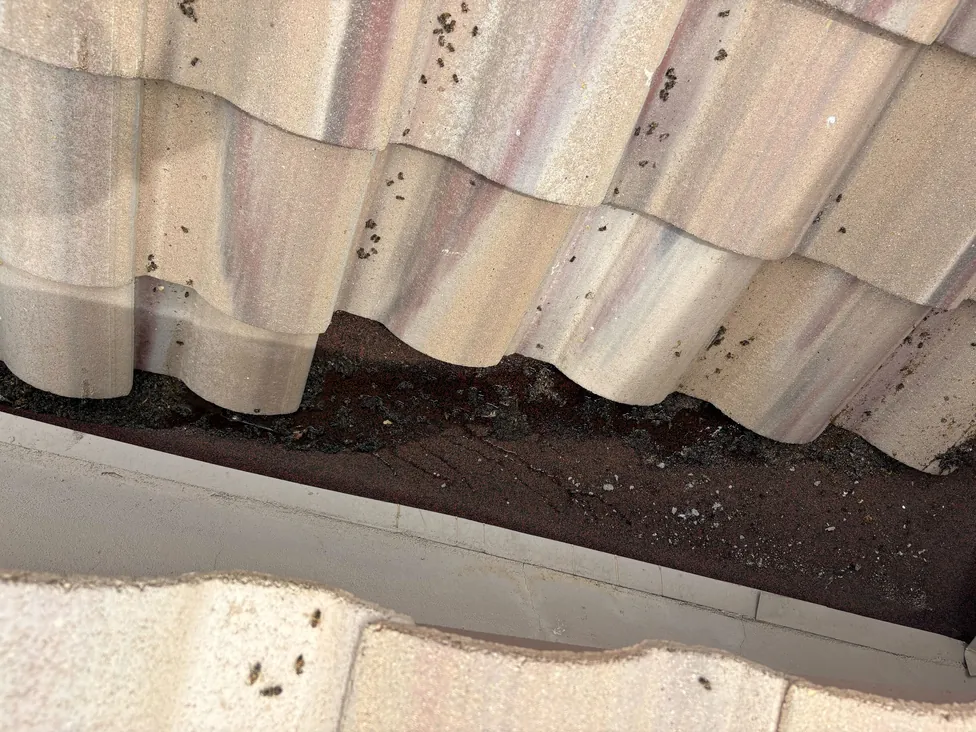
That closure is called a bird stop, also sold as an eave closure or eave riser. Eagle Roofing Products, which manufactures tile in Phoenix, describes it as “a code approved 26 gauge Galvanized or Aluminum metal” component that “prevents intrusion under the tile by birds or other wildlife” and “provides proper rise for the eave course, or first row of tile.”
Here is the part most homeowners do not know. The Tile Roofing Industry Alliance installation manual, the industry standard for tile installs in moderate climates and recognized in ICC-ES and Uniform ES evaluation reports as an approved alternative to the code’s tile provisions, says: “Bird stop required on High Profile tile and optional on Low and Medium profile tile unless required by local building official.”
Read that again. On a barrel or S tile roof the manual requires it. On a flat tile roof it is optional, unless your local building official says otherwise. So if you have a flat tile roof and your first course is open, that is not necessarily a defect. It may be exactly how it was permitted.
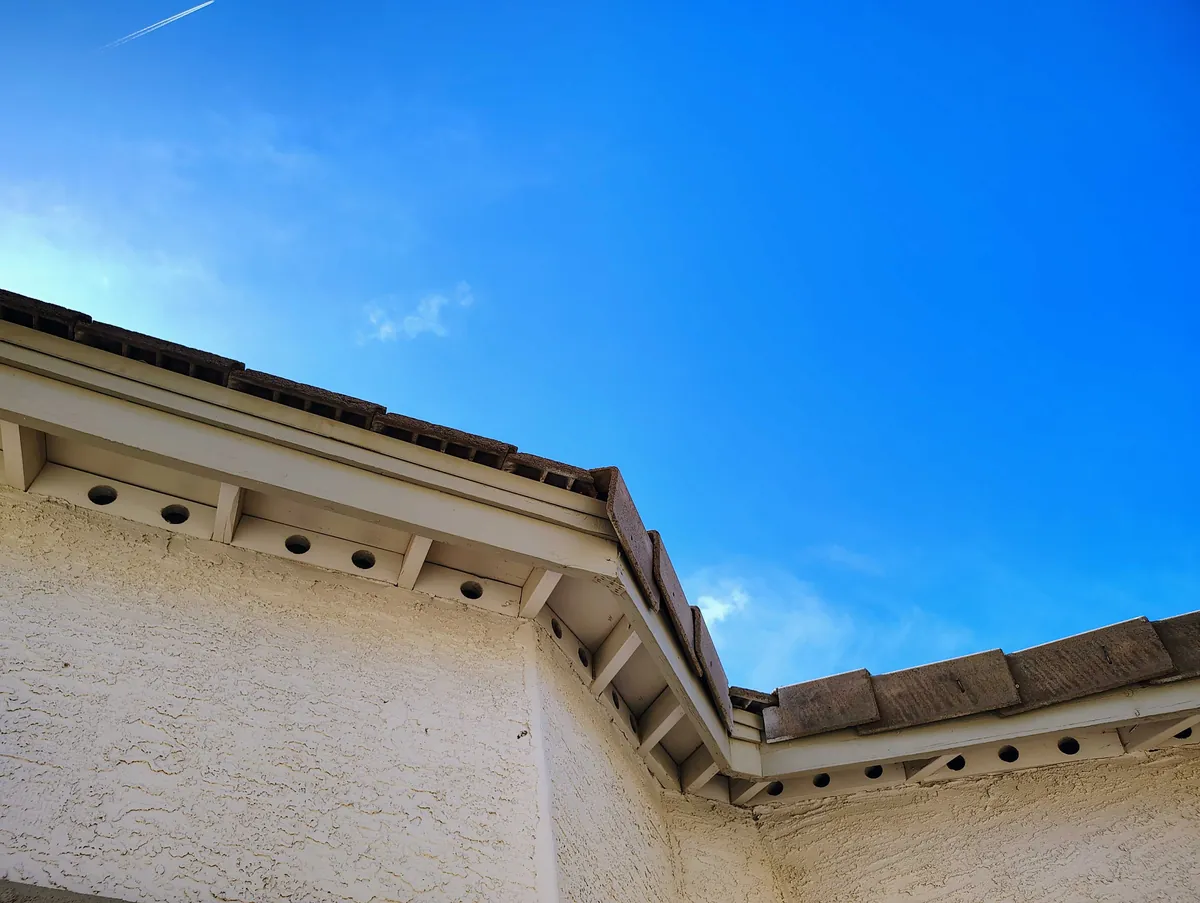
The same manual has a separate line about sealing: “Vermin Screening: Metal, honeycomb plastic, foam fillers, mortar or equivalent should be considered to seal larger openings into the roof system.” Note the wording. Should be considered. A recommendation, not a requirement.
The opening itself is not large, an inch or two of channel depending on profile, more under a high barrel tile than a flat one. That is plenty, because a paper wasp does not need a hole at all. She does not nest inside a cavity. She hangs a nest from the underside of any protected overhang, and the channel under a tile is a textbook protected overhang.
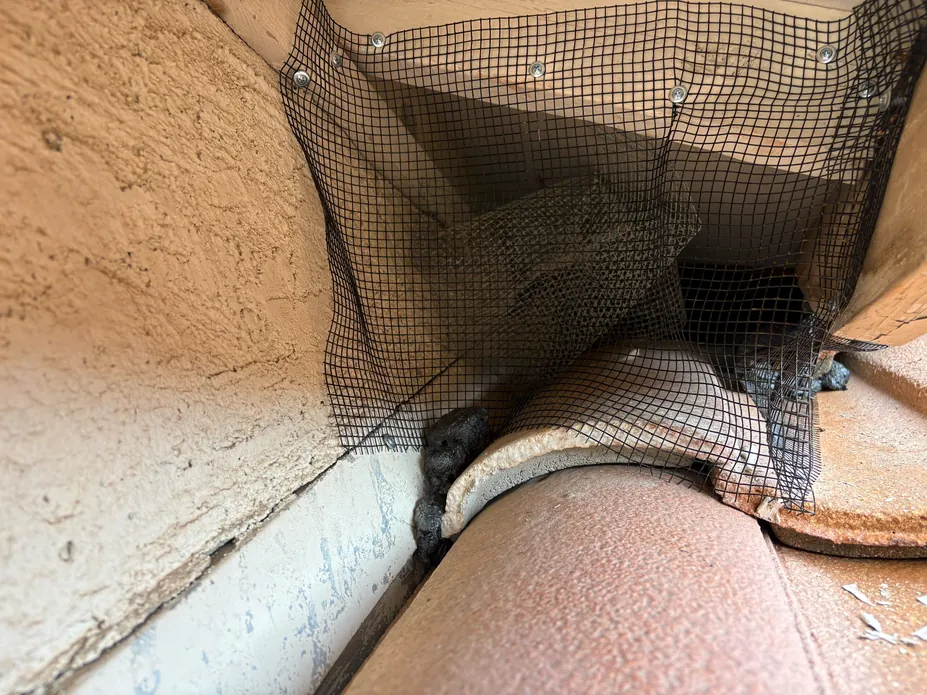
Honey bees do need a hole, but not much of one. The University of Arizona describes them building comb “in a protected area or cavity with an access hole the size of a pencil eraser or larger.” Call it a quarter inch. A tile channel is a front door.
Why this comes up so much in Peoria. North of Old Town, most of the housing is both young and tile roofed. Fletcher Heights was built between 1999 and 2002 and holds 2,098 homes. Westwing Mountain’s planned area development case dates to 1998 and Vistancia’s to 2001, with Terramar building out from the late nineties onward. In ZIP 85383, about 41 percent of homes were built between 2010 and 2019 and another 34 percent between 2000 and 2009, with under one percent predating 1970, per Census ACS five year estimates, Table B25034. People assume a newer house is a sealed house. The roof detail that matters here has nothing to do with age.
Seeing steady traffic at one point on your roofline? That is worth an inspection before it becomes a repair. Call 623-289-3375.
The rooftop AC unit
Do not open the service panel to find out.
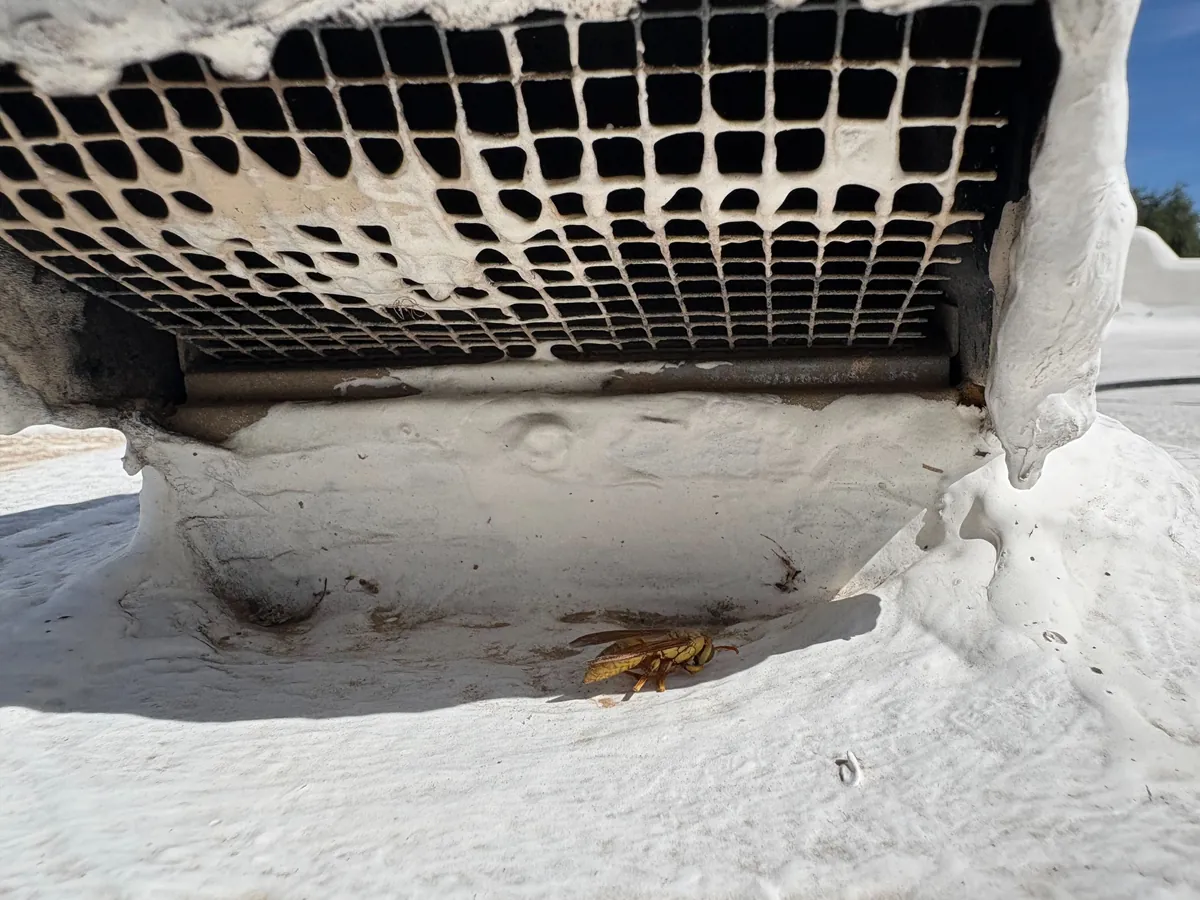
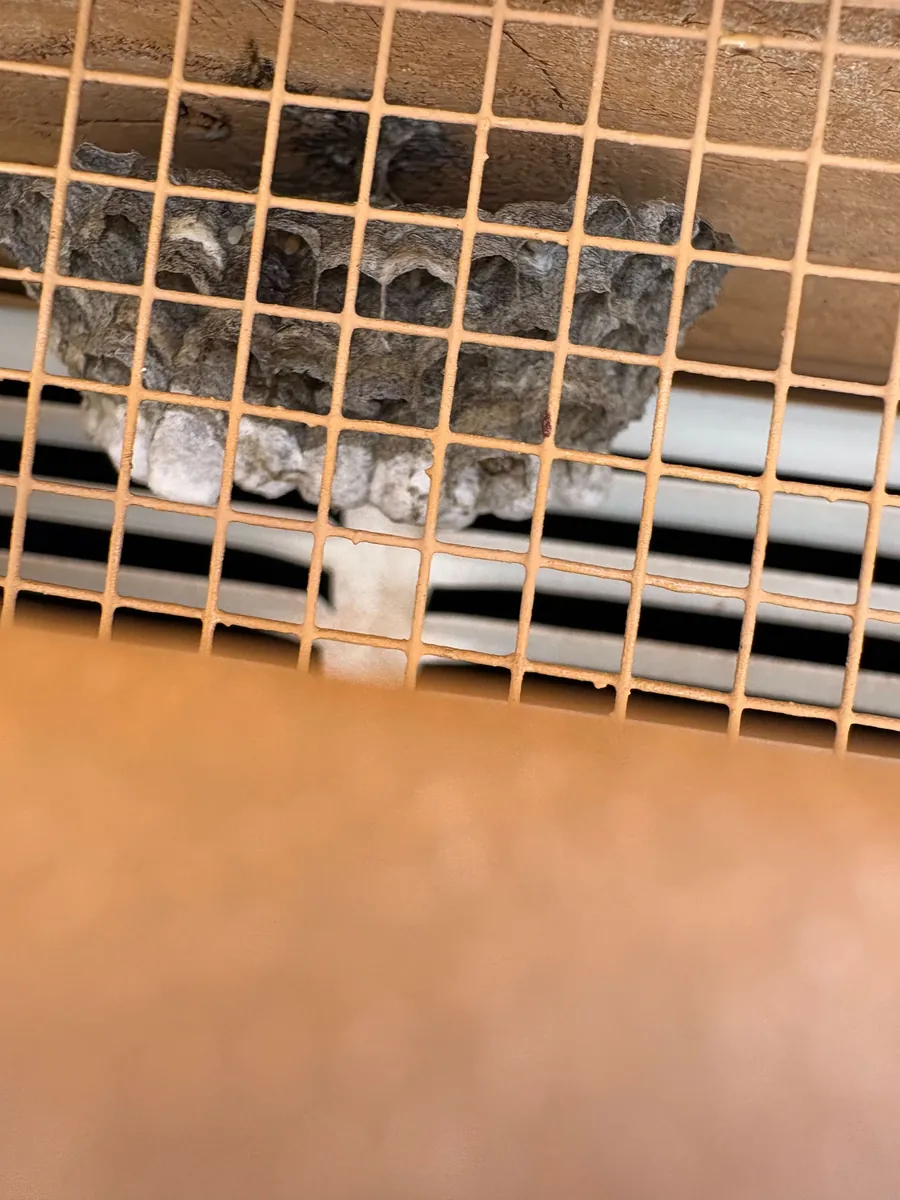
Rooftop package units turn up constantly on our Peoria calls, especially on single story slab houses with no attic mechanical closet, and the inside of one is close to ideal for a paper wasp. It is dry, shaded, sheltered from wind, and nobody opens it between service visits. We find nests in the electrical and control compartment behind the removable panel, behind the condenser fan grille, and in the burner section on gas and electric packs.
Manufacturer literature does not name wasps, but it does tell you the compartment matters. Goodman’s manual for its packaged units instructs owners to have the gas heating section checked at least once a year “to be sure that the combustion air inlet and flue outlet hoods are not blocked by debris, which would prevent adequate combustion air and a properly operating vent system.” Its separate instruction to inspect and clean the outdoor coil is flagged qualified servicer only. A nest is debris, and Goodman does not want you reaching for it either.
Two reasons this is not a DIY item.
The first is what is under your feet. In 2011 there were 113 fatal work related ladder falls in the United States and roughly 34,000 nonfatal work related ladder injuries treated in emergency departments, and the CDC notes that 43 percent of all fatal falls in the preceding decade involved a ladder. Separately, the Department of Energy’s incident review describes a worker who set a ladder against a house to install a soffit vent, struck a bush, disturbed an unseen beehive and died of an allergic reaction to the stings. He never left the ground. Add roof height to that and you have two problems at once.
The second is the pesticide. Under federal law a pesticide may only be used in a manner consistent with its labeling, and consumer wasp aerosols generally carry no directions for application inside HVAC equipment. EPA has made the parallel point about a different product class, telling applicators not to treat HVAC systems with disinfectants or sanitizers that lack specific HVAC directions on the label. Same principle: if the label does not describe the site, the label does not cover it. There is a practical concern on top of the legal one, which is that this equipment moves air into rooms where your family sleeps.
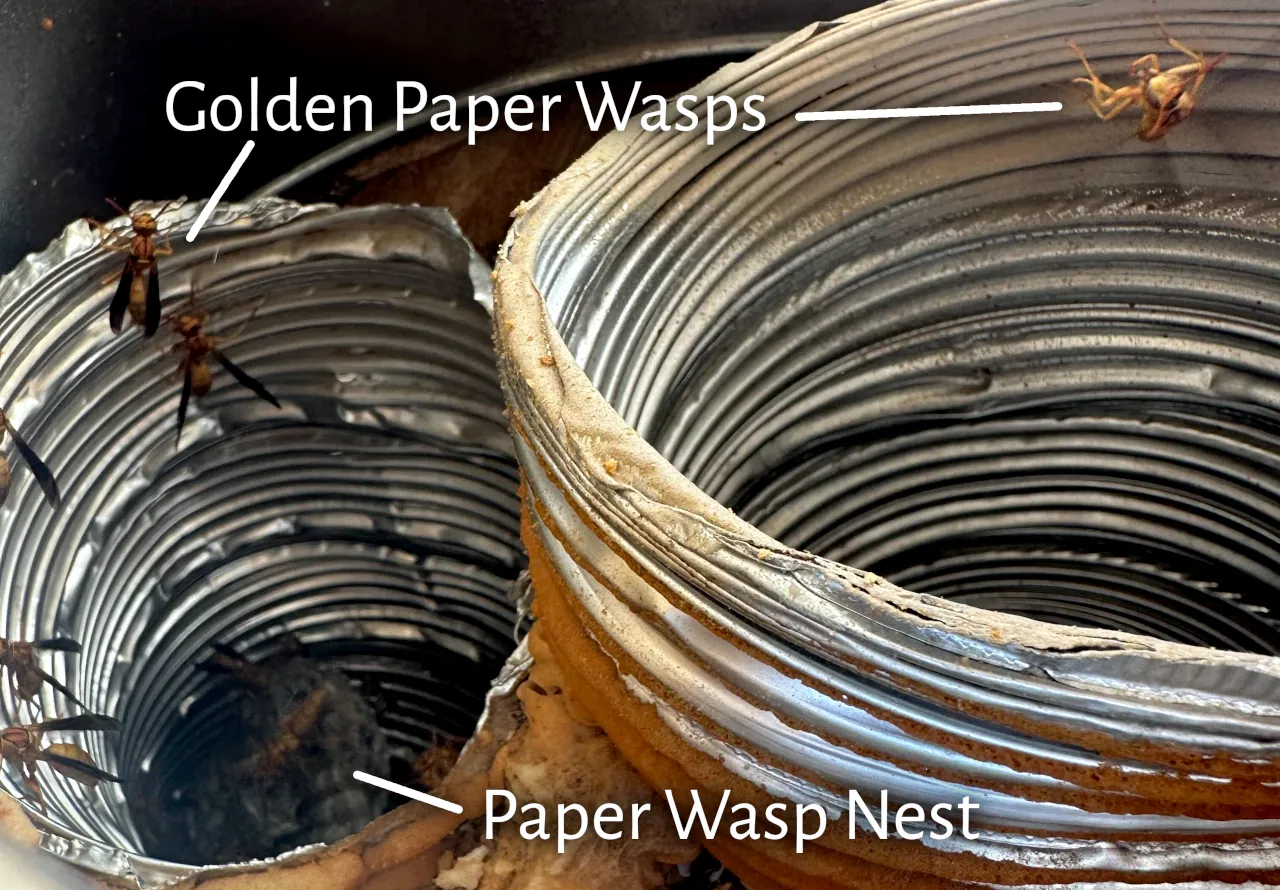
If you hear buzzing at the unit, leave the panels on and call. Our technicians carry the protective equipment for exactly this, and the risk of the sting transfers to us, which is most of what you are paying for.
The patio: umbrellas, furniture and the grill
On our calls, the patio is where homeowners are most often stung, and it is the one place on this list where you can often handle it yourself.
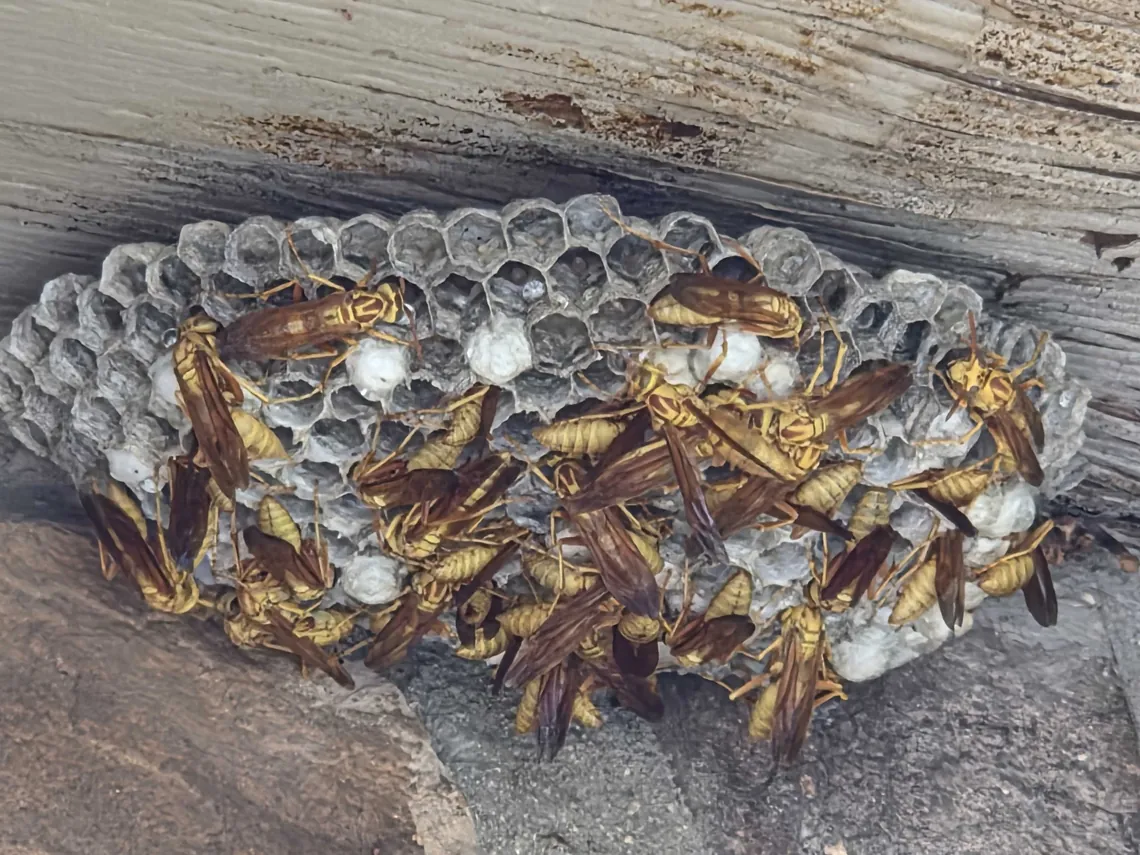
University of Kentucky Extension lists paper wasp nest sites as “under eaves, gutters and ledges, or in attics, barns or sheds,” and calls out nests “behind shutters, or inside porch lights, barbeque grills, and mailboxes.” Justin Schmidt, writing for the Arizona-Sonora Desert Museum, gives the Sonoran Desert version: a queen builds her nest “in a protected rock crevice, among thick vegetation such as dead fan palm leaves, or under the overhang of a man-made structure.”
That last phrase is the whole pattern. Anything that overhangs and is left alone qualifies. In Peoria, three qualify constantly.
The umbrella. A furled patio umbrella is a covered vertical cavity that nobody disturbs for weeks at a time. If yours has been closed since spring, open it slowly, from as far away as the crank allows, and do not put your face over it. It is the cheapest sting prevention there is.
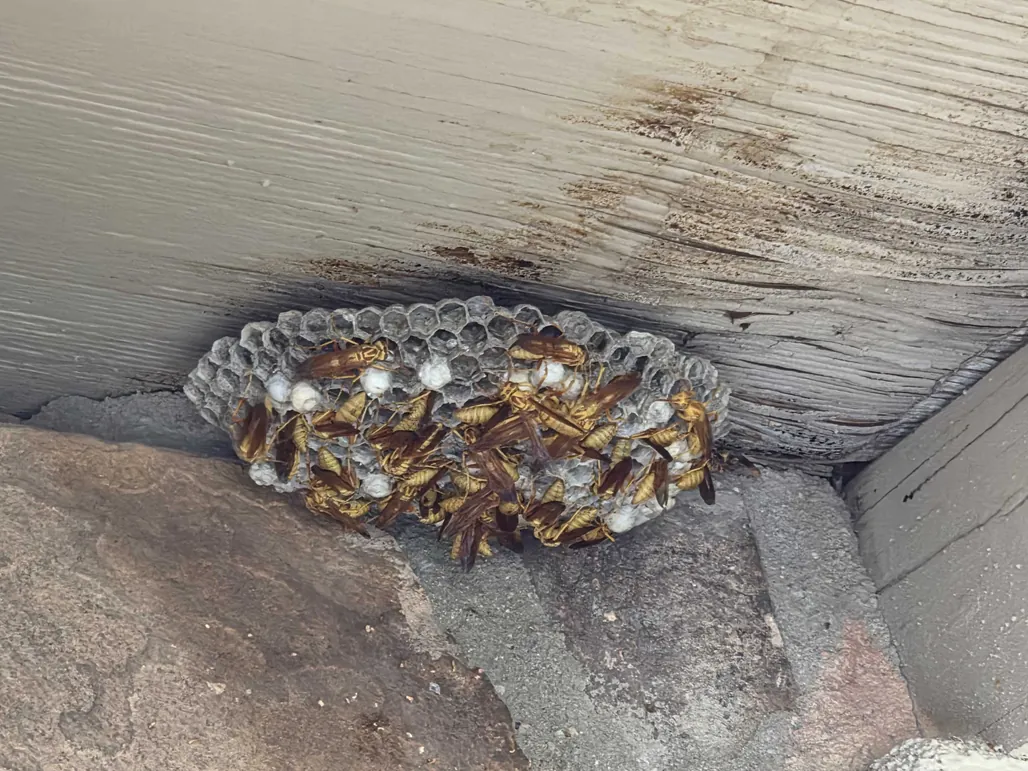
The furniture. Look up under the rim of chair seats, the underside of table edges, and inside the hollow legs of anything tubular. A founding queen’s nest in April is the size of a thumbnail and holds a handful of cells, which is far easier to deal with than what it becomes by August. The queen is on it and she will defend it, so read the section below before you reach for anything.
The grill. Two different problems live in a grill and it is worth keeping them straight. Under the lid and in the cabinet you may find a paper wasp nest, which is a sting problem. Inside the burner venturi tubes the blockage is usually a spider web, sometimes a mud dauber’s mud tube. That one is not a sting problem, because as University of Minnesota Extension puts it, mud daubers “do not defend their nests, so there is little to no risk of stings.” It is a fire problem. The Consumer Product Safety Commission has been explicit since 1989: “The venturi tube is often a nesting place for spiders and other insects when the grill is stored for the winter; if any obstruction blocks the gas flow to the main burner, a fire hazard exists.” Its 2013 gas grill fact sheet says to “check the Venturi tube for blockage by insects, spiders, or food drippings” at least once a year and clear it with a pipe cleaner or wire.
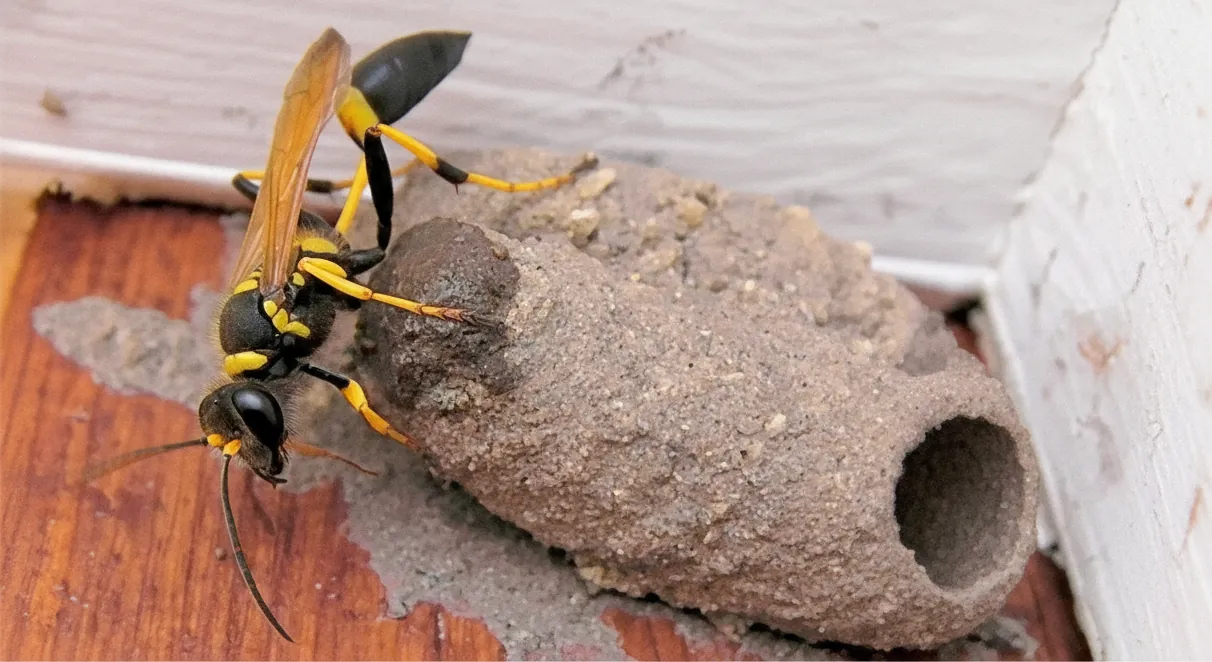
CPSC wrote that for a colder country. In Phoenix the risk window is not winter. It is the July and August stretch when the grill sits unused because nobody wants to stand over it. Check it in September before you fire it up.
The hummingbird feeder
This one is not a nest. It is a dinner invitation, and almost all of the advice online about it was written for somewhere else. The fix is not repelling anything. It is removing the spill.
Cornell Lab of Ornithology explains the mechanism in a way that matters more here than almost anywhere: “Hummingbird bottle feeders tend to leak in the sun, because air trapped in the top of the bottle expands as it warms and pushes the nectar out. This doesn’t happen in tray feeders.” In a Peoria June that thermal expansion runs at maximum all afternoon. Which is why saucer style feeders, with the ports in the top, hold up better against bees and wasps.
Bee guards help, with a caveat Audubon is honest about: “if the feeder is covered in sugar water, barring bees from the drinking hole won’t do much good.” Guards protect the port. Syrup on the outside of the reservoir is what is actually drawing the insects in most backyards, and only washing fixes that. Worth noting a small contradiction in the standard advice: Audubon also suggests avoiding feeders with yellow decor if you are still having trouble, since bees are drawn to the color, and the classic bee guard is bright yellow.
On the mix, two major authorities differ and Peoria resolves it. Audubon’s nectar guidance is a flat one part sugar to four parts water. Cornell allows up to one to three, but only for “cold, rainy spells,” and says that in hot dry weather you should go “no stronger than a quarter cup of sugar per cup of water.” Peoria is the hot dry case for most of the year, so for most of our season both land in the same place: one to four.
One thing every source agrees on, and people still do it anyway. Do not put petroleum jelly, cooking oil, or any sticky substance on the feeder, the hanger or the pole. The International Hummingbird Society, based in Sedona, is direct: “Never use insecticides, petroleum jelly, cooking oil, or sticky traps around feeders. These can harm or kill hummingbirds and other wildlife.” A hummingbird that gets oil on its feathers cannot preen or fly properly. Even the feeder manufacturers say not to.
One local note. Arizona State Parks counts “at least 17 species” of hummingbird in Arizona and says Anna’s “can be observed year-round in most of their Arizona range.” Peoria feeders stay up all year, so they are a year round attractant, not a summer one.
What the season does to all of this
The same nest is a different problem in April than it is in August, and the difference is mostly size.
Schmidt describes the Sonoran Desert cycle: the queen overwinters “deep in rock cracks, behind peeling tar paper, or inside enclosures,” builds her nest in spring under a protected overhang, and then “by late spring, the colonies have grown to contain 20 to 50 wasps; by late summer as many as 200 wasps may be present.” By late fall the colony is finished and the next generation of queens goes into hibernation.
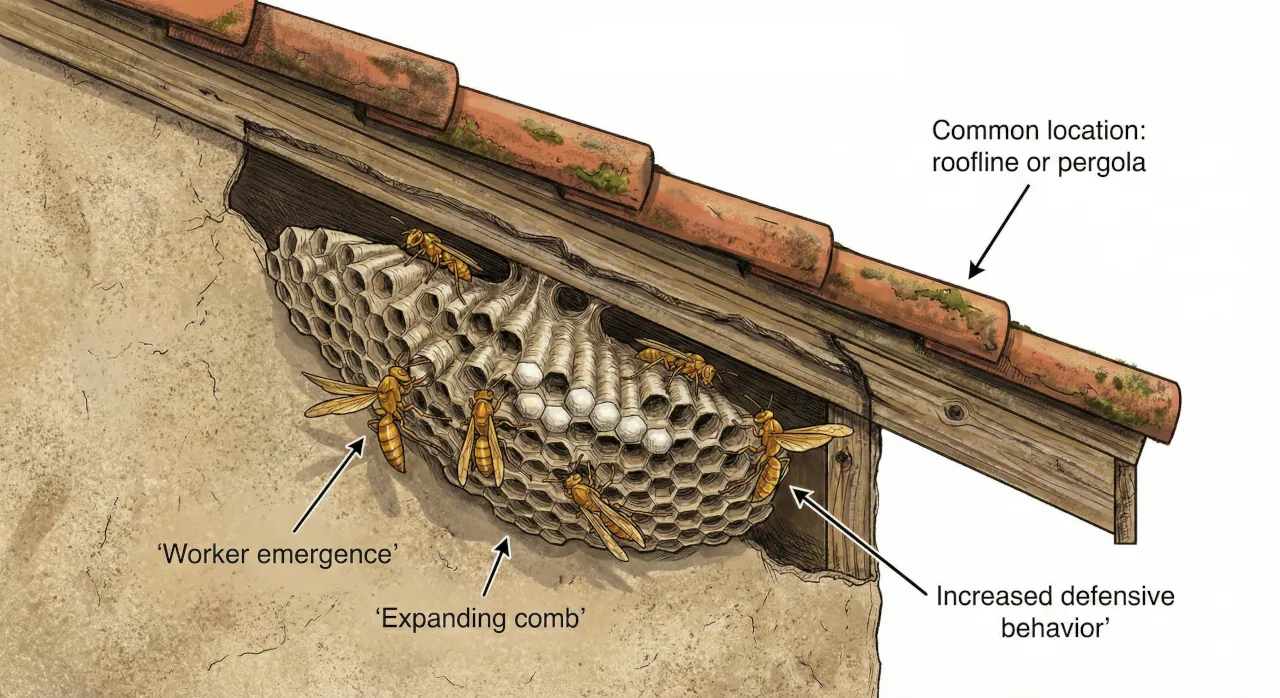
Be accurate about what actually changes, though. UC IPM describes that seasonal escalation in yellowjackets, noting that “defensive behavior increases as the season progresses and colony populations become larger while food becomes scarcer,” while calling paper wasps themselves “much less defensive” and most species “relatively unaggressive.” So for the wasp on your patio, what changes through the summer is not really temperament. It is arithmetic. A nest of 200 is a different proposition from a nest of 20 at the same disposition.
In our experience across Maricopa County the calls change character sharply from about June onward, which is also when people start using their patios again after the first stretch of real heat.
What not to do
Do not seal the entrance to an active honey bee colony. This is the most expensive mistake people make on a roofline, and the University of Arizona says it outright: “Do not attempt to seal holes or fill voids if bees are actively moving in and out of it.” Sealing a colony into a roof void does not kill it quickly. It pushes the bees to find another way out, often into the house, and it leaves comb and honey behind the tile.
Do not spray into an AC unit, for the label reasons above.
Do not treat a nest you cannot reach from the ground. University of Kentucky’s guidance is that nests are best treated at night, and that paper wasps can be handled in daylight “provided you do not stand directly under the nest during treatment.” Workable at head height with a step. Not workable at roof height on a ladder.
Do not use a garden hose on a nest. It does not remove it and it does provoke a defense.
And the honest one: if the nest is small, low, and nobody in the household has a sting allergy, you may well not need us. We would rather you handle a thumbnail nest on your own patio chair than pay for a call.
When it is worth calling
Call if the nest is above head height, if it is inside equipment, if you are seeing steady traffic at a roofline, or if anyone in the household has a known sting allergy.
On that last point, keep it simple. The American College of Allergy, Asthma and Immunology describes anaphylaxis as “a severe life-threatening allergic reaction that impairs breathing, causes a sudden drop in blood pressure and can send the body into shock,” with signs including dizziness, “a hoarse voice, coughing, swelling of the tongue or difficulty swallowing.” Their instruction: use your auto injector, “call 911 and get to the nearest emergency facility at the first sign of anaphylaxis, even if you have already administered epinephrine.” Do not wait to see how it develops.
Nest above head height, or inside your AC? That is ours, not yours. Call 623-289-3375 for same day service across Peoria.
Frequently asked questions
Is that a wasp nest under my roof tiles or is it bees?
Look at the traffic pattern. Honey bees fly a dense, steady, two way line into one opening, and there will be a lot of them. Paper wasps come and go individually and you can usually see the grey papery nest itself if you get an angle on it. If you cannot tell, that is a reasonable thing to have someone look at.
My house was built in 2005. How are wasps getting in?
They are not getting in. Paper wasps do not need to. They hang a nest under any protected overhang, and the channel under the bottom row of roof tile is one. Most new construction in Peoria is tile roofed, so the detail that matters is much the same on a 2005 house as a 1985 one.
Do wasps die off in winter here?
The colony does. The Arizona-Sonora Desert Museum’s account is that by late fall the queen mother and workers die and the nest is abandoned. But the next generation of queens overwinters nearby, often “behind peeling tar paper, or inside enclosures,” which is why the same eave gets a nest year after year.
Can I just knock the nest down?
If it is small, at or below head height, and nobody in the household has a sting allergy, often yes. Kentucky Extension’s guidance is that nests are best treated at night, when the wasps are on the nest and least active, and that if you work in daylight you should not stand directly under the nest. Wear long sleeves, know where you are stepping back to, and afterward scrape the stalk so it is not rebuilt on. Even a thumbnail sized spring nest has a queen on it who will defend it. If the nest is over your head, on a ladder, or inside equipment, do not.
There are wasps all over my hummingbird feeder. Do I need pest control?
Almost certainly not. Switch to a saucer style feeder with the ports on top, keep the mix at one part sugar to four parts water, and wash the outside of the reservoir regularly. That solves it in most yards without anyone treating anything.
Will you relocate the wasps instead of killing them?
Honey bees, yes, wherever the situation allows it. That is what live removal means and it is core to what we do. Paper wasps are a different animal and relocation is not practical for them.
How fast can you get out to Peoria?
Same day in most cases. Call 623-289-3375 and we will tell you honestly what today looks like.
Where we work in Peoria
We cover Peoria end to end, from Old Town and the Grand and Olive corridors up through Parkridge, Fletcher Heights, Terramar, Westwing Mountain, Westbrook Village, Trilogy and Vistancia, and out toward Lake Pleasant. The city covers roughly 180 square miles and stretches a long way north, and the housing at either end is genuinely different, so the walkaround above is worth doing at your own house rather than assuming your neighborhood’s reputation applies to your roof.
If you would rather someone else did the looking, that is what an inspection is for. Call 623-289-3375.
Related: Peoria pest control · Peoria bee removal · Peoria rodent control · Wasp removal


