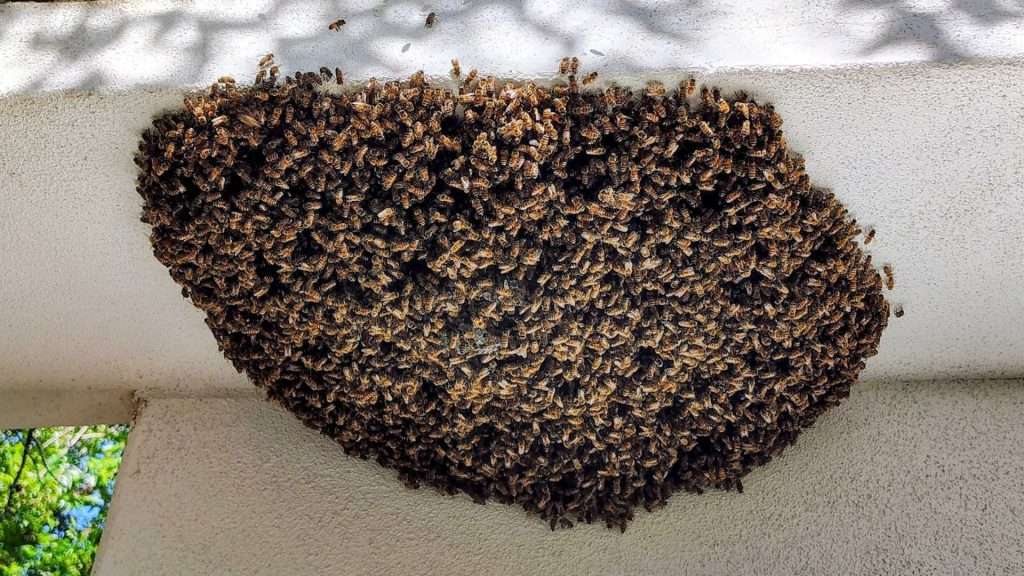
A Scottsdale homeowner’s guide to buzzing behind drywall, under tile, and inside block.
First: is it bees or wasps?
You can usually answer this from the driveway, without getting close to anything.
Stand back twenty or thirty feet, find the spot the insects are coming and going from, and watch it for a minute.
Honey bees move in a steady, businesslike stream. They fly a consistent line to and from one opening, like a tiny two way road. Up close they are generally amber to brown, banded, and slightly fuzzy. Many of the returning bees will be carrying pollen on their back legs, which reads as small coloured lumps. In a Phoenix summer the traffic is heaviest early and late, with a lull through the worst of the afternoon heat.
Wasps are glossier, more sharply yellow and black, with a pinched waist and no fuzz. Paper wasp nests are usually visible from outside, an open grey comb hanging under an eave or a patio beam. If you can see the nest, it is almost certainly not honey bees, because honey bees almost always build inside a cavity where you cannot see them.
One honest caveat before you rely on this. Some wasps, yellowjackets in particular, also nest inside wall voids, block walls and in-ground boxes, and they produce the same signature: steady traffic at one small hole with nothing visible from outside. So a visible paper nest is good evidence of wasps, but hidden traffic is not proof of bees. It just means something is nesting in a cavity and somebody should look properly.
That distinction matters more than it sounds. A wasp nest is usually a small job. A honey bee colony inside a structure is a construction problem wearing an insect costume, and the longer it stays the more of your house it involves.
Bees going in and out of your house right now? Call 623-289-3375. We can usually tell you what you are dealing with over the phone, and we offer same day service across Scottsdale.
Why Scottsdale houses in particular
Bees are not targeting Scottsdale. They are targeting cavities, and Scottsdale is built out of them.
The University of Arizona Cooperative Extension notes that the urban built environment offers colonies “many opportunities including hollow-block walls, building wall voids, attic and crawl spaces, and in-ground irrigation boxes.” Every one of those is standard construction here.
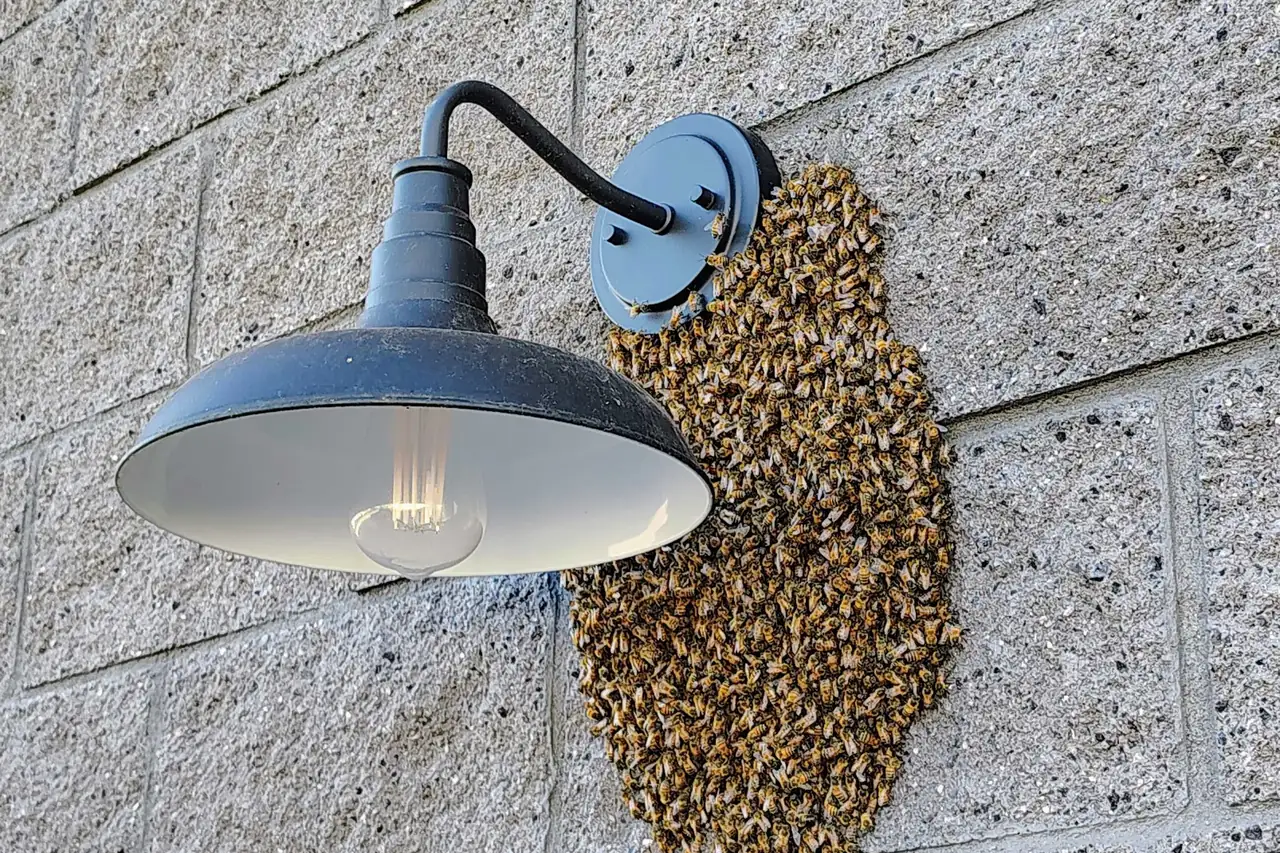
Where we find them, in our experience, roughly in order of how often:
| Entry point | What it looks like from outside | Why bees like it |
|---|---|---|
| Tile roof cavity | Bees disappearing under the curved edge of a roof tile, often at the eave line | Dark, dry, insulated, and completely enclosed once they are past the first tile |
| Stucco weep screed | A thin horizontal gap where stucco meets the foundation, or around a window | A ready made slot into the wall cavity that no one thinks of as an opening |
| Block wall void | A weep hole, a chipped cap, or the gap around a light fixture or outlet | Hollow the whole way down, shaded, and often nowhere near the house so nobody notices for months |
| Casita or guest house soffit | Traffic at a roofline on a building you do not walk past daily | Same construction as the main house, a fraction of the foot traffic |
| Irrigation or utility valve box | Bees at ground level around a green plastic lid | Underground, temperature stable, and often behind a hedge |
| Pool equipment enclosure | Traffic around the pad or an equipment screen | Shaded, sheltered, and next to water |
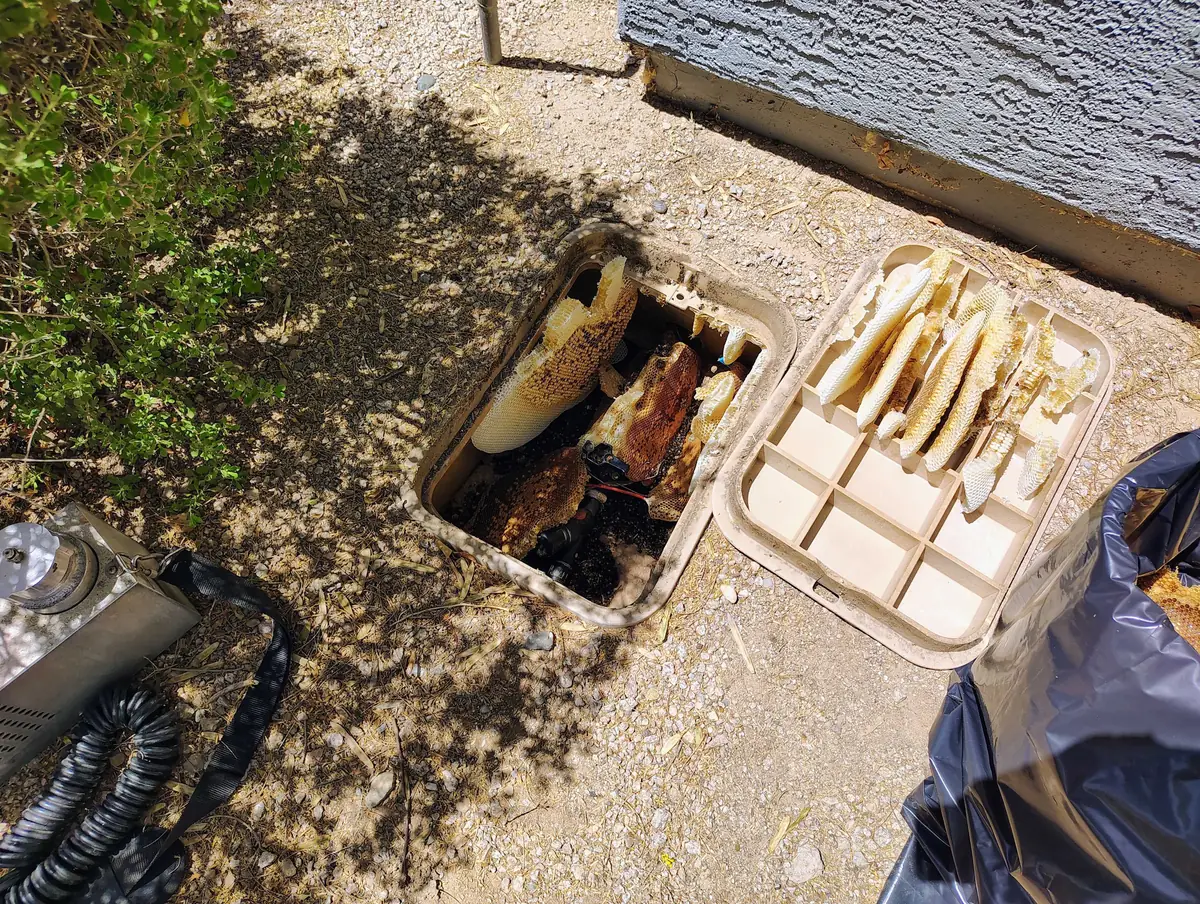
The pattern worth noticing: the least used part of your property is the most likely place to find a colony. A guest casita nobody has opened since March, the far corner of a courtyard wall, the valve box behind the oleanders. Colonies get discovered late here not because they are hidden well, but because nobody was looking.
That effect is amplified in Scottsdale by how the city actually lives. The City’s own 2025 Housing Needs Assessment counts 12,609 housing units classified as seasonal, recreational or occasional use, about nine percent of the housing stock, of which the city estimates more than 4,000 are short term rentals and the rest second homes. A swarm that moves into an empty house in April has until October before anyone hears it.
What is actually happening in there
Understanding the timeline is the difference between a straightforward job and an expensive one.
The first few days. A swarm arrives and moves in. Comb building starts almost immediately, but there is very little of it, no capped brood and no honey stores worth the name. This is the cheapest and simplest moment to deal with it, and almost nobody calls now because the bees are quiet and there is nothing to see.
The first few weeks. Comb expands quickly and the queen is laying within days of arrival, so the first new workers emerge at around three weeks. Traffic at the entrance increases noticeably. This is usually when homeowners first notice something.
Once there is brood. Defensiveness climbs as soon as the colony has young to defend, which is within the first couple of weeks rather than months in, and it keeps climbing as the colony grows. Treat any established colony as defensive regardless of how new it looks.
Months in. A mature colony holds a substantial amount of comb and honey. This is where the property damage starts, because honey seeps through drywall and stains it, and where the cost climbs, since more of the wall has to come open to get all of it out.
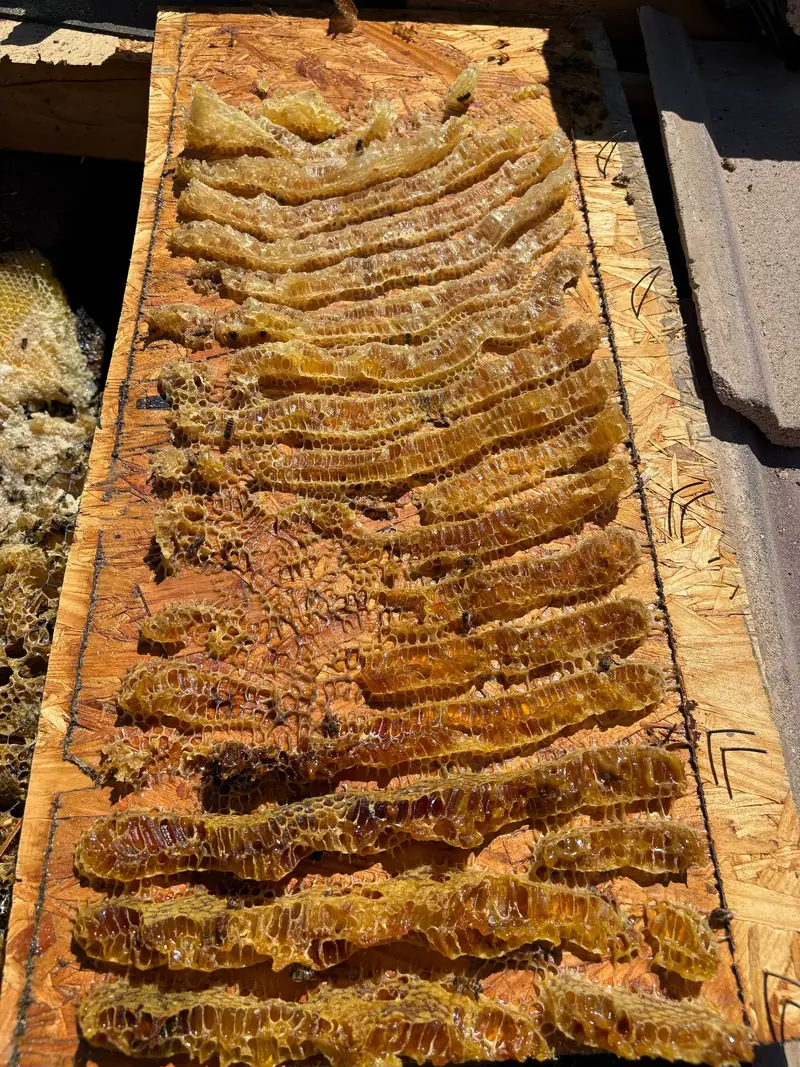
The Extension notes that in Arizona, “Swarming is common during spring and continues throughout the year while pollen and nectar sources support growing colonies.” In practice that means the Valley does not get a clean off season. Spring is peak, but colonies establish here well outside it.
What Arizona adds
There is a reason we treat a colony in a Scottsdale wall differently than a pest company in a temperate state would.
University of Arizona guidance is unambiguous: “All wild honey bees in Arizona are considered to be ‘Africanized’ to some extent and only genetic testing can reveal the specific lineages in a colony of bees.”
The Scottsdale Fire Department puts the practical consequence in plain terms on its own public safety page, noting that these bees show far greater defensiveness than European honey bees and can “pursue a perceived threat for a distance of well over 1640 feet.”
That is about 500 metres, or just under a third of a mile. It is also why a common way people get badly hurt is not by approaching a colony deliberately, but by running a leaf blower, a trimmer, a tile saw or a pressure washer near one they did not know was there. Extension guidance lists loud noises, vibrations, blowing dust and physical disturbance as triggers, along with some smells including petroleum products and pesticides, and notes that colonies tend to be more irritable on overcast days.
If you have found a colony on your property, the useful things to do are all boring: keep people and pets well back from it, keep the area quiet, do not let anyone work near it, and call someone licensed.
Why the City of Scottsdale asks you not to just kill them
This is the part most homeowners have never heard, and it comes from the city rather than from us.
The Scottsdale Fire Department states on its public safety page that the city “recommends humane removal of bees which does not result in the destruction of the swarm or hive.” It then says something notably direct about the industry:
“Be forewarned that most commercial bee removal services that you call will kill the hive. While that might solve your short-term problem, it could create a long-term problem for our ecosystem.”
The City’s environmental team reinforces it: “Do not try to remove honey bee colonies yourself. Bees should only be removed by experienced professionals.” and “Pesticide sprays are not recommended on bee swarms or colonies. Accidental or intentional misuse can lead to far more significant problems.”
We remove and relocate colonies alive wherever the situation allows it. We are not going to pretend that is purely altruism. It is also just better work, because the thing that actually solves your problem is getting the colony and the comb out of the wall, and spraying alone leaves both of those where they are.
The mistake that turns a job into a repair bill
The single most expensive thing a Scottsdale homeowner can do is seal the entrance.
It is an understandable instinct. There is a hole, bees are using it, so close the hole. Here is what actually happens.
The bees do not leave, they go inward. University of California Integrated Pest Management describes it precisely: trapped bees “will search around between the walls trying to find a new way out,” and some of them find their way into the living space instead. Sealing a colony in a wall is a reliable way to get bees in your bedroom.
The honey stays. This is the part people miss. Killing or trapping a colony does not remove anything from the cavity. The comb, the honey and the brood are all still in there, and now nothing is cooling or maintaining them. Honey ferments, seeps through drywall and stains it, and attracts secondary pests.
The next swarm gets an invitation. UC IPM again: after comb is left in a cavity, the residual beeswax odour is “noticeable from a long distance and highly attractive to any future honey bee scouts seeking new nesting sites, long after the previous bees have been removed.” Seal a wall this summer, host a new colony in the same cavity next spring.
Also worth saying plainly: do not reach for an over the counter wasp and hornet aerosol. Those products are labelled for exposed wasp nests, not for honey bee colonies inside structural voids, so using one there is inconsistent with the label. The City is blunt about it too: “Pesticide sprays are not recommended on bee swarms or colonies.”
Already sealed it, or already sprayed it? That is a very common call and it is fixable. 623-289-3375
What proper removal actually involves
A full extraction is a construction job done by people who are also beekeepers. The sequence:
Locate the colony precisely. The entrance is not the colony. Bees frequently enter at one point and build several feet away. Getting this wrong means opening the wrong part of the wall, so the location work matters more than anything else in the job.
Open the cavity. Stucco, drywall, soffit or tile, depending where it is. This is done in a controlled way, sized to the colony.
Remove the bees alive and relocate them wherever the colony and the location allow it.
Extract all of the comb. All of it, including the empty comb, because that residual wax odour is what draws the next swarm.
Clean the cavity and close it up, and seal the entry point so the same gap is not reused.
What drives the cost is not the bees, it is access and age. A colony three weeks old behind a soffit panel is straightforward. A three year old colony inside a second storey stucco wall behind a tile roof is a different job entirely. Height, what has to be opened to reach the comb, how much comb is in there, and what has to be repaired afterwards are what move the number.
This is why we quote after we have seen it rather than over the phone. Anyone giving you a firm price for a structural extraction sight unseen is guessing at the part that actually matters, which is how much of the wall has to come open.
Same day service across Scottsdale
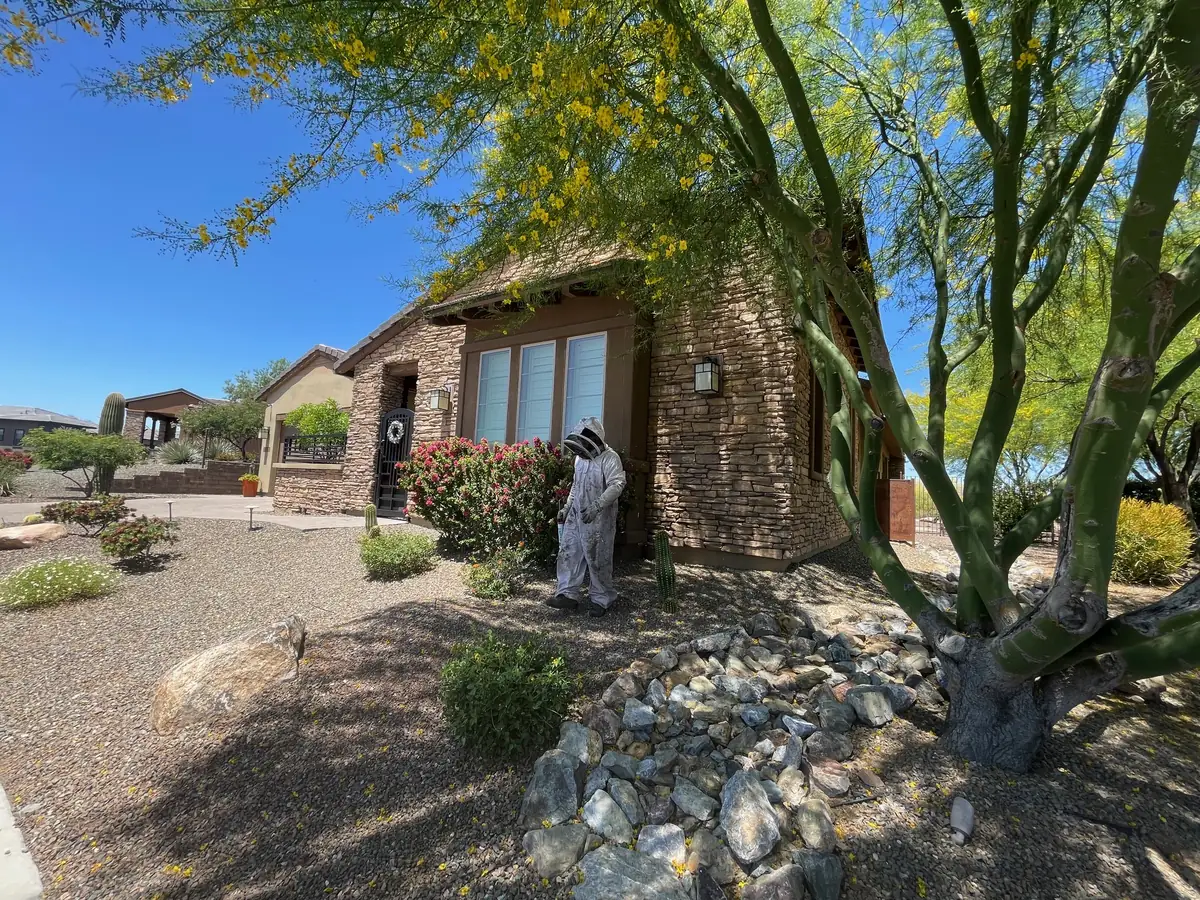
We are family owned, licensed and insured, and we have earned 1,800+ five-star Google reviews doing this work in the Valley.
We work throughout Scottsdale, including Old Town, McCormick Ranch, Gainey Ranch, Scottsdale Ranch, DC Ranch, Grayhawk, McDowell Mountain Ranch, Troon, Silverleaf, Desert Mountain and Pinnacle Peak, plus neighbouring Paradise Valley.
If you call in the morning about a colony in a wall, we can usually be out the same day. If it is near a front door, a pool a child uses, or a casita you are about to put guests in, say so when you call and we will prioritise it.
Call 623-289-3375. Busy Bee Pest Solutions. Live removal, full comb extraction, same day service across Scottsdale.
Learn more about our Scottsdale bee removal service →
Common questions
How do I know the bees are inside the wall and not just outside it?
Watch one spot for a minute. Bees entering and leaving the same small opening repeatedly, in a consistent flight line, means a cavity behind it. Bees moving around flowers in several directions may be commuting a mile or more from a hive elsewhere. Bees drinking at a pool, a drip line or a water feature are usually much closer to home, because water foragers favour the nearest reliable source, so persistent traffic at water is worth having someone look at rather than ignoring.
Can bees be removed from a wall without opening it?
Not properly. The bees can be driven out or killed without opening the wall, but the comb and honey stay inside, which is what causes the staining, odour, secondary pests and repeat swarms. A removal that leaves the comb in place has moved the problem rather than solved it.
Is it safe to stay in the house?
Usually yes, as long as nobody works near the entry point. Keep power tools, blowers, trimmers and pressure washers away from that wall, keep pets and children clear, and do not attempt to block the opening. If bees are appearing inside the living space, call rather than wait. One exception worth taking seriously: anyone in the household with a known sting allergy should stay well away from the area and follow the plan their doctor has given them. If someone is stung many times, or has any difficulty breathing, swelling of the face or throat, or dizziness after a sting, call 911.
Will the bees leave on their own?
An established colony does not. A swarm still clustered in the open, on a tree branch or a wall, may move on within a day or two, but once bees are inside a cavity and building comb they are staying.
Are Scottsdale bees Africanized?
University of Arizona guidance is that all wild honey bees in Arizona are Africanized to some degree, so it is a reasonable working assumption. It changes how a colony should be approached, not whether it can be handled. Never approach a suspected colony to check.
Do you kill the bees?
Not when we can avoid it. We remove and relocate colonies alive wherever the situation allows, which is what the City of Scottsdale recommends.
What if I already sealed the hole?
Call us. It is a common situation. The main thing is not to open it back up yourself, because a colony that has been trapped and disturbed is considerably more defensive than one that has been left alone.
How fast can you get here?
Usually same day across Scottsdale and the rest of Maricopa County. Call 623-289-3375.
Sources
- City of Scottsdale Fire Department, snakes and bees safety
- City of Scottsdale, bees and butterflies
- University of Arizona Cooperative Extension AZ1846, Wild Honey Bees in Community Environments
- UC Integrated Pest Management, Removing Honey Bee Swarms and Established Hives
- City of Scottsdale 2025 Housing Needs Assessment
City of Scottsdale pages quoted as published at the time of writing.