

Every spring and summer in Arizona, homeowners start noticing the same thing.
A few long-legged yellow wasps flying lazily around a pool. A small grey structure tucked under a roofline. Maybe one or two insects quietly walking across an open honeycomb-shaped nest.
The usual reaction is immediate concern.
Are they aggressive?
Are they dangerous?
Is the nest going to grow into a swarm?
In most cases, the insect responsible is the yellow paper wasp (Polistes flavus), one of the most common wasps found around homes in Phoenix, Scottsdale, and the surrounding desert.
Despite their intimidating appearance, paper wasps are often far calmer than people expect. Unlike yellowjackets, which aggressively defend hidden nests and frequently invade outdoor food, paper wasps tend to keep to themselves. Their daily routine revolves around hunting caterpillars, gathering water, and maintaining their delicate paper nests.
To someone unfamiliar with them, a paper wasp colony can seem threatening. In reality, it is usually a small, seasonal insect society that exists quietly for a few months before disappearing with the cooler weather.
Understanding how these wasps behave makes it much easier to decide whether they are simply harmless backyard neighbors or a nest that needs professional removal.
In this guide, we’ll look at:
- how to identify yellow paper wasps
- why they appear around pools and homes
- how their nests and colonies work
- when they are harmless, and when removal makes sense
By the end, you’ll know exactly what those yellow wasps are doing in your yard, and whether they deserve concern or simply a little space.
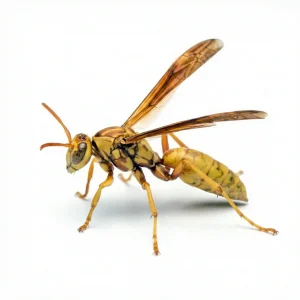
What Are Those Yellow Wasps Around My Pool?
They are almost always yellow paper wasps (Polistes flavus), and they come to the pool because it is a convenient water source, not because they are interested in you.
If you have a backyard pool in Arizona, you will eventually notice a small number of long-legged yellow wasps flying low over the water or landing briefly on the edge of the pool. Many homeowners assume this means a large nest is nearby or that the wasps are becoming aggressive.
In most cases, what you are seeing are paper wasps, commonly from the Polistes genus. One of the most widespread species in the Phoenix and Scottsdale area is the yellow paper wasp (Polistes flavus).
These wasps are not visiting your pool because they are interested in you. They are visiting because the pool is a convenient water source.
Adult paper wasps drink water for two primary reasons:
- Cooling the nest. Workers collect small droplets of water and spread them across the paper comb to regulate temperature during hot desert afternoons.
- Feeding larvae. Developing wasp larvae require moisture in addition to protein meals.
In natural environments, these insects would gather water from streams, irrigation runoff, cactus fruit, or morning dew. In suburban neighborhoods, swimming pools simply happen to be the most reliable source available.
The wasps you see hovering or briefly touching the water are typically foraging workers making quick supply runs back to their nest. They are not guarding the pool, and they are not looking for a confrontation.
A useful visual clue is their flight posture. Paper wasps fly with long legs dangling below the body, which makes them appear slightly awkward compared to bees or yellowjackets. This trait alone can help identify them at a distance.
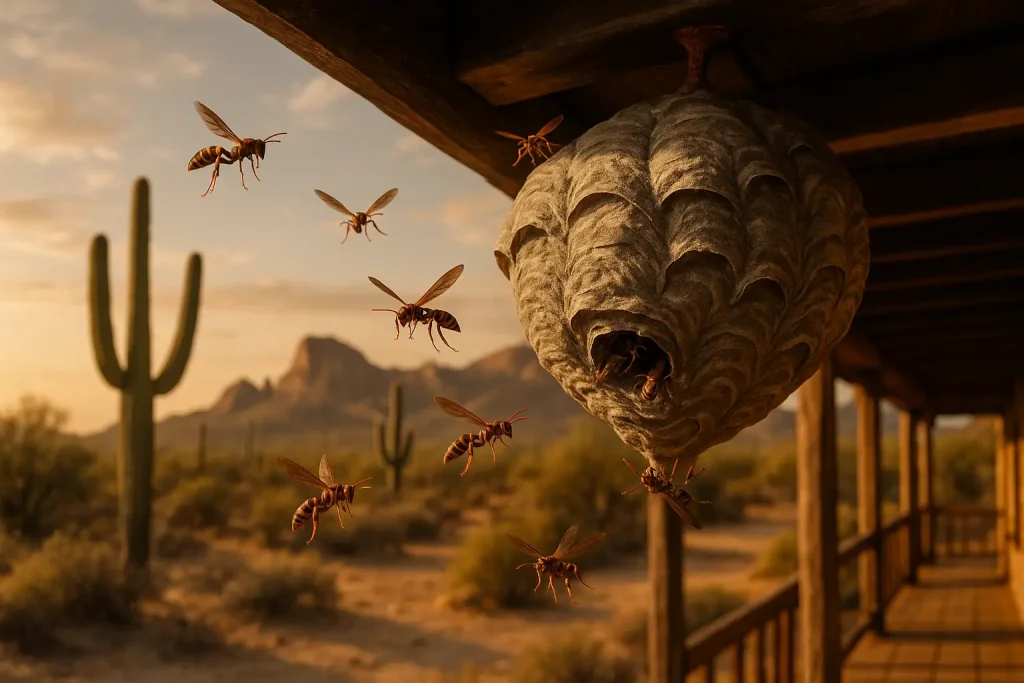
If a few yellow wasps occasionally visit your pool, it usually means there is a small paper nest somewhere nearby, often under an eave, fence rail, patio cover, or outdoor light fixture. The colony itself may only contain a few dozen individuals.
While the presence of wasps naturally makes people cautious, paper wasps are generally defensive rather than aggressive. If you are several feet away from their nest, they are usually far more interested in gathering water or hunting insects than interacting with humans.
In short, those yellow wasps around your pool are not conducting surveillance. They are simply running a very small desert water-collection operation for their nest.

How to Identify the Yellow Paper Wasp (Polistes flavus)
When people say they have “yellow wasps,” they are often referring to several different insects. In the Phoenix area, however, the most common species nesting around homes is the yellow paper wasp, Polistes flavus.
Correct identification matters, because paper wasps behave very differently from yellowjackets or hornets. Fortunately, they have several distinctive physical traits that make them fairly easy to recognize.
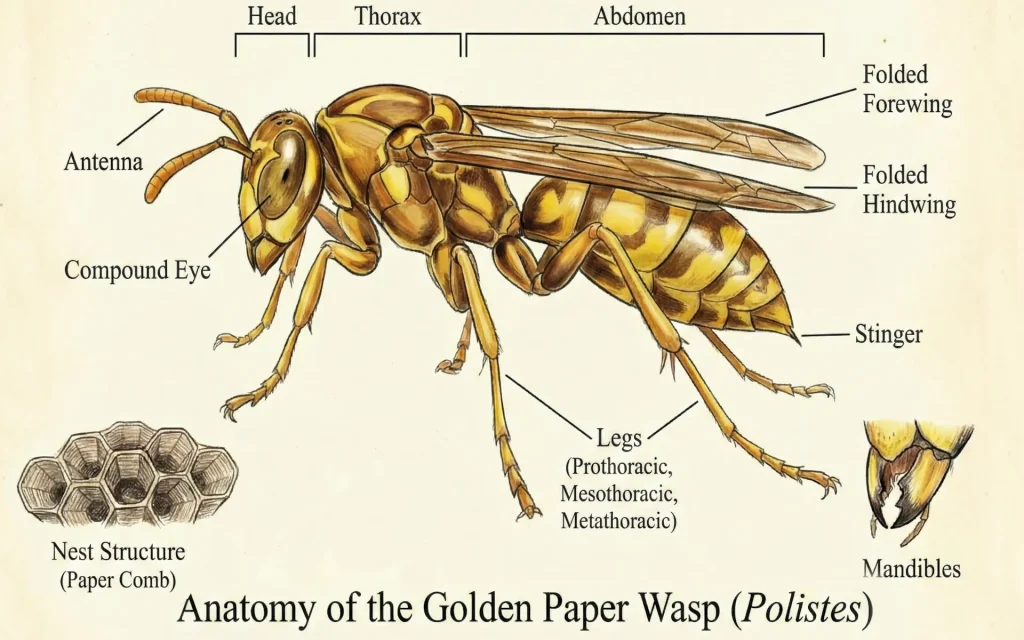
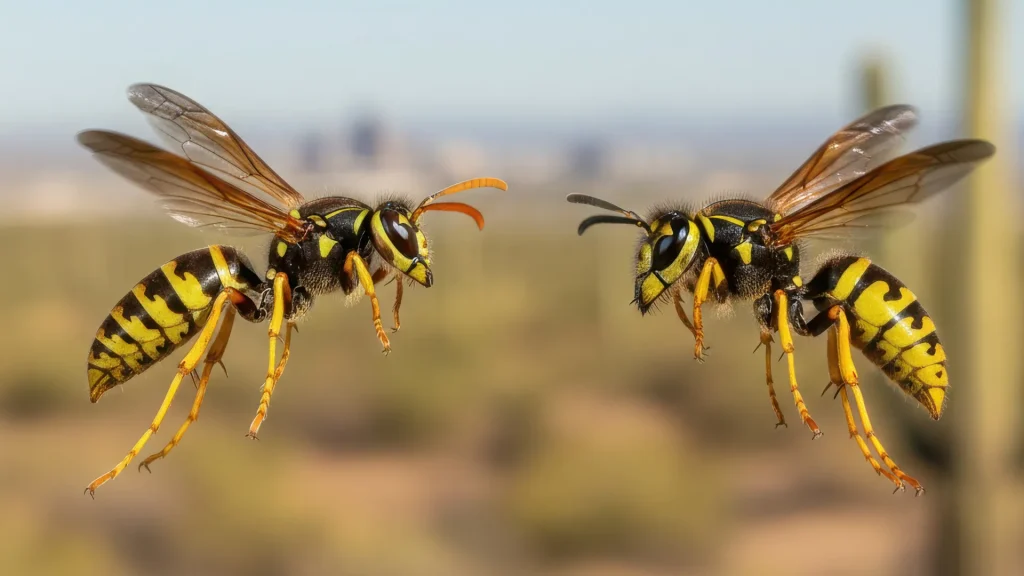
The first thing most people notice is the body shape. Paper wasps are slender insects with a very narrow waist between the thorax and abdomen. They look noticeably longer and thinner than yellowjackets, which are more compact and muscular.
Another useful feature is their legs. When paper wasps fly, their long legs hang loosely beneath the body. This creates a slightly dangling appearance in flight, almost as if the insect is carrying invisible landing gear. Yellowjackets, by contrast, keep their legs tucked tightly against the body.
Coloration also provides clues. Polistes flavus typically has a bright yellow or golden body with darker bands along the abdomen. The overall coloration tends to appear softer and more golden than the stark yellow-and-black contrast seen in yellowjackets.
The antennae are also distinctive. Paper wasps have long, flexible antennae that curve forward from the head. In males, the tips of the antennae often curve slightly downward, which can give them a somewhat relaxed or “drooping” appearance.
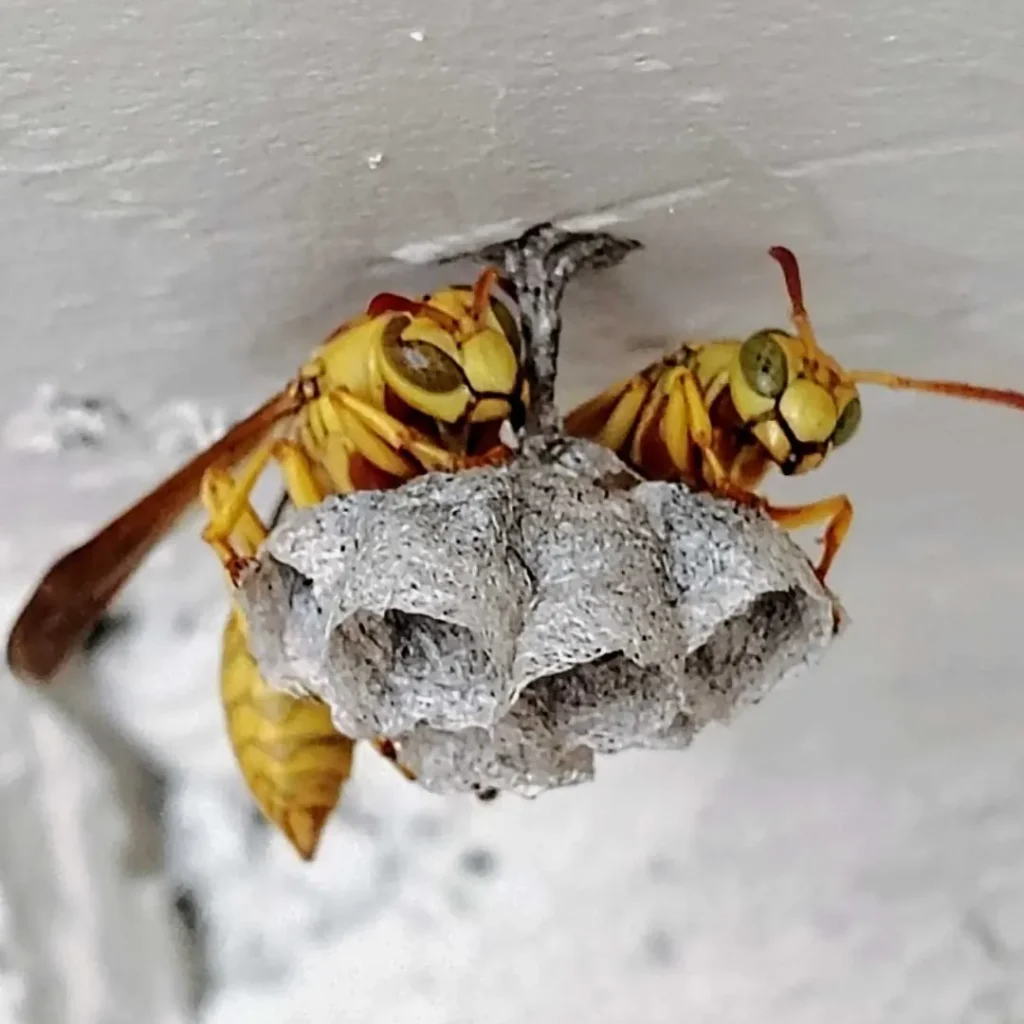
Perhaps the most reliable way to confirm identification is to look at the nest.
Paper wasp nests have a very characteristic design:
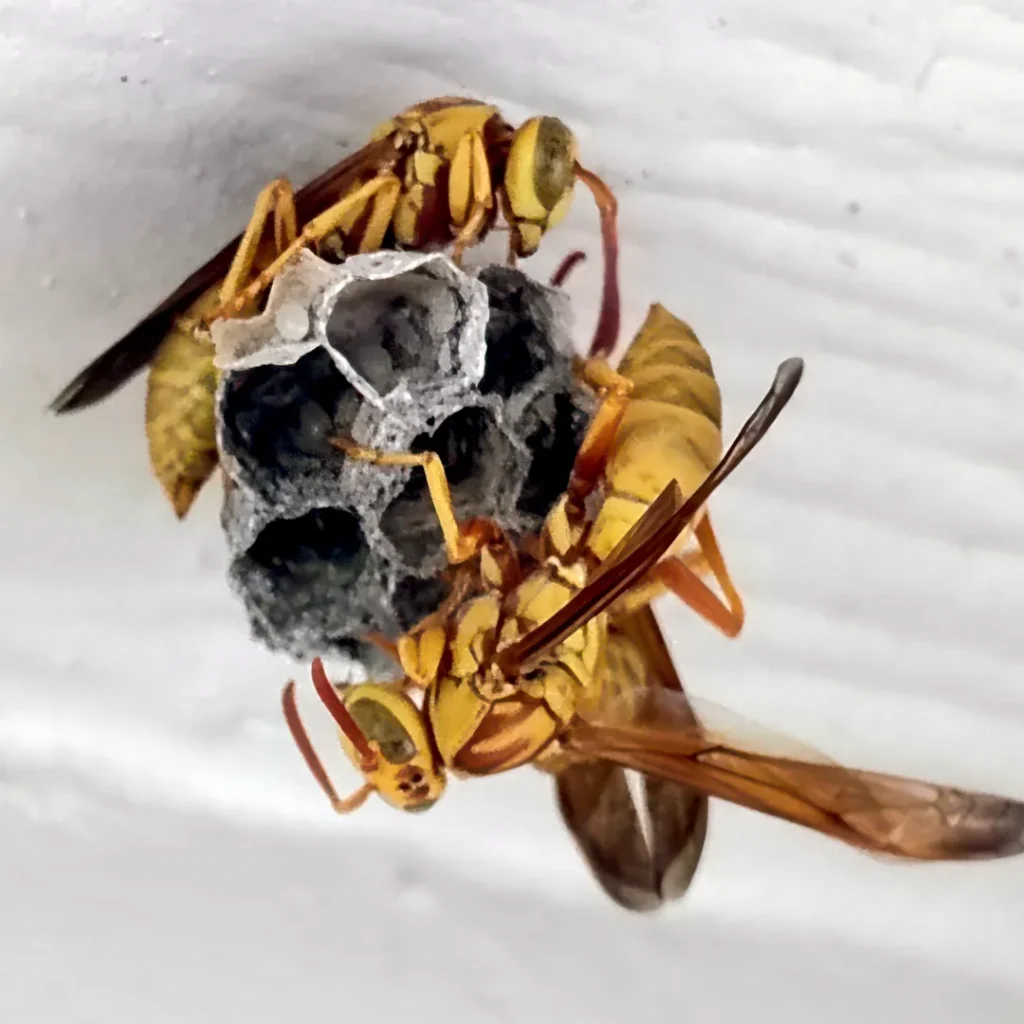
- a single exposed comb of hexagonal cells
- shaped like a small umbrella
- attached to a surface by one narrow stalk (called a petiole)
- cells remain open and visible from below
The material itself resembles grey paper or cardboard, because it is made from wood fibers chewed into pulp and mixed with the wasp’s saliva.
Unlike honeybees, which build large wax hives filled with stored honey, paper wasps construct lightweight seasonal nests designed only to raise the next generation of workers.
If you see a small umbrella-shaped nest under an eave or patio with a few yellow wasps walking calmly across the open cells, you are almost certainly looking at a paper wasp colony, and very likely Polistes flavus in the desert Southwest.
Correct identification is important, because these insects are often mistaken for more aggressive species. In reality, most paper wasps are quiet structural engineers of the backyard, focused on nest maintenance and hunting small garden pests rather than interacting with people.
Where Paper Wasps Build Nests Around Homes
Once you know what a paper wasp nest looks like, the next question is usually obvious: where exactly are these nests hiding?
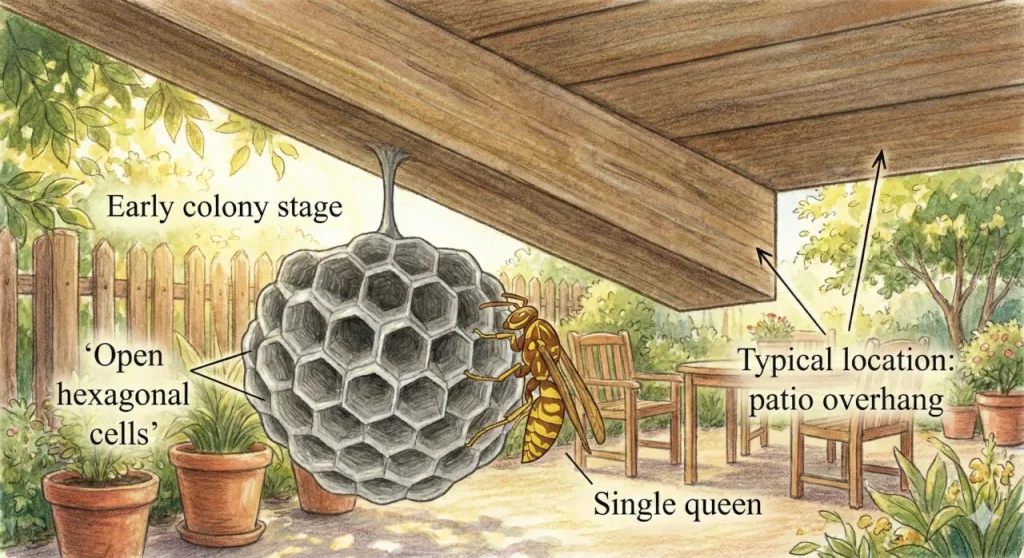
Paper wasps prefer locations that resemble the protected overhangs they would use in nature. In the wild, many Polistes species build nests under rock ledges, cliff faces, or thick tree branches. Suburban structures unintentionally provide hundreds of nearly perfect substitutes.
Around homes in Phoenix and Scottsdale, paper wasps most commonly build nests in places such as:
- the underside of roof eaves
- patio covers or pergolas
- door and window frames
- fence rails or gates
- light fixtures and security cameras
- the corners of garage ceilings or sheds
From the wasp’s perspective, these locations provide several advantages.
First, the nest remains protected from rain and direct sunlight, which helps regulate temperature and prevents the delicate paper structure from degrading too quickly.
Second, these sites offer clear visibility around the nest. Because paper wasp combs are open and exposed, workers can easily monitor approaching threats and defend the colony if necessary.
Third, many of these surfaces provide good building material. Female wasps scrape tiny wood fibers from fences, decks, or weathered boards, chew the fibers into pulp, and shape the material into the thin grey paper that forms the nest.
Despite the dramatic reputation of wasps, most colonies around homes remain surprisingly small. Early in the season a nest may contain only one founding queen and a few developing larvae. Even mature colonies often contain fewer than a few dozen workers.
Because the nests are open and relatively fragile, paper wasps rely more on strategic placement than heavy fortification. A nest tucked quietly into the corner of a roofline can go completely unnoticed for weeks.
This is why homeowners often discover them by accident. One day you simply notice a small grey umbrella with a few yellow insects calmly walking across it, and suddenly realize a miniature insect city has been operating above your head the entire time.
Understanding where paper wasps prefer to nest can help explain why they appear around certain areas of the house, and why you might occasionally see them flying predictable routes between the nest and nearby water sources.
The Life Cycle of a Paper Wasp Colony
Although paper wasp nests may appear permanent, the colony that builds them is actually temporary and seasonal. Each nest represents a single year of activity, beginning with one overwintered queen and ending when cold weather arrives.
The cycle begins in early spring.
During the winter, newly mated female wasps (future queens) survive by hiding in protected locations such as bark crevices, wall voids, or sheltered outdoor structures. When temperatures begin to rise in spring, these queens emerge and begin searching for a suitable place to start a nest.
The founding queen builds the first few paper cells entirely by herself. She collects wood fibers, chews them into pulp, and constructs the small umbrella-shaped comb that forms the foundation of the colony.
Once the first cells are complete, she lays a single egg in each cell.
The developing larvae pass through several stages before becoming adult wasps. During this period, the queen must perform every task alone:
- nest construction
- feeding larvae
- hunting caterpillars
- defending the nest
After several weeks, the first generation of worker wasps emerges. These workers are all female and immediately begin assisting with the colony’s labor. They take over tasks such as foraging, nest expansion, and feeding the developing brood.
With workers now handling daily operations, the queen focuses primarily on laying eggs.
Through late spring and summer, the nest gradually expands as new cells are added. The colony reaches its largest size during mid to late summer, when dozens of workers may be present.
Toward the end of the season, the colony produces a final generation of males and new reproductive females. The males leave the nest to mate, while fertilized females search for protected locations where they can survive the coming winter.
As temperatures drop in autumn, the original colony begins to collapse. Workers and males die off, and the nest is abandoned.
The paper structure itself remains behind, slowly weathering away over time. The following spring, new queens will start fresh nests elsewhere rather than reusing the old one.
In other words, each paper wasp nest is a short-lived architectural project, built with great precision for one season and then quietly left behind once the colony’s work is complete.
What Paper Wasps Eat (And Why They Are Often in Your Yard)
Paper wasps are frequently misunderstood because people assume they behave like yellowjackets. Hovering around food and aggressively scavenging at picnics. In reality, their diet is very different.
Adult paper wasps mostly consume sugars. This usually comes from nectar, plant sap, fruit juices, or other natural sources of carbohydrates. These sugars provide the energy needed for flight, nest construction, and hunting.
The larvae, however, require protein.
To feed the developing brood, worker wasps hunt soft-bodied insects. One of their primary targets is caterpillars, which makes paper wasps surprisingly beneficial in gardens. They also capture other small insects such as beetle larvae, flies, and occasionally spiders.
The hunting process is efficient and direct. A worker wasp will locate prey on a plant, sting it to immobilize it, and carry the insect back to the nest. There, the prey is chewed into small pieces and fed to the larvae inside the open cells.
In return, the larvae produce a sugary secretion that the adults consume. This exchange forms a nutritional feedback loop within the colony: workers provide protein to the larvae, and the larvae provide energy-rich liquids to the workers.
This feeding behavior explains why paper wasps are often seen flying around gardens, trees, or flowering plants. They are not searching for human food. They are conducting routine hunting and nectar-gathering patrols.
Water also plays an important role in their diet and nest maintenance. Workers frequently collect droplets from pools, irrigation lines, or birdbaths. The water is used to hydrate larvae and help regulate the temperature of the nest during hot weather.
Because of these habits, paper wasps often become accidental neighbors in suburban yards. A backyard with plants, insects, and a reliable water source provides everything a small colony needs to survive the season.
While their presence may make some homeowners uneasy, paper wasps are effectively acting as natural pest control, quietly removing large numbers of caterpillars and other plant-eating insects from the surrounding area.
Should You Exterminate a Paper Wasp Nest?
Only when people pass within a few feet of it. A nest above a doorway, near outdoor seating or around children’s play equipment should be removed; one high under an eave that nobody passes can usually be left for the season.
When people discover a wasp nest near their home, the first instinct is usually to remove it immediately. However, with paper wasps (Polistes species) the answer is often more nuanced.
In many situations, extermination simply isn’t necessary.
Paper wasps are generally defensive rather than aggressive. If their nest is located in an area where people rarely pass within a few feet, the colony will usually ignore human activity entirely. A nest high under an eave or tucked into the corner of a patio structure may coexist peacefully with the household for the entire season.
Unlike yellowjackets, paper wasps are not interested in scavenging human food or swarming outdoor gatherings. Their daily routine is focused on hunting insects, collecting nectar, and maintaining the nest.
Because of this, a small colony can actually be beneficial.
Worker wasps spend much of their time hunting caterpillars and other plant-eating insects. In gardens and landscaped yards, this makes them effective natural pest control agents.
That said, there are situations where removal is the safer option.
A paper wasp nest should generally be removed if it is located:
- directly above a doorway or entry point
- near outdoor seating areas
- around children’s play equipment
- in places where people frequently pass within a few feet of the nest
In these cases, accidental disturbance becomes much more likely. Paper wasps will defend their nest if they perceive a threat at close range, and repeated human traffic increases the chances of a defensive sting.
Another factor is colony size. Early in the spring, nests may contain only a single queen and a few developing larvae. Removal at this stage is much easier than later in the summer when the colony has dozens of workers.
For nests located far from regular activity, many homeowners choose the simplest option: leave the colony alone until autumn. When colder weather arrives, the workers die off and the nest is abandoned naturally.
The remaining paper structure eventually weathers away, and the site is rarely reused the following year.
In other words, not every wasp nest is a problem that needs solving. Sometimes it is simply a temporary insect civilization operating quietly above your head for one season.
Safe Paper Wasp Nest Removal
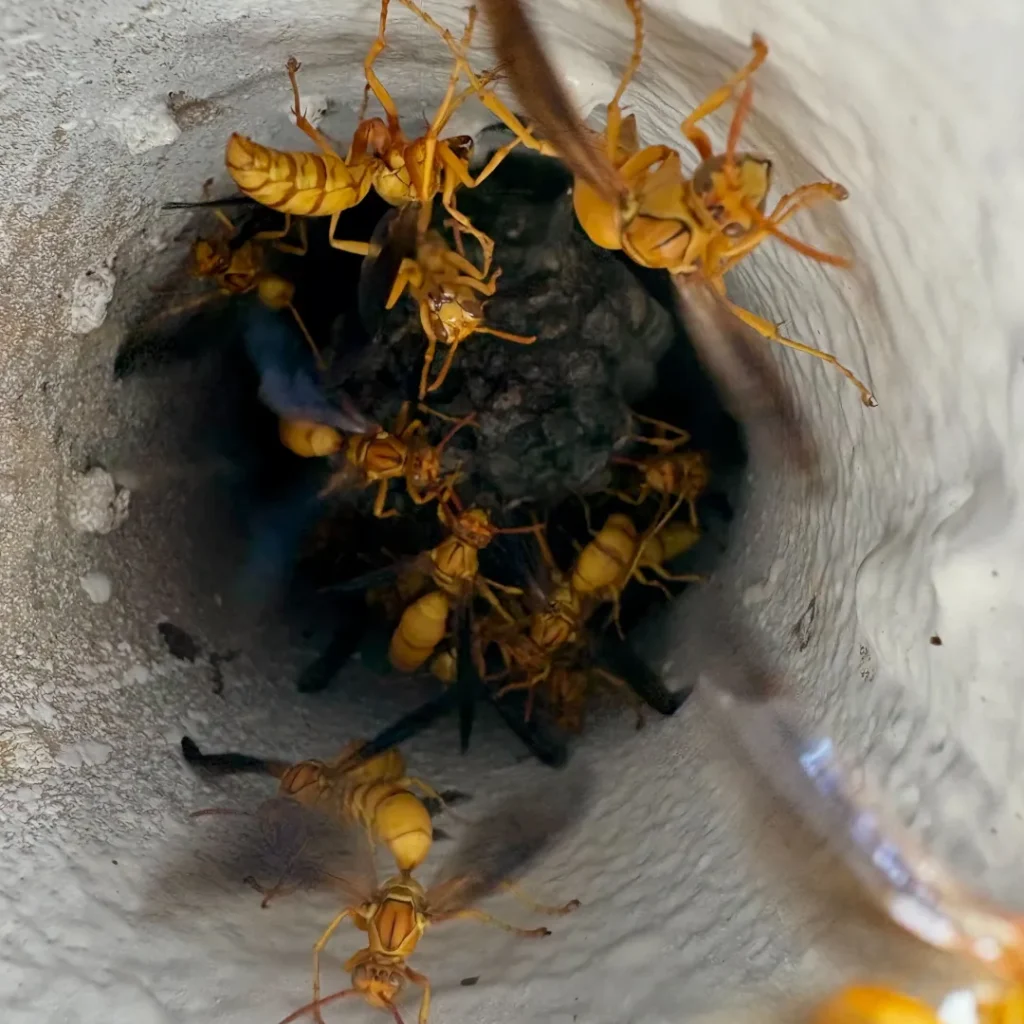
If a paper wasp nest is located in a high-traffic area of your home, removal may be the safest option. However, attempting to remove a nest yourself can quickly lead to stings, especially if the colony has grown large.
Paper wasps usually behave calmly unless they believe the nest itself is under threat. Approaching too closely, striking the nest, or attempting removal during the daytime can trigger a defensive response from multiple workers at once.
For that reason, professional removal is often the safest option.
A trained technician can:
- correctly identify the species
- determine whether removal is actually necessary
- use proper protective equipment
- safely eliminate the colony without damaging your home
Professional removal is particularly recommended when nests are located near doorways, patios, pool equipment, or children’s play areas, where accidental disturbance is more likely.
If you live in the Phoenix, Scottsdale, or greater Valley area, you can contact:
Busy Bee Pest Solutions
📞 623-289-3375
Busy Bee specializes in the safe removal of wasps, bees, and other stinging insects across the Phoenix metro area.
If you are not located in Phoenix, the easiest solution is simply to search online for “wasp removal near me.” Most cities have licensed pest control professionals who can safely remove a nest and confirm the species involved.
In many situations, homeowners discover the insects are paper wasps rather than aggressive yellowjackets, and the nest may not require removal at all.
But when a nest is located in a place where people frequently pass nearby, having a professional handle the situation can eliminate the risk while keeping the process safe for everyone involved.
Sometimes the best solution is patience. Other times, it’s better to let someone with protective gear deal with a group of insects that evolved specifically to defend their home. 🐝

Very helpful information. We have an active nest in a dense Indian Hawthorn bush. After reading your post I’ll put up a sign in Spanish alerting our gardener to the potential danger.