If you live in Arizona, you recognize the sound immediately. It isn’t the soft pastoral hum associated with European gardens or backyard hives. It is sharper, louder, and more insistent. The unmistakable turbine-like whine of a feral colony that has decided your wall cavity, eaves, or irrigation box is now sovereign territory.
Arizona doesn’t do anything halfway. We don’t get “a few bees.” We get widespread Africanized honey bee genetics, summer temperatures that routinely exceed 110°F, and modern construction full of hollow voids that function like thermal traps. In this environment, bee removal is not a cosmetic inconvenience or a simple pest issue. It is a problem that sits at the intersection of biology, structural engineering, and public safety.
That is why live bee removal is not merely the more humane choice in the Southwest. It is, in most cases, the only method that is scientifically and structurally sound.

The Extermination Trap: Why “Kill and Seal” Fails in the Desert
The most persistent misconception about bee infestations is that the bees themselves are the primary problem. In reality, the bees are only the visible component of a much larger system. The true issue is the hive.
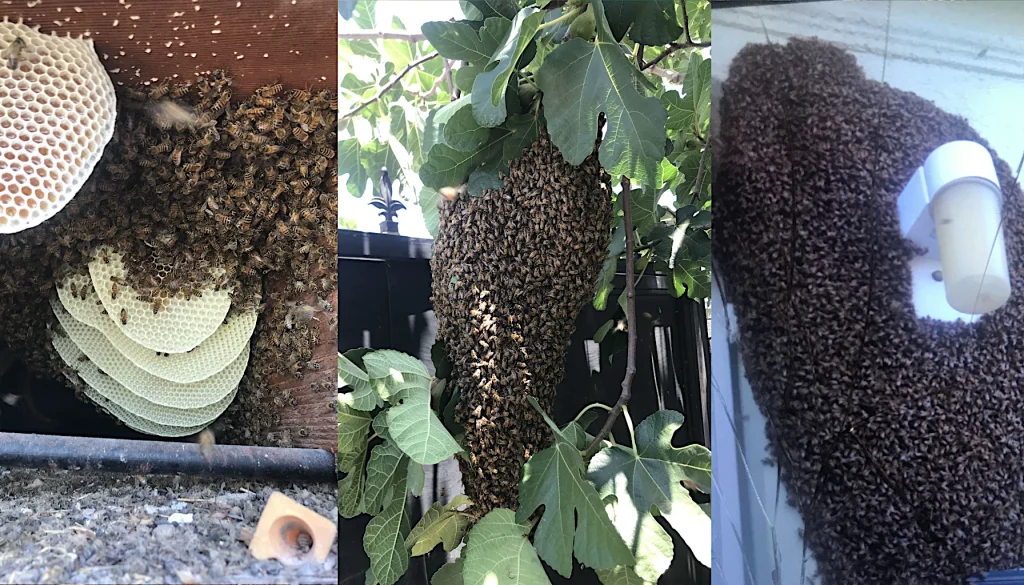
A mature honey bee colony inside a wall void or attic can contain anywhere from 20 to over 100 pounds of honey, wax, pollen, and brood. When a technician exterminates a colony without removing the hive structure, two critical failures occur almost immediately.
Cooling Systems Collapse
Bees actively regulate the temperature of their hive by fanning their wings and circulating air. Once the colony is killed, that cooling mechanism stops entirely. In Arizona, where attic temperatures can exceed 150°F, the wax comb begins to soften and melt within days.
Honey Becomes Structural Damage
As the wax collapses, liquid honey mixed with dead bees, larvae, and residual pesticide flows downward through framing, soaking insulation and drywall. What begins as an odor often turns into visible staining, material degradation, and in some cases the need for extensive interior demolition. This is not cosmetic damage. It is a failure of building materials under biological load.
In parallel, the remaining hive contents create a powerful attractant for secondary pests. Ants, cockroaches, beetles, moths, and rodents are drawn to abandoned honey stores. What was once a single-species problem becomes a cascading infestation event.
Extermination alone does not remove risk. In Arizona’s climate, it frequently creates new problems.

The Pheromone Problem: Why Bees Come Back
Honey bees possess an exceptionally refined sense of smell. Hive locations are marked with persistent pheromones that permeate wax, wood, and even masonry. These chemical signatures do not dissipate quickly. In protected cavities, they can remain active for years.
When a colony is exterminated but the wax and propolis are left behind, the site effectively becomes a vacancy advertisement. Scout bees from passing swarms detect the odor and interpret it as proof of a previously successful nesting site.
This is why homeowners often experience repeat infestations in the exact same location months after extermination. Without physical removal and cavity cleanup, the structure remains biologically “listed” as available housing.
Live removal addresses this problem directly by extracting the comb, removing residue, and eliminating the pheromone signal that draws future colonies.
The Africanized Reality in Arizona
Arizona is home to established populations of Africanized honey bee hybrids. These bees are not a different species, but they exhibit behavioral traits that make infestations riskier. They defend their colonies faster, deploy more workers during a perceived threat, and pursue disturbances over greater distances.
This defensive behavior does not mean that all Africanized colonies must be destroyed, but it does mean that removal requires experience, planning, and proper equipment.
In many live removals, a captured colony can be re-queened with a European honey bee queen. Over time, this dilutes defensive traits and converts a feral hive into a manageable agricultural colony. This outcome is not guaranteed and depends on colony condition, accessibility, and behavior, but it is frequently achievable when removal is performed carefully.
At the same time, ethical practice demands realism. Colonies exhibiting extreme aggression in high-risk locations, such as schools or medical facilities, may require eradication to protect human life. Responsible live removal is not sentimental. It is risk-based and situational.

Live Bee Removal as a Structural Procedure
Live bee removal is often misunderstood as extermination with a gentler motive. In reality, it is a construction-informed extraction process.
A proper live removal typically involves:
- Accurate identification of hive boundaries using experience, sound, and sometimes thermal diagnostics
- Controlled access through drywall, stucco, soffits, or roofing materials
- Low-pressure vacuum collection of worker bees to prevent injury
- Manual removal of all wax comb, brood, and stored honey
- Cleaning and preparation of the cavity to eliminate pheromone residue
- Sealing and exclusion work to prevent re-entry
This process is labor-intensive and invasive by necessity. However, it directly addresses the biological, chemical, and structural realities of a hive embedded within a building envelope. It is the only approach that reliably prevents melt damage, odor problems, and recurring infestations.
Why Live Removal Is Both Ethical and Scientific
Live bee removal is ethical because it avoids unnecessary destruction of pollinators when safe alternatives exist. Honey bees play a critical role in both natural desert plant communities and agricultural systems. Preserving colonies when possible supports ecosystem resilience rather than diminishing it.
It is scientific because it works with, rather than against, bee biology. It accounts for:
- Thermodynamics in enclosed structures
- Chemical persistence of hive pheromones
- Behavioral ecology of swarming and scouting
- Material limits of modern construction
Rather than treating bees as a disposable nuisance, live removal treats the hive as a complex biological system with physical consequences. That perspective leads to better outcomes for homeowners and fewer downstream problems.

A Smarter Standard for Arizona Homes
In Arizona, bee removal cannot be approached with shortcuts. The climate, the construction, and the genetics involved make incomplete solutions costly and dangerous over time.
For homeowners in the Phoenix and Tucson metro areas, Busy Bee Pest Solutions specializes in professional bee removal with a strong emphasis on live removal when conditions allow. Their approach prioritizes safety, structural integrity, and responsible handling of pollinators, balancing realism with ecological responsibility.
Live bee removal is not about being sentimental. It is about recognizing that in the desert, biology and physics do not forgive half measures. Proper removal solves the problem at its source and prevents the quiet failures that appear months later.
Bee removal is a science. Arizona demands that it be treated like one.
We also discuss the science behind live bee removal in Arizona’s desert climate in a companion podcast episode, covering hive melt, pheromone persistence, and why extermination often leads to repeat infestations.
🎧 Listen here:
For expert bee removal in Phoenix, Tucson, and surrounding areas, visit Busy Bee Pest Solutions