

You walk out to your patio with your morning coffee, glance up at the eaves, and freeze. There is a buzzing. A loud one.
For most Arizona homeowners, this is the moment of panic. Is it a swarm passing through? Is it a massive colony that has been living in your attic for six months? Or is it just a few scouts looking for a way in?
In the pest control world, we see a lot of confusion between a bee swarm and a bee hive. To the untrained eye, both look like “a lot of bees.” But the difference between them is the difference between a 24-hour guest and a permanent tenant who destroys your drywall.
This guide is designed to help you visually identify what you are looking at, and more importantly, tell you exactly how to react.
What is the Difference Between a Swarm and a Hive?
Before we dive into the biology, let’s look at the immediate visual cues. You don’t need to be an entomologist to spot these; you just need to know where to look.
1. The Swarm (The Travelers)
A swarm is a temporary cluster. It usually looks like a heavy, vibrating football or basketball made entirely of bees.
- Location: Hanging from a tree branch, a fence post, a mailbox, or even the side handle of a car door.
- Appearance: A solid, singular mass. You won’t see them flying in and out of a hole; they are all clumped together, holding onto each other.
- Sound: A loud hum when they first arrive, settling into a quiet buzz once they land.
- Comb: None. There is no white wax or honeycomb visible.
2. The Hive (The Residents)
A hive is a permanent structure hidden inside something. You usually won’t see the cluster itself; you will only see the traffic.
- Location: Inside a wall void, a roof eave, an irrigation box, or a shed floor.
- Appearance: You see bees “streaming” like an airport runway. They fly with purpose. Zipping in and out of a small crack, hole, or vent.
- Sound: A constant, low-level vibration from inside the wall (often heard at night).
- Comb: If you can see the nest (like in a shed), you will see distinct parallel “sheets” of white or yellow wax.

This side-by-side image compares a temporary honey bee swarm resting on a wall (left) with an established bee hive inside a roof eave showing exposed honeycomb (right).
What Does a Bee Swarm Look Like?
Why Do Bees Swarm on Trees and Fences?
A swarm is not an attack force; it is a moving van.
When a colony gets too strong and crowded, the old queen leaves with about 60% of the worker bees to start a new family. This is how bees reproduce. They aren’t trying to sting you; they are homeless and vulnerable. They gorge themselves on honey before leaving the old hive, which makes them physically heavy and surprisingly docile. They can’t sting easily when their abdomens are full of honey.
Where You’ll See Them
Swarms are opportunistic. They need a place to rest while their “scouts” go house-hunting. In Phoenix, we frequently find them in:
- Mesquite and Palo Verde trees: Usually on a branch 4 to 10 feet off the ground.
- Trampolines and Patio Furniture: The underside of a table is a favorite shaded rest stop.
- Block Walls: Hanging off the lip of a cinder block fence.
The “Bivouac” Behavior
This cluster is called a bivouac. They are protecting the queen in the center. If you see a ball of bees on a branch, they are likely just resting.
- Duration: They typically stay for 1 to 3 days.
- Risk Level: Low (unless provoked).
- Action: What to Do for a Bee Swarm in Phoenix: Top Tips
However, do not assume they will leave. If that swarm decides your attic vent looks like a nice place to live, that “temporary” swarm becomes a permanent hive in less than 48 hours.

This diagram compares the external appearance of a temporary honey bee swarm with a cross-sectional view showing how worker bees surround and protect the queen during a swarm event.
How to Spot a Hidden Bee Hive in Your House
Why Do They Do It?
Once the scouts find a suitable void (your wall), the swarm moves in. This is the dangerous phase for a homeowner. Once they move inside, they are no longer “travelers.” They are defenders.
Within hours of entering your wall, they begin secreting wax and building honeycomb. The queen starts laying eggs. Now, they have something to protect (babies and food), and their aggression levels skyrocket.
What Does a Bee Entry Hole Look Like? (The Landing Stain)
One of the most reliable ways to spot a hive inside a stucco wall is the landing stain.
- What it is: A dark, greasy-looking smudge around a small hole or crack.
- Cause: It’s a mix of propolis (bee glue) and thousands of dirty bee feet tracking in and out.
- Where to look: Check the peaks of your rooflines, the vents in your attic, and the weep holes near the foundation of your home.
The “Stream” Behavior
Unlike a swarm that sits still, a hive is an engine of activity. Watch the hole for 30 seconds.
- Inbound Bees: Look for bright orange or yellow balls on their hind legs. That is pollen. If you see pollen going into a hole, you 100% have an established hive with babies to feed inside.
- Outbound Bees: They fly out fast and high, heading to flowers.

A cutaway-style view of an active honey bee colony in a tree cavity, showing layered honeycomb structure and worker bees maintaining the hive.
Hidden Dangers: The Weight of Honey
A common misconception is that a hive is just a “nest.” In reality, a mature hive in a wall can contain 50 to 100 pounds of honey.
- The Structure: Bees build comb between the 2×4 studs of your wall. (See our Common Bee Hive Locations in Arizona guide).
- The Damage: If you ignore it, the honey can melt (especially in Arizona summers), soaking through your drywall and ruining your carpet. Fermenting honey also attracts ants, roaches, and rats.
Where Do Bees Build Hives in Arizona Homes?
We’ve cataloged the most surprising places we find bees hiding. You can see photos in our article Where Are Phoenix Bees Hiding?, but here is your checklist for a Saturday morning inspection.
1. Irrigation Control Boxes
This is the #1 “surprise” spot. Those green plastic lids in your grass are cool, dark, and underground. Perfect for our desert heat.
- The Sign: Bees hovering just above the grass or flying into the finger-hole of the lid.
- The Danger: You open it to check a timer and get blasted by defensive guard bees.
2. Shed Floors
If your shed is raised slightly off the ground on wooden skids, the space underneath is prime real estate.
- The Sign: Bees disappearing under the shed rather than flying over it.
3. Roof Eaves and Soffits
Rotted wood or a missing screen on a vent is an open invitation.
- The Sign: A constant trickle of bees entering a gap where the wood meets the stucco.
- The Danger: This leads directly into your attic. (Read about Attic Hives here).
4. Chimneys
Even if you don’t use your fireplace, the chimney creates a hollow, protected column.
- The Sign: You might hear buzzing inside your living room, or see bees dropping into the firebox.
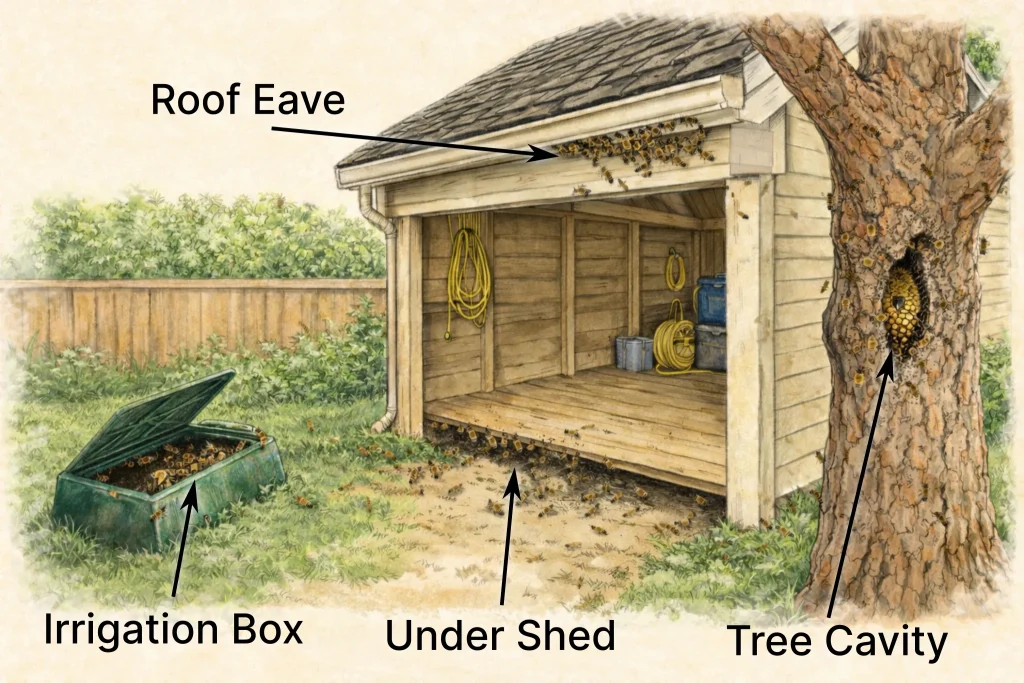
This illustration highlights the most frequent places honey bees establish hives in Phoenix backyards, including roof eaves, irrigation control boxes, spaces beneath sheds, and natural tree cavities.
Can I Spray a Bee Hive With Wasp Killer?
STOP. Put the can of wasp spray down.
We understand the instinct. You see bees; you want them gone. But trying to spray a hive entrance is the single worst thing you can do, and here is why:
- You Can’t Reach the Queen: The entrance you see is just the front door. The colony is likely 4 to 10 feet away from that hole inside the wall. The spray kills the guard bees, but the 40,000 bees inside survive.
- You Trap Them Inside: If you spray foam or, worse, seal the hole with caulk, the bees have no exit. They will panic. They will chew through the softest material to escape. That is usually your drywall. We have seen homeowners wake up to a living room full of angry bees because they sealed the outdoor hole.
- The “Honey Bomb”: Even if you manage to kill the bees (unlikely), you have left 50 pounds of honey, pollen, and dead larvae in your wall. Without air conditioning from the bees’ wings, the wax melts. The honey rots. The smell is indescribable, and you will eventually have to tear the wall open anyway to clean the mess.
See our article: Is Beehive Removal in Arizona Safe to do Yourself? for the horror stories.
Are the Bees in My Yard Africanized (Killer Bees)?
In Arizona, we have to assume all wild hives are Africanized (Killer Bees).
- Visual Difference: There is none. You cannot tell an Africanized bee from a European bee by looking at it.
- Behavioral Difference: European bees might send 10 bees to sting you if you kick their hive. Africanized bees will send 500, and they will chase you for a quarter-mile.
- Trigger Distance: Africanized bees are hypersensitive to vibration. A lawnmower 50 feet away can trigger a massive attack.
This is why we stress professional removal. It’s not just about getting stung; it’s about liability and safety for your neighbors. Read more on Africanized Bees in Arizona: Why You Need Professional Bee Control.
Live Removal vs. Extermination
At Busy Bee Pest Solutions, we advocate for Live Bee Removal whenever possible.
The Live Removal Process
- Identification: We find the exact location of the hive using thermal imaging or stethoscopes.
- Access: We carefully open the structure (roof, wall, or floor) to expose the comb.
- Vacuuming: We use a specialized low-pressure vacuum to gently suck the bees into a safety box.
- Comb Removal: This is critical. We cut out every inch of honeycomb. If we leave the wax, the scent remains, and a new swarm will move in next year.
- Relocation: The bees are taken to an apiary where they can be rehabilitated and used for pollination.
Why choose live removal? Because bees are essential to our agriculture, and in Arizona, “saving the bees” isn’t just a slogan. It’s a necessity. Check out: The Science of the Sting: Why Live Bee Removal Is Arizona’s Only Real Option.
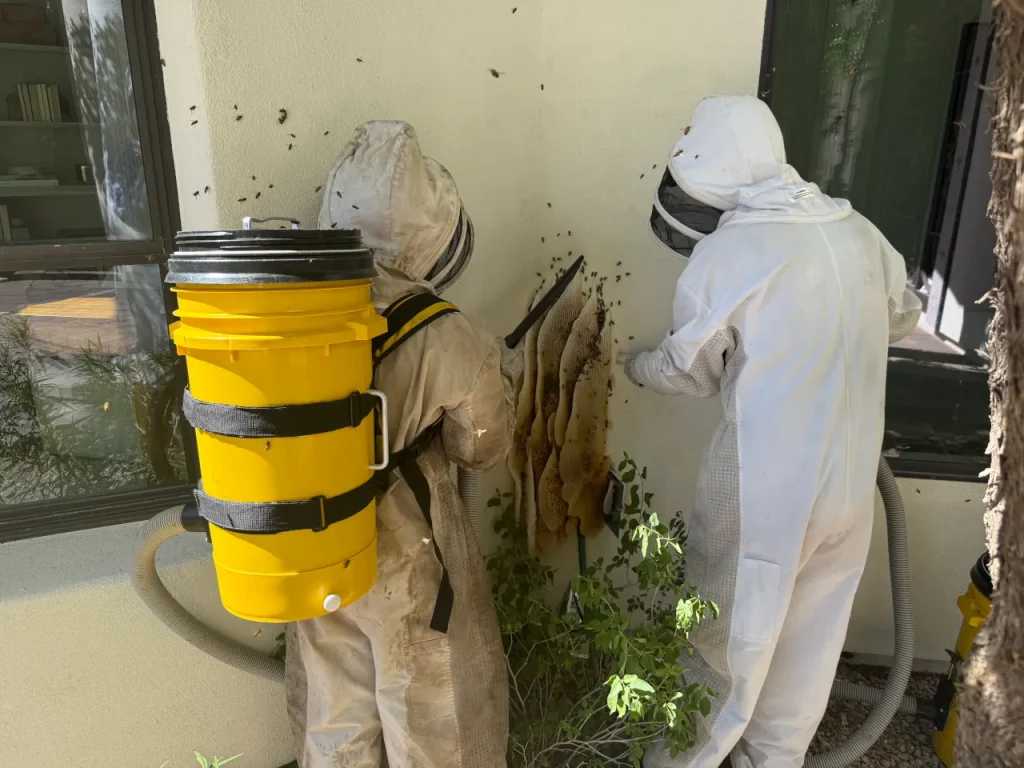
Licensed technicians safely remove an active honey bee hive from a home exterior using protective gear and specialized equipment, allowing the colony to be relocated without extermination.
How Much Does Bee Removal Cost vs. Free Swarm Collection?
You might find a hobbyist beekeeper willing to collect a swarm (the ball on the branch) for free or cheap. That’s great!
But if the bees are inside your wall (a hive), that is construction work, not just beekeeping. It involves carpentry, safety gear, and insurance.
- Swarm Removal: Fast, simple, lower cost.
- Hive Removal: Complex, labor-intensive, higher cost.
Don’t get scammed by a “cheap” quote that leaves the honeycomb rotting in your walls. Read: What Really Goes Into Professional Bee Removal (And Why It’s Not a $99 Job).
Summary Checklist: Swarm or Hive?
Is it a SWARM?
- Hanging from a branch or open object?
- Ball-shaped cluster?
- Appeared suddenly (overnight)?
- No visible honeycomb?
- Action: Keep kids/pets inside. Wait 24 hours. If they stay, call us.
Is it a HIVE?
- Bees entering/exiting a hole in the house?
- “Landing stain” on the wall?
- Constant traffic (carrying pollen)?
- Been there for more than 3 days?
- Action: Call a professional immediately. Do not seal the hole.
Need Help Identifying?
If you are staring at a buzzing mass of insects and don’t know if it’s a temporary bivouac or a permanent infestation, don’t guess. The safety of your family (and your drywall) depends on getting it right.
Contact Busy Bee Pest Solutions today. We can assess the situation, determine if it’s a swarm or a hive, and give you a safe, humane solution.
Get a Free Quote or Assessment Here
Protect your home. Save the bees. Do it the right way.


