🐀 Check Out Our Rodent ID Guide
Arizona’s Most Common Rodents in 2026. How to Identify and Prevent Them
If you’re hearing scratching sounds in your attic, especially at night, you’re not imagining it, and you’re not alone. In Phoenix and across the Valley, attic noises are one of the most common early signs of rodents or wildlife moving into insulation, duct chases, or roofline gaps.
This guide will help you identify what those sounds likely are, what they mean, and what to do next. Before a small problem becomes a gnawed-wire, contaminated-insulation, not-sleeping-tonight situation. In Phoenix it is most often roof rats; see roof rat removal in Phoenix.
Quick Answer: What Causes Scratching Sounds in the Attic?
Most of the time, attic scratching sounds come from:
- Roof rats (very common in Arizona neighborhoods)
- Mice
- Pack rats (woodrats)
- Birds (especially near vents and fascia gaps)
- Squirrels (less common in Phoenix than other regions, but possible)
- Bats (typically more fluttering/chittering than scratching)
The exact sound, timing, and location can narrow it down fast.

What “Attic Scratching” Usually Sounds Like (and What It Indicates)
Different pests make different “sound signatures.” Here’s what homeowners report most:
1) Light scratching or scurrying at night
This often points to mice or roof rats, because they’re most active after dark.
2) Chewing or gnawing noises (tiny crunching)
This can be rodents chewing wood, plastic, or wiring. Chewing sounds are a bigger red flag than simple movement.
3) Thumps, heavier footsteps, or dragging sounds
Heavier sounds can indicate larger animals (or multiple rodents). If it sounds “too big to be a mouse,” don’t ignore it.
4) Noise near one corner of the attic or near a roof vent
That often means the entry point is close by. Like a roofline gap, vent opening, fascia break, or roof-to-wall intersection.

Why Scratching in the Attic Often Happens at Night
If the scratching is mostly at night, that’s a strong hint you’re dealing with rodents. Roof rats and mice prefer to move when the home is quiet and the house lights are low.
In the Valley, attic activity also spikes seasonally:
- Colder nights push rodents into warmer attic spaces
- Hot summer days can drive animals to seek shelter and nesting areas
- Monsoon season can increase movement as pests relocate from disturbed outdoor nesting
Common Signs You Have Rodents in the Attic (Not Just “Random Noises”)
Scratching sounds are the soundtrack, but these are the receipts.
Look for:
- Droppings (in attic corners, insulation, garage storage, pantry)
- Grease marks along beams or pipes (“runways”)
- Shredded insulation or nesting material
- Chewed cardboard, plastic, or wiring
- Urine odor (a sharp ammonia smell)
- Pets intensely staring at walls/ceilings, especially at night
- New insect activity (flies can appear when rodents die in hidden spaces)
If you’re hearing scratching and seeing droppings, it’s time to act quickly.

Is It Dangerous to Have Rodents in the Attic?
It can be. Especially if it goes unaddressed.
Rodents can:
- Chew electrical wiring, increasing fire risk
- Contaminate insulation with droppings and urine
- Spread bacteria and parasites
- Damage ductwork, causing airflow and HVAC issues
- Multiply fast (a “small” attic problem rarely stays small)
The bigger danger is delay. Most serious damage happens gradually while the noises become “normal” in the background. Until something expensive fails.

What You Should NOT Do (Common Mistakes)
When people hear attic scratching sounds, they often try quick fixes that make things worse:
- Don’t throw poison baits into the attic
- This can lead to rodents dying in walls/attic voids → odor and insect problems.
- Don’t seal entry points before the animals are out
- You can trap rodents inside, forcing them into living spaces or causing die-offs.
- Don’t rely on ultrasonic devices
- They’re inconsistent and rarely solve an established attic infestation.
- Don’t ignore it because it “stopped”
- It may just mean the animal moved locations… or nested in a quieter spot.
What To Do Right Now If You Hear Scratching in the Attic
Once you are satisfied the noise is rodents, the next question is where they are getting in. We mapped the openings rats actually use on Phoenix homes, tile eaves, roof vents, AC line penetrations, fascia gaps, in How Rats Get Into Phoenix Attics.
Here’s a safe, practical action list:
- Listen for timing
- Mostly at night → rodents
- Mostly early morning or daytime → birds/squirrels (depending on area)
- Check the pantry and garage
- Droppings in pantry corners, behind appliances, or near pet food are common.
- Look for entry points outside
- Roof vents, attic vents, fascia gaps, roofline intersections, garage corners, and AC line penetrations.
- Avoid moving insulation yourself
- Disturbing contaminated insulation can release particles you don’t want to breathe.
- Schedule an inspection
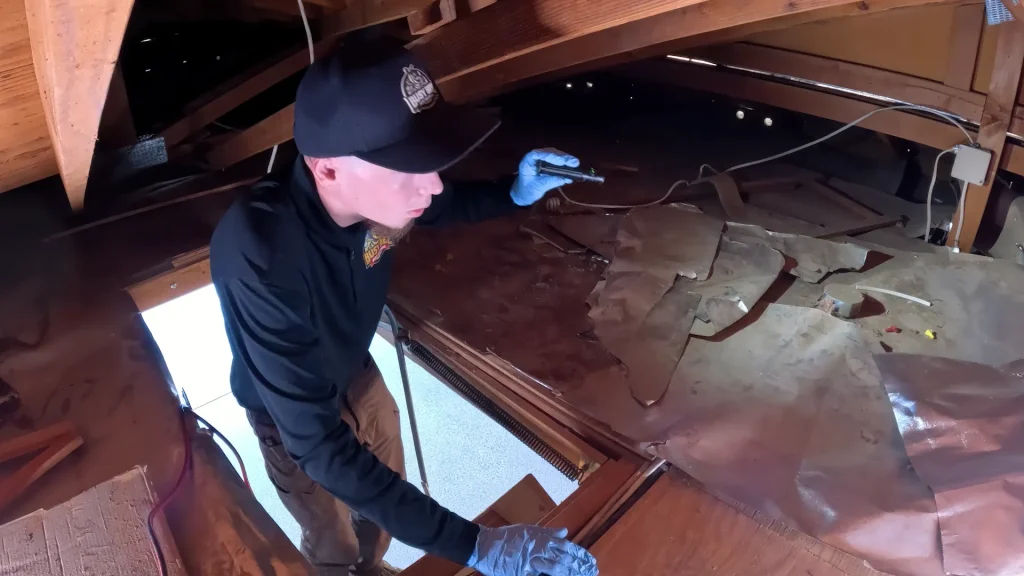
- A pro inspection pinpoints entry points, activity zones, and the right removal method.

Professional Rodent Control in Phoenix: Why Inspection Matters
In Phoenix, rodent problems are less about “one rat” and more about how they got in.
A proper service focuses on:
- Identification (roof rat vs mouse vs pack rat)
- Removal
- Exclusion (sealing and preventing re-entry)
- Sanitation recommendations if contamination is present
If the home isn’t sealed after removal, the problem often returns. Sometimes within weeks.

Need Help Today?
If you’re hearing scratching sounds in your attic, call us: the inspection is free, a technician calls you back the same day, and you get a written price before any work starts. We trap with no poison inside the home and seal the entry points for long-term prevention.
The sooner you identify the cause, the easier (and cheaper) the fix tends to be.

FAQ: Attic Scratching Sounds
How do I know if it’s rats or mice?
Rats tend to sound heavier. More thumping or longer movement patterns. Mice often sound lighter and faster. Dropping size and location also helps confirm.
Can rats chew through walls from the attic?
They can chew through vulnerable materials and widen existing gaps. More often, they travel through voids, duct chases, and openings around penetrations.
If the scratching stopped, does that mean it’s gone?
Not necessarily. Activity can shift locations, especially if nesting behavior changes.
Are attic rodents common in Phoenix?
Yes. Especially roof rats and mice, depending on the neighborhood and nearby food sources.
What it costs to fix
If the noise turns out to be rodents, here is what resolving it costs. Rodent control is $245 for the initial service and $95 per follow-up. The Phoenix rodent control price guide breaks down every line item, including what rodent damage costs to repair if you wait. If you are adding year-round pest control, the initial rodent visit drops to $29 under the $29 rodent special. Trapping ends the infestation you have now; rodent exclusion is what stops the next one.
Attic work varies by roof type and area
What is above your ceiling changes the job. Concrete tile roofs are especially common in Mesa and Chandler, where the failed foam closure at the eave is the entry point we find most often. Large multi-wing custom roofs in Paradise Valley and Scottsdale have far more penetrations and take proportionally longer to inspect.
Related: nine signs of a roof rat in the attic and what rodent exclusion involves.