

A Phoenix homeowner’s guide to what those bees actually want, and what to do about it today.
First, the question you actually came here to ask: is it safe to swim?
For most households, yes, as long as nobody swats and nobody in the pool has a known sting allergy.
Bees gathering water are not defending anything. They are working. The University of Arizona Cooperative Extension’s guidance on foraging bees is that they “will sting only if they are trapped in clothing, stepped on or otherwise threatened.” A bee hovering at your waterline is not sizing you up. It is filling its honey stomach and flying home.
The real poolside risk isn’t the bee in the air. It’s the one on the wet decking that somebody steps on barefoot, or the one that gets scooped into a hand and squeezed. That is a very manageable risk, and we’ll cover exactly how to manage it in a minute.
But there is a second question underneath the first one, and it’s the important one: are these bees just visiting for water, or is there a colony living somewhere on your property?
Those two situations look similar from a lounge chair. They are completely different problems, with different levels of urgency, and completely different fixes. Here’s how to tell them apart in about a minute.
Bees at the pool right now and kids in the house? Call 623-289-3375. We offer same-day service across Maricopa County, and we can usually tell you over the phone which of these two situations you’re looking at.
The 60-second test: foragers or a colony?
Go stand where you can see the pool and the yard, and watch for one minute. You’re looking for one thing: do the bees have a destination, or do they just have a water source?
| Water foragers | An established colony | A swarm in transit | |
|---|---|---|---|
| What you see | Bees at the waterline, on wet tile, in the skimmer, on the wet deck | A steady two-way stream of bees flying to and from one fixed point | A dense hanging cluster the size of a football or basketball on a branch, wall, or eave |
| Direction of travel | Arriving and leaving in several different directions | One consistent flight line, like a tiny highway | Not traveling. Clustered and still, with bees swirling around it |
| Timing | Heaviest mid-morning to late afternoon; nearly gone at dusk | Constant during daylight, all season | Appeared suddenly, often within an hour or two |
| Time of year | Peaks June through September | Any time; established colonies persist year-round | Most common February through May |
| What it means | Probably no colony on your property. But a one-minute look can’t rule one out. Check for a flight line before you assume. | There is a hive on your property. | Bees are house-hunting and resting. May move on in a day or two, or may move in. |
| What to do | Poolside deterrent service | Live removal and full hive extraction | Call. Don’t wait to find out which way it goes. |
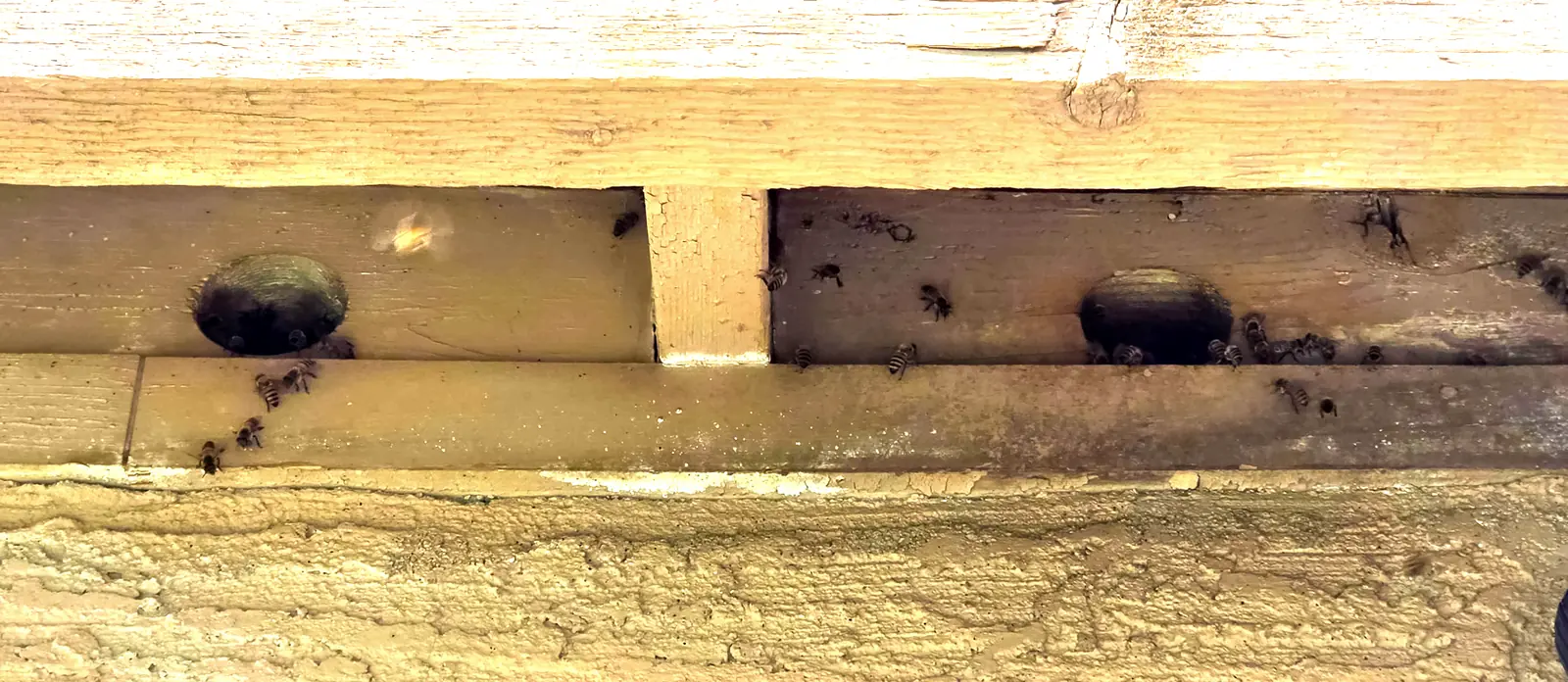
The single most useful thing to look for is a flight line. Stand back twenty or thirty feet and watch a spot on the house or fence for thirty seconds. If bees are entering and exiting the same small opening repeatedly, that’s a colony. The usual spots are a weep hole in the block, a gap under a roof tile, the seam of an irrigation valve box, the vent on the pool equipment pad, a hollow in a block fence, the underside of a BBQ island, and the wooden framing of a patio cover or ramada, where an old knot hole or bolt hole makes a ready-made entrance. Note the location, keep everyone well back from it, and call us.
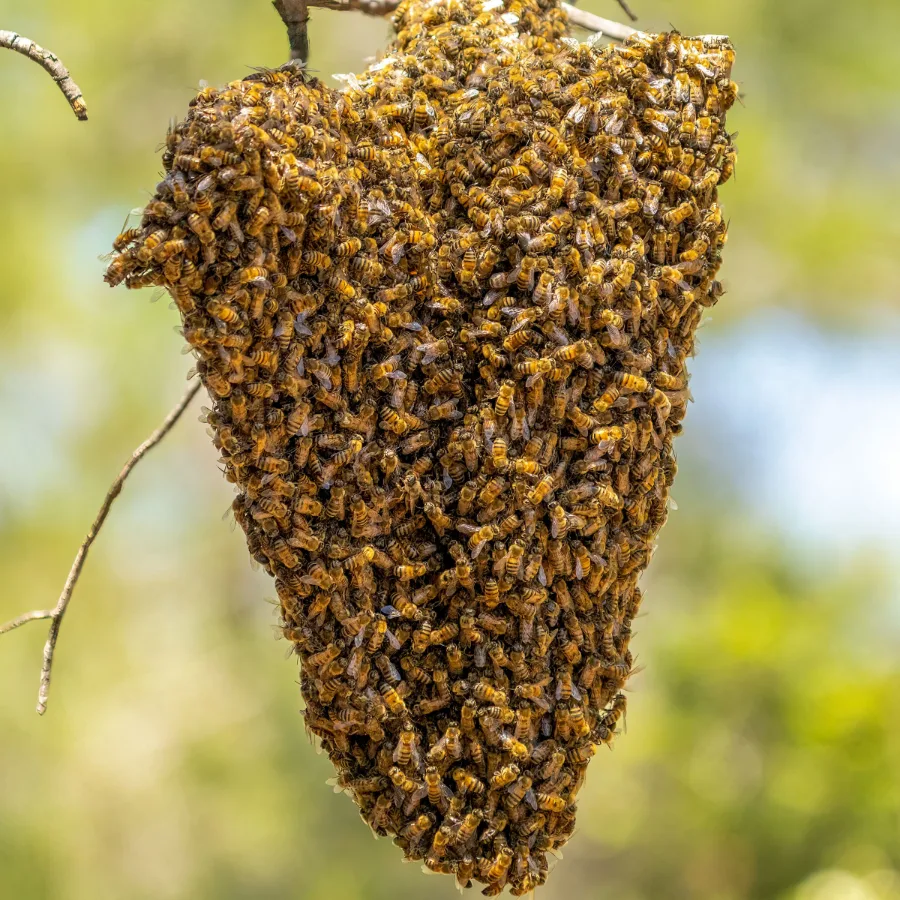
If there’s no flight line, and the bees are simply showing up at the water and leaving in every direction, you’re most likely looking at foragers. And here’s the part most people find surprising.
Your bees probably don’t live at your house
Honey bees routinely forage two to three miles from the hive for nectar and pollen. They’ll generally take water from closer in when they can. But in a Phoenix summer, “closer in” can still mean several streets away, because there may be nothing else holding water for a mile in any direction.
So when a Chandler homeowner calls us convinced there’s a hive in the yard because “there must be hundreds of them out there,” what’s often happening is that a colony somewhere in the neighborhood (a park, a wash, a saguaro, an abandoned utility box, a neighbor’s block fence) has designated their pool as the household water supply.
This is worth understanding before you call anyone, including us. If a company only offers hive removal, hive removal is the only thing it can recommend. But if there’s no colony on your property, there’s nothing to remove. You can pay for an inspection, be told there’s no hive, and still have three hundred bees at the shallow end tomorrow morning.
That’s the situation our poolside service exists for.
Why your pool specifically, and why the birdbath didn’t work
Two reasons, and the second one is the one nobody tells you.
The obvious reason is Phoenix. In 2024 the Valley ran 113 consecutive days at or above 100°F, a record. In heat like that there is essentially no reliable open water in the desert, and a colony’s need for it becomes urgent: bees spread water on the comb and fan it to cool the brood nest, which has to be held near 95°F or the developing bees are in trouble. Research at Cornell found that water-deprived colonies under heat stress saw brood nest temperatures climb by more than a degree Celsius per hour. Your pool is fifteen thousand gallons that never runs dry. From a bee’s perspective it is the most valuable resource for blocks in any direction.
The less obvious reason is chemistry. Research published in the Journal of Experimental Biology found that honey bee water foragers respond strongly to water containing dissolved sodium and magnesium. That is an appetite for salt, not just for water. Salt is a genuine nutritional need for a colony. When those same researchers sampled the water sources bees were actually collecting from, swimming pools came in among the highest in sodium of anything they measured, second only to seawater.
Which goes some way toward explaining the most common frustration we hear on the phone: “I put out a birdbath like the internet said, and they completely ignored it.”
A bowl of tap water is simply not a competitive offer against a resource the colony has already found, tested, and told the rest of the hive about.
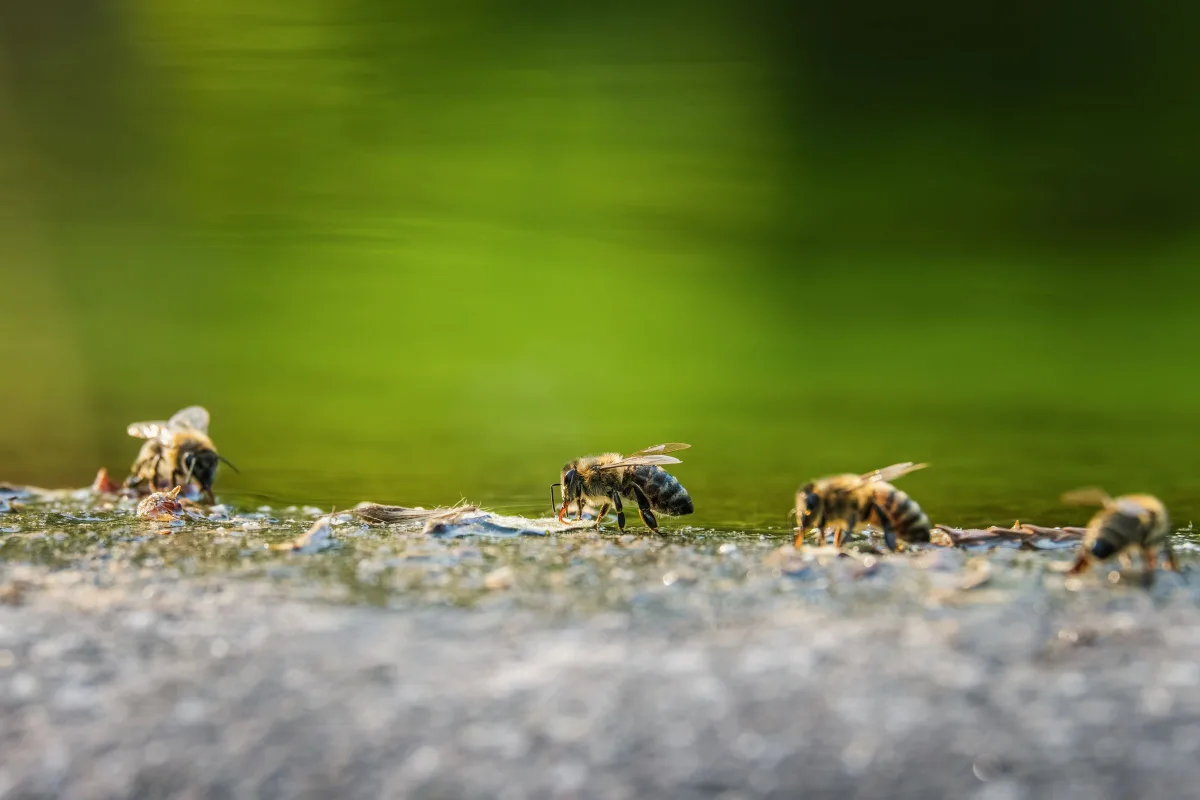
And it gets more entrenched over time. Water foragers don’t find your pool and keep the news to themselves. They expose the Nasonov gland to scent-mark productive water sites, and they communicate the location back at the hive. Water is one of the resources honey bees have been known to waggle-dance about since von Frisch. Your pool gets written into that colony’s map of the neighborhood, and experienced foragers return to a known site day after day. That’s why this problem rarely stays small, and why the two or three bees you noticed in early June are a steady crowd by late July.
Getting your pool off that map is a different job than removing a hive.
What Arizona adds to the equation
There’s a reason we’re more careful about this than a pest company in Ohio would be.
University of Arizona guidance is that all wild honey bees in Arizona are Africanized to some degree. As the University’s Cooperative Extension describes them, these are bees “that may be more easily aroused to defend their ‘homes’ than bees we are used to.”
Two things follow from that, and they’re both practical.
Foraging bees are still foraging bees. Defensiveness is about the colony, not the water bowl. Bees at your pool, away from their hive, are not in defensive mode. This is why “is it safe to swim” has a reassuring answer even here.
But a colony on your property is a different matter entirely. And there’s a specific trap in how these colonies develop. Extension guidance notes that “small colonies that have recently set up housekeeping may be docile at first, but can become more defensive with age.” The mechanism is brood: a fresh swarm has no young to protect and is relatively mellow, but once a colony is rearing brood it has something to defend and the risk climbs sharply.
That’s the part that catches Valley homeowners. The little cluster in the irrigation box that nobody minded in March is a large, well-established, brood-rearing colony by July, and the person who finds out is usually holding a weed trimmer or a leaf blower.
In our experience that’s the most common way people get badly stung around here: not by bees at a pool, but by vibration and noise near a colony they didn’t know was there.
The poolside risks people actually underestimate
Not to alarm anyone, but these are the five scenarios we hear about, and four of them are avoidable in about ten minutes.
- Bare feet on wet decking. Bees land on wet concrete and travertine to drink, and it is very hard to see one against wet stone. Pool shoes near the steps solve most of this.
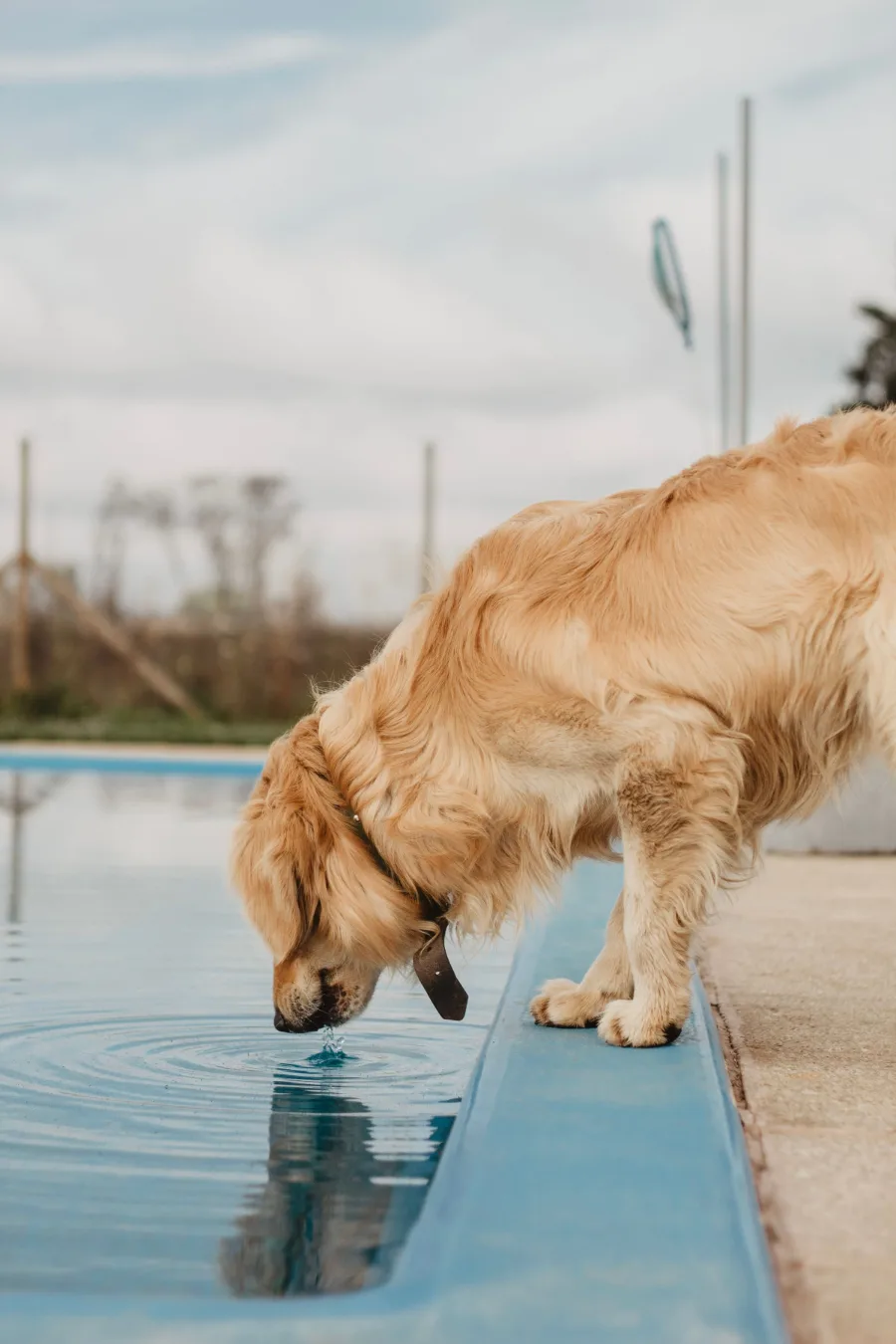
- Dogs at the waterline. Dogs drink from the pool edge and get stung in the mouth or throat. Swelling around the head and neck can affect breathing and is a genuine veterinary emergency. If your dog drinks from the pool, this is your motivation to fix the problem.
- The skimmer basket. Drowned bees accumulate there, and some of them aren’t dead. Anyone reaching in bare-handed to clear the basket is reaching into a handful of stressed bees. Gloves, always.
- A guest with an allergy. You know your own family’s allergies. You don’t know your kid’s friend’s. A pool party is exactly where this becomes a problem.
- Swatting. A bee at the water is harmless right up until someone panics at it. Teach kids to walk away rather than swing. This one costs nothing and prevents most stings.
What not to do
We’d rather you skip our service than get hurt, so this section is not a sales pitch.
The University of Arizona Extension is unusually blunt on this point, and we’ll quote it directly:
“Do not try to remove colonies yourself! NEVER shoot, throw rocks at, pour gasoline on, burn, treat with pesticides, or otherwise threaten established honey bee colonies.”
Add to that a few things we see specifically at pools:
- Don’t put dish soap in your pool. It’s widely recommended online. It kills the bees, it foams and fouls your water chemistry, and it isn’t a labeled use of the product. It also doesn’t stop tomorrow’s foragers, because it does nothing about the colony sending them.
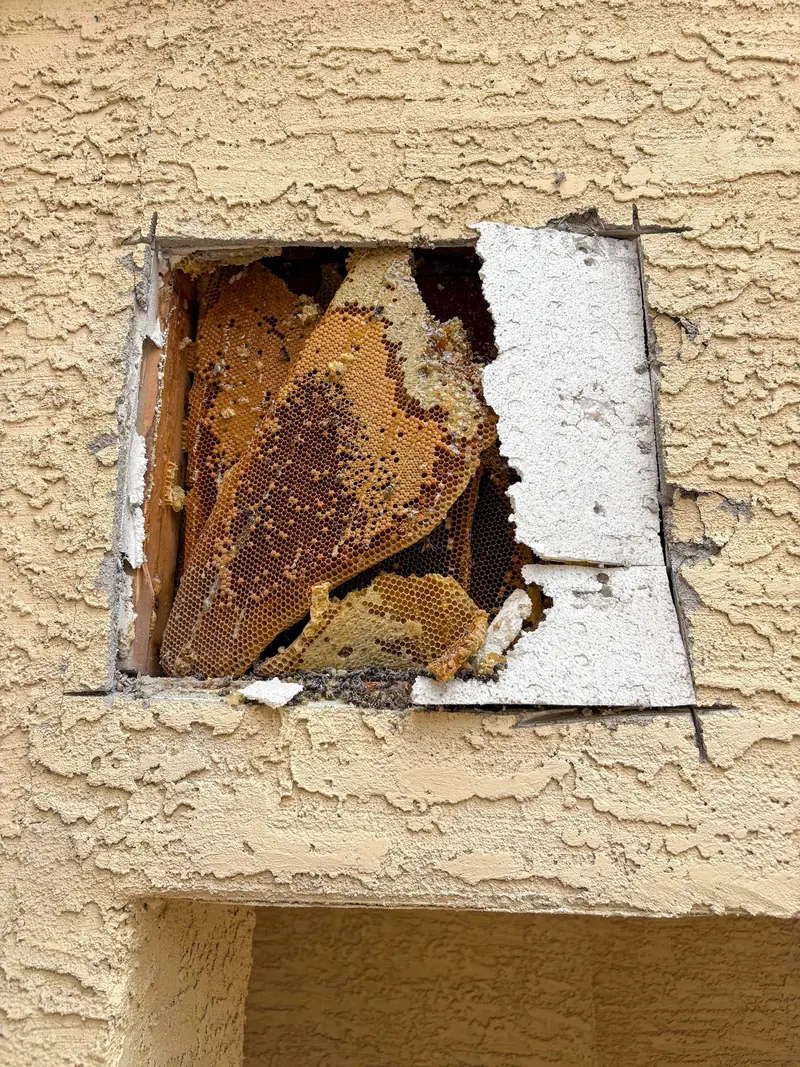
- Don’t seal a colony’s entrance. UC Integrated Pest Management is explicit about what happens: trapped bees “will search around between the walls trying to find a new way out,” and some find their way into the living quarters instead. You also leave abandoned comb and honey behind, which ferments, seeps through drywall, and leaves a beeswax odor that UC IPM describes as “noticeable from a long distance and highly attractive to any future honey bee scouts.” Seal a wall today, host a new colony in the same cavity next spring.
- Don’t spray a colony with over-the-counter wasp foam. It rarely kills a full colony, it definitely provokes one, and it complicates proper removal.
- Don’t plant mint, thyme, or lemongrass to repel bees. Several of the top-ranking articles on this topic recommend exactly that. Flowering mint and thyme are among the best bee-forage plants there are. And lemongrass oil is the active ingredient in commercial swarm lures, used to attract honey bees into cavities. This advice is pointed the wrong direction.
Not sure which situation you have? Send us a photo or just describe what you’re seeing. 623-289-3375. We can usually identify it over the phone in under a minute.
Your two paths forward
If you have foragers, meaning no hive on the property, you need Bees by the Pool.
This is our poolside service, and it’s built specifically for the situation where there’s nothing to remove. A licensed technician inspects the areas foragers are actually working (the coping and deck, water features, the equipment pad, irrigation boxes, any standing seepage), identifies what’s drawing and holding them there, and treats the site accordingly, using products applied strictly according to label for this use.
It’s backed by our Bee-Free Guarantee: if they come back, we come back, at no charge. That’s not something you’ll find attached to every preventative service in this market, and we think it should be. If we’re going to tell you a treatment works, you shouldn’t have to take our word for it. You should have our schedule on the line.
If you have a colony, you need live removal and full hive extraction.
We locate the colony, remove the bees alive and relocate them wherever it’s possible to do so, and extract the comb, because comb left in a wall means honey, staining, odor, secondary pests, and a scent trail that draws the next swarm to the exact same cavity.
If you have both, and this is more common than you’d think, do them in that order. Remove the colony, then treat the pool area. Removing the hive stops today’s traffic. Treating the poolside keeps the next colony in the neighborhood from inheriting the water source your pool has been advertising all summer.
Same-day service across the Valley
We’re family-owned, licensed and insured, and we’ve earned 1,800+ five-star Google reviews doing this work in the Phoenix area.
We service Phoenix, Scottsdale, Mesa, Chandler, Gilbert, Tempe, Glendale, Peoria, Surprise, Goodyear, Avondale, Paradise Valley, and Queen Creek, plus the rest of Maricopa County.
If you call in the morning about bees at your pool, we can usually be there the same day. If it’s a colony near a doorway, a play area, or a pool your kids use, tell us that when you call and we’ll prioritize it.
Call 623-289-3375. Busy Bee Pest Solutions, Bees by the Pool. Same-day service. Live removal. Bee-Free Guarantee.
Learn more about our Bees by the Pool service →
Common questions
Can I swim while bees are at the pool?
Generally yes. Foraging bees aren’t defensive and sting mainly when trapped against skin or stepped on. Wear pool shoes on wet decking, don’t swat, and clear the skimmer basket with gloves. If you’re seeing a dense hanging cluster or a steady stream of bees into one spot on the house, stop and call before anyone goes outside.
How do I know if there’s a hive on my property?
Watch for a flight line: bees entering and exiting the same small opening over and over. Check weep holes, roof tile gaps, irrigation valve boxes, pool equipment, block fence cavities, BBQ islands, and the beams of patio covers and ramadas. Bees only at the water’s edge, arriving from multiple directions and gone by dusk, usually points to foragers from a colony somewhere else. A one-minute look can’t rule out a hidden colony, though. If you’re unsure, have it inspected rather than assuming.
Why do bees keep coming back even though I put out a water dish?
Honey bee water foragers respond strongly to water containing dissolved sodium and minerals, and researchers sampling the water sources bees actually use found swimming pools among the highest in sodium of anything measured. Add the fact that foragers return to a known, proven site day after day, and a fresh bowl of tap water is not a competitive offer.
Are the bees at my pool Africanized?
University of Arizona guidance is that all wild honey bees in Arizona are Africanized to some degree, so it’s a reasonable assumption. It matters much less for bees at the water than for a colony on your property. Defensiveness is about defending the hive and the brood inside it. Never approach a suspected colony to check.
Will bees go away on their own when the weather cools?
Water foraging drops off significantly in cooler months, so the pool problem often eases in fall. But if a colony has established on your property, it doesn’t leave. It overwinters, and by the following spring you’re dealing with a large brood-rearing colony rather than the small quiet one you first noticed.
Do you kill the bees?
Not when we can avoid it. We remove and relocate colonies alive whenever the situation allows. Our poolside service is a deterrent, designed to stop bees from using your pool, not to kill the colony.
How fast can you get here?
Usually same day for Maricopa County. Call 623-289-3375.


